Reading Kipling in Darjeeling:Part 2
Updated: Jul 24
This three-part essay series records my impressions of Darjeeling during a week-long stay. My mornings consisted of long solitary walks followed by afternoons on the hotel's terrace, reading Kipling while waiting for the elusive Kanchenjunga to reveal itself.
In Part 1 I took a chukker around Observatory Hill on the Mall Road. In this post I walk from the Windamere Hotel, where I was putting up, to the Town Hall.

The DHR Club at Windamere
Before setting out for my walk, I stopped by at a nineteenth-century stone cottage on the Windamere's premises that once housed the DHR Club:
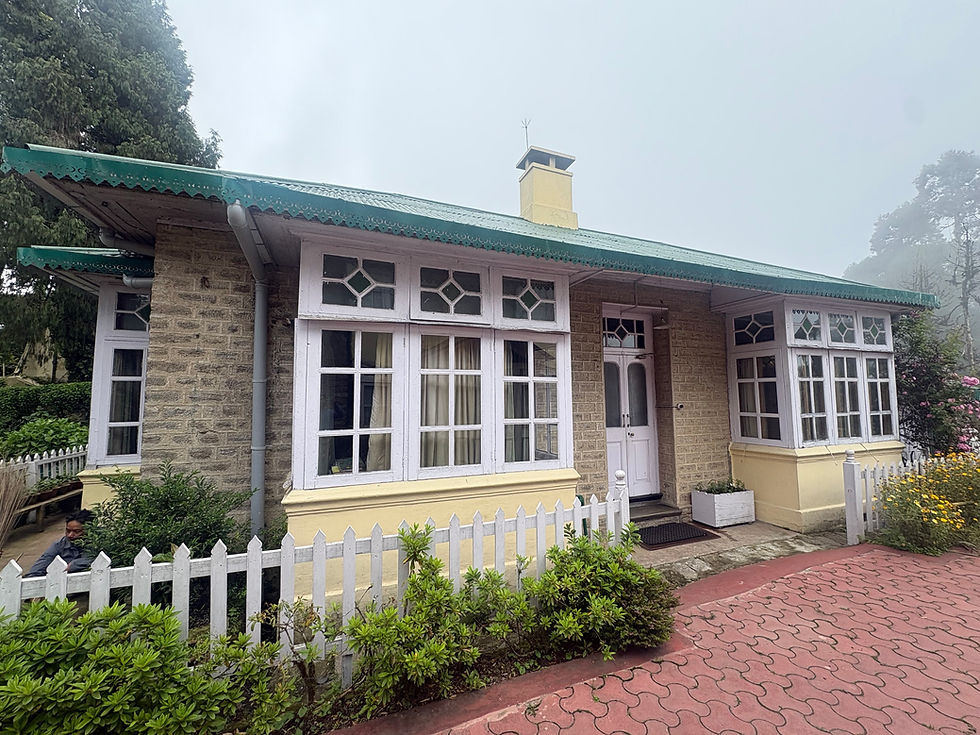
The DHR Club is named after the Darjeeling Himalayan Railway, which marked a milestone in making Darjeeling accessible.
In the early years after its cession to the British, reaching Darjeeling from Calcutta was a slog. A reading of E.C. Dozey's A Concise History of Darjeeling District since 1835 (1922) suggests three broad phases in the evolution of connectivity.
The first, lasting until 1854, required travelers to cover the entire 400-mile journey by horse-drawn carriage or travel halfway by river before continuing overland. The final ascent from the plains at Siliguri followed the Old Military Road, opened in 1842. Unsuited to motorized transport, it was traversed on horseback, on foot, or by palanquin.
The second phase, which lasted until 1879, saw the railways conquer the plains. Travelers could now journey by train from Sealdah to Siliguri before ascending to Darjeeling via the improved Hill Cart Road, constructed between 1864 and 1869 and suitable for bullock carts and horse-drawn tongas.
The third phase began in 1880, when the mountain tramway reached Kurseong. The first steam engine, appropriately named Tiny, proved too weak to haul heavy loads. Dozey recounts that during a visit by Viceroy Lord Lytton, coolies had to be deployed with ropes to pull the train up the steep gradients. On July 4, 1881, the tracks were completed all the way to Darjeeling. Officially known as the Darjeeling Himalayan Railway, the tramway is better known today as the toy train.
Today, there are three popular roads to ascend the hills: Pankhabari Road, which follows the alignment of the Old Military Road; Rohini Road; and Hill Cart Road (NH10). All three converge at Kurseong, from where the journey continues to Darjeeling. A fourth route via Mirik bypasses Kurseong altogether. It is widely regarded as the most scenic, though it takes considerably longer.
You can see the train tracks while traveling by Hill Cart Road. The lucky may even catch a glimpse of the train. But if you are picturing Rajesh Khanna serenading Sharmila Tagore from an open jeep while she gazes out from the train, a reality check is in order: long stretches of the track are littered with garbage. The UN added the DHR to the list of World Heritage Sites in 1999, making the dilapidated condition of both the train and its route all the more disappointing.
The DHR Club has two rooms, each named after an illustrious guest of the hotel: Lowell Thomas and Heinrich Harrer.

Lowell Thomas was an American journalist who, during World War I, met a British army officer helping the Hashemite royal family overthrow the Ottomans on the west coast of modern-day Saudi Arabia. Thomas photographed the Englishman dressed in Arab attire and bestowed on him the moniker "Lawrence of Arabia":

Image: photo of T.E. Lawrence taken by Lowell Thomas
Source: Library of Congress
The DHR Club at the Windamere is replete with photographs and artifacts from Thomas's life. Among them is the vintage promotional poster for his blockbuster multimedia travelogue, With Allenby in Palestine and with Lawrence in Arabia, which caused a sensation when it opened in London on August 14, 1919:

A random fun fact: the Dale Carnagey credited as the director in the poster is the same Dale Carnegie who wrote How to Win Friends and Influence People. He later changed the spelling of his surname because people kept misspelling it. His first exercise in winning friends may have been simplifying the spelling.
Lowell Thomas arrived in Europe in 1917 as a war correspondent, searching for propaganda material for the war-weary American public. He found the perfect story in the campaign of the British cavalry general Edmund Allenby to wrest Palestine from the Ottomans—a ready-made "Last Crusade."
When Thomas reached the Middle East in early 1918, he met an officer under Allenby's command, Colonel Lawrence, who with his blond hair and blue eyes was central casting for the role of the last crusader, provided one overlooked his short stature. Better still, the facts cooperated: Lawrence had already proved his courage in battle.
Providence supplied the perfect protagonist but neglected to schedule an exciting performance during the time Lowell Thomas spent with Lawrence. Thomas regarded facts as an excellent foundation, though not necessarily a ceiling. Hence he wrote stories of dramatic events that he had supposedly witnessed.
One such story, cited in this link involves Lowell Thomas claiming that he accompanied Lawrence and 200 local tribesmen on a nighttime raid against a Turkish troop train. In the ensuing battle, Lawrence, who was supposedly recognized as the mysterious Englishman with a bounty on his head, calmly waited until Turkish soldiers closed in, then drew his Colt pistol and single-handedly shot six of them before escaping to rejoin his companions.
In Kipling's Drums of the Fore and Aft, the exhausted soldiers of the Fore and Aft regiment flee when confronted by charging Afghan tribesmen wielding terrifying knives. Two foul-mouthed orphaned teenage drummer boys, Jakin and Lew, who had persuaded their colonel to let them join the regiment band into battle, also try to escape. But their short legs leave them behind. The boys seize a drum, strike up a march, and advance straight into the enemy's line of fire, shaming their fleeing comrades into returning to the fight and turning defeat into victory.
There is one omitted detail above that may alter your impression of Jakin and Lew's heroism. Before their celebrated act, the boys stumble upon a water bottle filled with canteen rum lying on the battlefield and drink it dry to steady their nerves. Their apparent act of defiance was, in fact, a display of Dutch courage.
Perhaps Kipling, who had spent years as a war correspondent alongside British and Indian soldiers, cared more about the gulf between manufactured myth and messy reality than Lowell Thomas did.
Thomas first came to India in late 1920 on a nationwide tour that included a stop in Darjeeling, where he stayed at the Windamere. Of Darjeeling, he writes in his autobiography:

Darjeeling stands about 6,700 feet above sea level, so Lowell Thomas was probably referring to nearby Tiger Hill. Even from Tiger Hill, however, Mount Everest is visible only on exceptionally clear days. I did not make it there on this trip, but the view of Everest in the picture below is reason enough to make the journey to Tiger Hill and take your chances with the weather.

Source: Wikimedia Commons
For all his journalistic flaws—flaws that would scarcely register by today's cable news standards—Thomas genuinely loved India, its land, and its people. In 1927 and 1928, he undertook a two-year, 60,000-mile expedition across the subcontinent. The journey became the basis for his 1930 book India: Land of the Black Pagoda.
In the summer of 1949, Lowell Thomas and his son arrived in Darjeeling en route to Tibet, where the Tibetan government had invited them to help solicit Western support against an imminent Chinese invasion. Some historical context is useful here, given the intertwined histories of Darjeeling, Sikkim, and Tibet.
The graphic below summarizes the history of Darjeeling outlined in the previous post:

The very first event depicted above—the formation of the Kingdom of Sikkim, of which Darjeeling was then a part—points to a deep Tibetan connection.
The three lamas who anointed the Namgyal dynasty came from Tibet. While the aboriginal inhabitants of Sikkim were Lepchas, the Namgyals themselves belonged to the Bhutia community, descendants of immigrants from Tibet who had been settling in Sikkim for centuries. The Sikkimese aristocracy also married into Tibetan families. Before Sikkim became majority Nepalese, it would have been classified as "ethnographic Tibet," distinct from "political Tibet" in Sir Charles Bell's framework.
Against this historical backdrop, China came to view Sikkim as an extension of Tibet and therefore as Chinese territory. This brings us to the question of why China lays claim to Tibet and the reason for Lowell Thomas's stopover in Darjeeling.
Drawing on H. E. Richardson's Tibet and Its History (1962 edition), one can organize historical Sino-Tibetan relations into eight phases.
The first phase, spanning the seventh to the ninth centuries, saw Tibet and China as rivals, with Tibet invading Chinese territory on several occasions. Before the seventh century, Tibetan governance was decentralized among multiple clans. This changed when the tribal chiefs chose Song-tsen Gampo as their king. He unified Tibet into a political and military power while also introducing Buddhism to the country. Buddhist practices were amalgamated with the indigenous Bon religion, giving rise to the distinctive form of Buddhism that is practiced in Tibet.
The second phase, from the ninth century to the beginning of the thirteenth, saw little engagement between the two countries. Indeed, relatively little is known about Tibet during this period.
The third phase lasted from the thirteenth century to the middle of the fourteenth, when Tibet and China became colonies of Genghis Khan's Mongol Empire. The nature of Mongol rule, however, differed markedly between the two. In China, the Mongols governed as a conventional colonizing power. Tibet, by contrast, was administered indirectly through lamas of the Sakya sect, who served as the Mongols' viceroys.
The roots of this unusual fusion of spiritual and temporal authority lay in a curious turn of events. While Genghis Khan had left Tibet alone in exchange for tribute, his grandson Godan invaded Tibet and then asked the abbot of the Sakya monastery for instruction in Buddhism. One imagines this is not the sequence prescribed in Buddhist etiquette: invade first, then seek enlightenment from the vanquished.
This odd form of theocracy was made possible by the character of Tibetan Buddhism at the time. Buddhism had initially been embraced by the aristocracy before spreading through wider society. Over time, numerous sects emerged, including the Sakyas and the Gelugs; the Dalai Lama belongs to the latter. These sects became rivals, each backed by different noble families and sustained by its own grand monasteries and private armies.
In Richardson's account, although the Sakya lamas spent considerable time cultivating the favor of their Mongol overlords at the imperial court in China, Tibet and China remained separate political entities. The Mongols never created a unified administration for the two.
The fourth phase began in the second half of the fourteenth century and lasted until the middle of the seventeenth. Both China and Tibet regained their independence from the Mongols. China came under the Ming dynasty, while in Tibet secular aristocrats displaced the Sakya lamas. The Ming dynasty maintained distant diplomatic relations with Tibet.
It was during this phase that a lama named Tsong Khapa (1357–1417) founded the Gelug sect, popularly known as the Yellow Hats. One of his successors, Sonam Gyatso, visited Mongolia in 1578 and converted Altan Khan, a descendant of Genghis Khan, to Buddhism. Altan Khan bestowed upon him the title Dalai, meaning "ocean," a reference to the depth of the monk's knowledge.
The title was later applied retrospectively to his two predecessors, making Sonam Gyatso the Third Dalai Lama. It is perhaps just as well that Hollywood never adopted this convention. Had numbering depended on the quality of the third installment, The Godfather might never have become a trilogy.
During this period, however, Tibet was ruled by noblemen affiliated with rival sects, and the Dalai Lamas exercised no temporal authority.
The fifth phase lasted roughly eight decades, beginning in 1642. It was during this period that China became enmeshed in Tibetan politics.
In 1642, Tibet lost its independence to the Mongols once again when the Qoshot tribe, led by Güshi Khan, invaded the country and entrusted its administration to the Fifth Dalai Lama, recreating the earlier relationship between the Mongols and the Sakya lamas. Around the same time, the Manchus displaced the Ming dynasty and established the Qing (pronounced Ching) dynasty in China in 1644.

Image: a sketch of made by Johannes Grueber, a Jesuit missionary who visited Lhasa in 1661, the Fifth Dalai Lama sitting in the lobby of the Dalai Lama's palace, a statue of Güshi Khan next to him
Source: Wikimedia Commons
The Fifth Dalai Lama was the first of the Dalai Lamas to assume the "priest-king" model, and he did so more effectively than the earlier Sakya lamas. It was during his reign that Lhasa became the capital and the Potala was constructed.
All hell broke loose when the "Great Fifth" died in 1682. During the fourteen years between his death and the enthronement of his reincarnated successor, Tibet was administered by Sangye Gyatso, rumored to be the late Dalai Lama's son. Seeking to preserve his autonomy from his nominal overlords, the Qoshot Mongols, Sangye Gyatso began cultivating ties with the ascendant Dzungar Mongols.
The Manchu emperor feared that a unified Mongol empire under Dzungar leadership would pose an existential threat to Qing rule in China. He therefore readily acceded to a request from Lhabzang Khan, Güshi Khan's great-grandson, for military and political assistance against the Dzungars.
Late seventeenth- and early eighteenth-century Tibet thus became the arena for a struggle between two rival Mongol powers, one of them backed by the Manchus.
The sixth phase began in 1720 and lasted for nearly two centuries, marking the period of explicit Chinese influence over Tibet. Manchu forces entered Tibet to expel the Dzungars, who had invaded and plundered the country. Strange as it may seem today, the Tibetans welcomed the Manchu forces as liberators.
Although no formal treaty defined the relationship, Tibet functioned as a Chinese protectorate for much of the next two centuries. Chinese authority was exercised through two civilian representatives known as ambans, together with the Dalai Lama and a regent drawn from one of the elite monasteries of the Yellow Hat sect.
The patron in the "patron-priest" relationship that had begun under the Mongols was now the Manchu emperor.

Image: the Amban's residence in Lhasa, photos taken in 1900-1901 by two Mongolian Buddhist lamas
Source: Library of Congress
The regent, in theory, administered Tibet on behalf of the Dalai Lama until the reincarnated child came of age. But most of the Dalai Lamas during this period had a surprising propensity to die young. The regents were repeatedly spared the inconvenience of relinquishing power.
The degree of Chinese involvement in Tibet's internal affairs waxed and waned, increasing during periods of crisis—such as the Gorkha invasions of Tibet (1788–1792)—and receding in more tranquil times. But by the second half of the nineteenth century, the Manchu dynasty itself had weakened and exercised only nominal overlordship over Tibet. During this period, the Tibetans' principal concern was the imperial ambitions of Britain, which had by then, as noted in Post 1, reached Sikkim.
In 1895, the Thirteenth Dalai Lama, who had managed to survive long enough to assume power, took charge. During his reign, Tibet faced invasions by both the British and the Manchus, the latter seeking to tighten their grip on their protectorate. But the overthrow of the Manchu Qing dynasty following an army mutiny enabled the Thirteenth Dalai Lama to declare Tibet's independence in 1913. The Thirteenth Dalai Lama was no Manchurian Candidate!
The seventh phase, between 1913 and 1950, was a period of de facto independence for Tibet. The Fourteenth (current) Dalai Lama was enthroned in 1940. While China was then too weak to exert control over Lhasa, Tibet struggled to gain recognition as a sovereign state, the major powers being wary of antagonizing the Middle Kingdom.
Lowell Thomas's stopover in Darjeeling came at the twilight of this "independent" phase of Tibetan history. By the time of his visit in 1949, Mao Zedong had established the People's Republic of China (PRC) and made the "liberation" of Tibet a top priority.
One event during this seventh phase has had enduring significance for India. At the Simla Convention of 1914, Sir Henry McMahon (representing British India) and Lonchen Shatra (representing Tibet) agreed on a boundary that forms the basis of India's claim to Arunachal Pradesh. China has never accepted the agreement, arguing that Tibet, not being a sovereign state, lacked the authority to define an international boundary.
Somewhat ironically, under the Anglo-Chinese Convention of 1890, the Chinese amban, representing the weakened Qing dynasty, accepted Sikkim as a British protectorate. Tibetans, who regarded Sikkim as an extension of their own country, rejected the agreement because they had not been party to it.
The eighth phase began in 1950, when the PRC invaded Tibet and defeated its small army. The following year, Tibet was compelled to sign the Seventeen Point Agreement, formally recognizing Chinese sovereignty in return for promises of autonomy that steadily eroded in the years that followed.

It seemed remarkable that historical events so distant in time had brought Lowell Thomas to these rooms at the Windamere in 1949:

During their two weeks in Tibet, Lowell Thomas and his son met the few Westerners who had been permitted into the country at the time. One of them was Heinrich Harrer, the Austrian mountaineer after whom the second room at the DHR Club (pictured below) is named:

Heinrich Harrer's entry into Tibet had been far more dramatic than that of the Thomases. At the outbreak of World War II, he was interned as an enemy alien in British India while on a mountaineering expedition. He escaped from a prisoner-of-war camp in 1944 and, after a grueling trek across the Himalayas, reached Tibet.
At the time Harrer entered Tibet, the country was closed to foreigners. This isolationism was rooted in the Sino-Tibetan history described earlier. Following the wars in which the Manchu Qings repelled the Gorkhas from Tibet, the Qing government issued the Twenty-Nine Article Ordinance for the Better Governing of Tibet in 1793. The decree formally prohibited all foreigners from entering Tibet without the permission of the ambans stationed in Lhasa. The Qing emperor suspected the Gorkhas of acting at the behest of the British and therefore barred all foreigners.
The Tibetan religious elite, traumatized by the Gorkhas' looting of their monasteries, embraced the decree. They came to view all outsiders—particularly non-Buddhists—as existential threats. They were wary of the British Empire, on their doorstep. It is therefore unsurprising that, as mentioned in the previous post, the Tibetans were particularly chagrined by the Darjeeling deed fiasco of 1835.
Harrer had to disguise himself as a pilgrim to avoid being turned back to India by the border guards. When he finally reached Lhasa after nearly two years on foot, he won over the local Tibetan officials. Harrer became a tutor and close friend to the young Fourteenth Dalai Lama. Brad Pitt later portrayed Heinrich Harrer in the film adaptation of his book Seven Years in Tibet.
Harrer fled Tibet in 1951, shortly after the People's Liberation Army advanced into the country. He wrote Seven Years in Tibet from a hotel room in Kalimpong before returning to Austria. On his subsequent visits to India, he became a "regular" at the Windamere.
Patient readers of these chronicles will by now have been introduced to three fascinating Westerners associated with the Windamere: the Gyalmo of Intrigue, Hope Cooke; the Sultan of Spin, Lowell Thomas; and the Fugitive Mountaineer, Heinrich Harrer. A fourth, no less fascinating personality is Alexandra David-Neel, after whom a room in the hotel's original 1841 wing is named:

In the December 1987 issue of The New Yorker, Jeremy Bernstein sketches a brief profile of this extraordinary woman.
Born in Paris in 1868, Alexandra David-Neel grew up dreaming of mountains and glaciers. In her twenties, she traveled to India and Ceylon. When she ran out of money, she returned to Paris and supported herself as an opera singer with a traveling troupe.
While in North Africa, she married the railway engineer Philippe-François Neel in 1904. For most of their unconventional platonic marriage, which lasted until his death in 1941, they lived essentially separate lives while remaining the closest of friends.
In 1911, she returned to Asia on a trip that lasted fourteen years. In Darjeeling, she became the first Western woman to be granted a private audience with the Thirteenth Dalai Lama, predecessor of the current one. There she also met the Crown Prince of Sikkim, Sidkeong Tulku Namgyal (uncle of Hope Cooke's husband), who invited her to Gangtok.
Incidentally, Sidkeong Tulku's reign was cut short in 1914 after barely ten months when he died of complications from jaundice—or, if you paid attention to the previous post, the Lepcha curse. In Smash and Grab: Annexation of Sikkim, Sunanda K. Datta-Ray writes that the Chogyal had been showing alarming signs of self-assertion. When he fell ill, the ever-solicitous British brought in a physician who administered a "heavy transfusion of brandy," after which the Chogyal was dead within an hour. Alas! there is nothing to preclude the Lepcha curse from operating through a spiked nightcap.
In 1916, she crossed the Sikkim–Tibet border illegally with a Sikkimese teenager, whom she would eventually adopt. On her return, she was expelled from India for the transgression and began planning a second journey to Tibet, this time through China. She was like Kipling's "Explorer," propelled by an inner voice that said:

Alexandra David-Neel arrived in Peking in 1917 and set out on a seven-month, 2,000-mile trek to Mongolia, where she spent the next three years. Finally, in 1923, at the age of fifty-five, she embarked on her greatest adventure—a journey to Lhasa, once again entering Tibet illegally, this time in disguise. After trekking on foot for more than four months, she and the Sikkimese boy finally reached the Forbidden City:

Image: Tibetan child, Alexandra and Aphur Yongden (whom she later adopted) in Lhasa 1924
Source: Wikimedia Commons
There is an amusing anecdote about her life in the New Yorker profile. At the age of eighty, she agreed to bequeath the posthumous royalties from her books to the French town where she lived. But, somewhat contrary to what one might expect from a woman renowned for her Buddhist spirituality, she insisted on a lifetime exemption from local taxes in return. Then again, the Buddha asked us to be simple, not simpletons.
It turned out that the town made the actuarial mistake of underestimating a woman who had crossed the Himalayas on foot. Alexandra David-Neel lived for another twenty years, dying just weeks short of her 101st birthday. Bond investors would say she died at par.
As I stood overlooking the Windamere Hotel, I congratulated myself on having chosen a hotel with such a rich history of colorful guests:

The Market
To walk from the Windamere Hotel to the Town Hall, stand with the hotel behind you and take a right at the intersection of Chowrasta and the Pineridge Hotel (pictured below), onto Nehru Road:

The right turn leads to a street lined with shops that have a premium feel, while walking straight ahead plunges one into a far more congested commercial district. But in peak season, when I went, going to either of the roads in the evening is not a good idea. It is a stampede waiting to happen. Hence, I took all my walks around the Chowrasta stretch before 4 PM.
The Pineridge Hotel stands on the site of Drum Druid, one of Darjeeling's earliest hotels, which dates to the early 1840s.

A search for the word "haunted" in Tripadvisor reviews produced hits in seventeen percent of the hotel's reviews. For comparison, the same search returned none among the Windamere's reviews. For the avoidance of doubt, Pineridge's patrons were not using "haunted" to describe how they felt; they were referring to actual ghosts. The resident spirits, if they exist, appear considerably more forgiving of the hotel's shortcomings than its acerbic Tripadvisor reviewers.
In My Own True Ghost Story, in which an overnight guest at a dak bungalow hears long-dead Englishmen playing billiards next door, Kipling describes a whole catalogue of Indian ghosts. Some, according to him, hide in trees and attack travelers; some are the restless spirits of women who died in childbirth and lure people to their deaths; and others are the ghosts of abandoned children who haunt wells and lonely places, weeping and pleading to be carried. Note to self: stay at the Pineridge next time to determine which category its spectral residents belongs to.
Directly opposite the Pineridge Hotel stands a modern building called the Bellevue Hotel. If you take the elevated walkway behind it, you will come across a faded old sign that is barely legible. It reads: "Main Olde Bellevue Hotel."

The hotel was closed for renovation when I visited. The Main Olde Bellevue Hotel dates to the early 1870s. The current owners acquired it in 1942.
If you are wondering about the name, adding an extra "e" to words such as old (olde) and shop (shoppe) was common in early English printing before spelling became standardized. By the late nineteenth century, however, the use of olde was probably a pseudo-archaism intended to signal that a property was historic—a pedestrian application of Eric Hobsbawm's "invented tradition."
Continuing along Nehru Road, one passes the famous Glenary's Bakery, an eatery that dates to 1885:

According to one account, an Italian baker named Vado opened a bakery in a house called Glenary's in 1885. After marrying a Tibetan woman and raising a family, he returned to Italy, selling most of the business to Adolf Pliva, an Austro-Hungarian confectioner who transformed it into a German-style bakery. The business became known as Vado & Pliva Confectioners.
Following Indian independence, Pliva sold the bakery to a local Indian businessman, under whose ownership it declined. Augustine Tarcius Edwards, a former manager whom Pliva had trusted, took over, renamed the establishment Glenary's, and restored its reputation. The Edwards family continues to own Glenary's today.
Although many people stop to take photographs with Glenary's as a backdrop, I found it surprisingly easy to walk in and buy goodies to take home:

While I generally avoid these "iconic" eateries as a matter of principle, the cakes and cheese straws turned out to be excellent and unlike anything you get at chain bakeries.
Continuing along Nehru Road, one arrives at Keventer's:
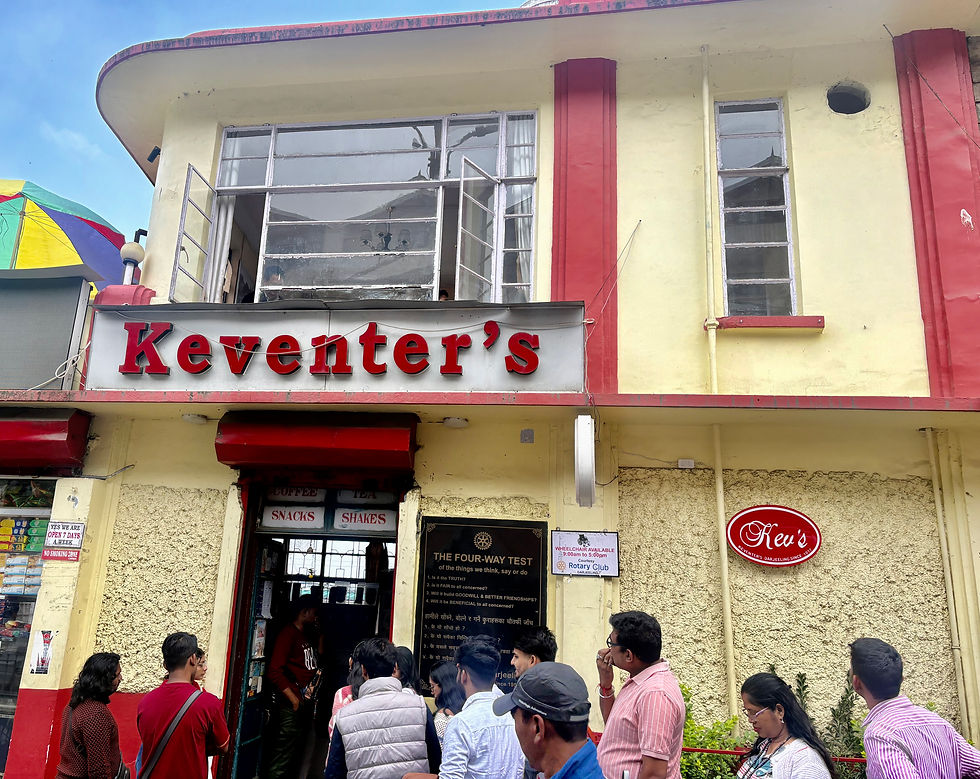
In 1889, the British government tasked Edward Keventer, a Swedish dairy entrepreneur, with modernizing dairy farming in India. By the 1920s, the Keventer's brand had become the Amul of its generation. The brand survived independence under the Dalmia family before eventually fizzling out, though it has recently been revived. The restaurant he founded in 1911 survives to this day under different ownership.
The Planters Club
Right opposite Keventer's is the Darjeeling Planters Club:

Founded in 1868, the Darjeeling Planters Club began as a club for tea estate owners and managers, as well as British officials. The club still operates and has recently been renovated.
Some historical context on tea is useful here.
In 1662, Catherine of Braganza married King Charles II of England. The marriage had two significant consequences for India.
The first was immediate: Bombay formed part of Catherine's dowry. Those who have read my Fontainhas blog may know that Portugal, which had declared its independence from Spain in 1640, was seeking international legitimacy for the Braganza regime. A matrimonial alliance with the British royal family therefore served an important diplomatic purpose.
The second eventually brought tea to Darjeeling. Catherine introduced her love of tea to the English court, transforming it into a status symbol among the aristocracy. The East India Company (EIC) initially imported tea to serve this elite market. From the upper classes, tea spread to the masses, and by the eighteenth century the British public had developed an insatiable appetite for it. The EIC therefore began importing vast quantities of tea from China.
The problem was that China accepted only silver in payment, creating a massive balance-of-payments deficit for Britain. Any disruption in the tea trade would have been catastrophic—not only for the EIC but also for the British Exchequer, since duties on imported tea financed a large share of government revenue. Consequently, from the 1820s onward, the Company began cultivating tea in Assam and, later, in Darjeeling.
As I stepped into the Nathmulls Tea store on Laden La Road, I felt grateful to the Qing emperors. Had they—like today's CCP—been willing to accept paper emblazoned with "In God We Trust," tea may never have made it to India.

By the late nineteenth century, British tea imports from India had surpassed those from China. The East India Company (EIC) had mastered "China Plus One" long before Apple.
While the British were pursuing their own version of swadeshi to reduce imports, they were simultaneously following another strategy: expanding exports to earn the silver needed to buy tea from China. The problem was that they produced nothing China wanted. When comparative advantage failed, the EIC abandoned Ricardo for Escobar. It began shipping opium into China through smugglers, who paid in silver.
Acquire silver by selling opium to China. Use the silver to import tea from China. Rinse. Repeat. It was a circular economy long before the term became fashionable—only the circle ran through an opium den. But the British feared that China might legalize poppy cultivation, making the cultivation of tea in India all the more urgent.
The previous post touched on how Darjeeling's connection with the Kingdom of Sikkim is worthy of a Netflix series. Believe it or not, the story of Darjeeling tea is no less riveting.
In 1841, Dr. Archibald Campbell, the first Superintendent of Darjeeling, whom we encountered in Part 1, planted tea seeds at his Beechwood Estate. They had been obtained from Indian tea gardens, which by then were cultivating stock brought from China. Campbell's Beechwood experiment demonstrated Darjeeling's suitability for tea cultivation and triggered a gold rush among aspiring tea planters. To encourage tea cultivation, the government granted land on favorable terms to British and Bengali businessmen. Even today, Darjeeling's tea estates are largely owned by absentee landlords.
In 1848, in an act of industrial espionage, the British East India Company sent the Scottish botanist Robert Fortune, disguised as a local merchant, into Chinese tea estates to steal seeds, plant specimens, and manufacturing techniques.
Sarah Rose, in her biography of Fortune, For All the Tea in China: How England Stole the World's Favorite Drink and Changed History, explains that the geopolitical importance of plants such as opium and tea transformed men with expertise in them almost overnight from gardeners into a new profession: botanists. This helps explain why a "botanist" such as Darjeeling's Joseph Hooker would engage in the kind of roguish behavior described in the previous post. Calling these men botanists is a bit like calling hangmen rope specialists.
They say there is many a slip between the cup and the lip. There are just as many steps between the plucked leaf and the brewed cup. The entire manufacturing process was a black box to the British. Fortune spent three years in China (1848–1851), one of his four expeditions into the country, surreptitiously uncovering the secrets of the tea estates. He discovered how a basketful of freshly plucked tea leaves (pictured below at the New Chumta Estate near Siliguri) yields little more than a handful of processed tea.
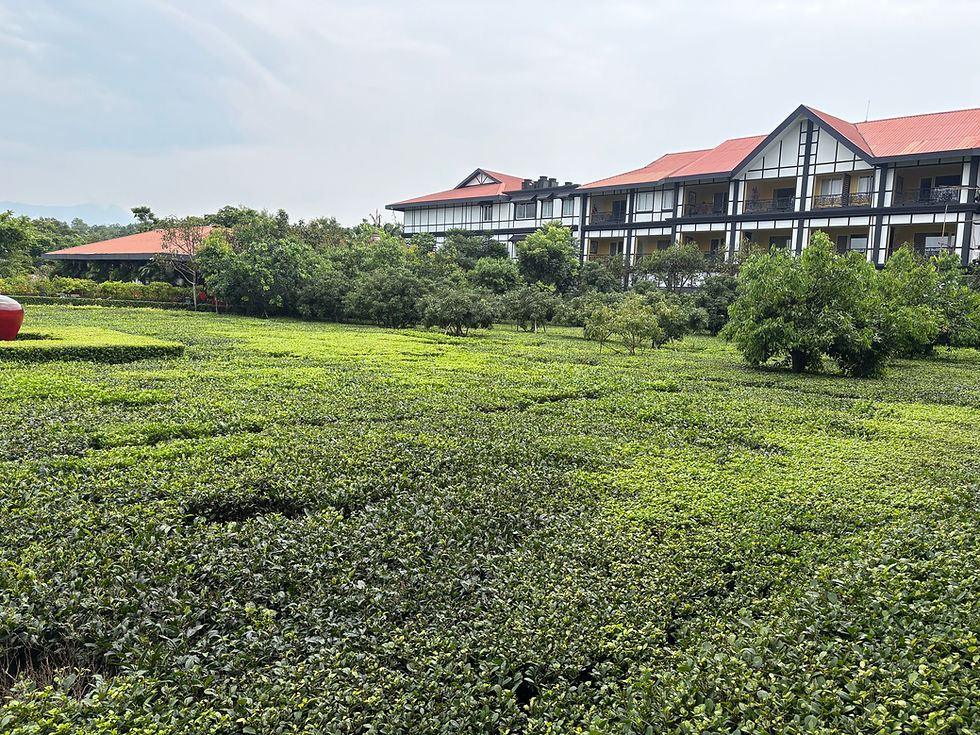
Sarah Rose describes Fortune's realization that black tea and green tea came from the same plant as a revelation to British botanists. He also discovered that the finest tea is made from just the bud and the top two leaves, which yield the most flavorful brew.
Fortune's smuggled tea stock from China, together with his newly acquired knowledge of tea manufacture, spread across India, including Darjeeling, and built upon the foundations Campbell had laid. While the tea plantations of Assam were established with indigenous varieties found in the forests there, those in Darjeeling were planted with Chinese stock.
There is another colorful character, Captain Samler, who is more directly associated with Darjeeling tea than Robert Fortune. While the principal event of 1835 was the emergence of the dubious deed, Rajah Banerjee recounts another episode from that year of significance to Darjeeling in The Rajah of Darjeeling Organic Tea.
Captain Samler, who was stationed at Tetuliya (in modern-day Bangladesh), raided the official armory with the help of ten Gorkha sepoys. Samler and his band then headed north and took refuge in the forests of Kurseong. After clearing a patch of land, they began cultivating maize, and the area became known as Makaibari (cornfield). Repeated military attempts to capture Samler were repelled by ambushes, eventually persuading the British to leave the band of renegades alone.
A few years later, Samler, who had never been overly respectful of other people's property, helped himself to a sapling from Campbell's tea garden in the noble cause of expanding Makaibari's biodiversity. Thus began the history of the Makaibari Tea Estate, which still exists in Kurseong.
The Sepoy Mutiny of 1857 gave Samler an opportunity to rehabilitate himself in British eyes by providing the "muscle" to suppress the rebellion. In return, the British formally granted him title to the Makaibari estate. But Samler fell ill soon afterward. In 1859, shortly before his death, he sold the estate to Girish Chandra Banerjee, the scion of an affluent zamindar family who ran the mail service in the Darjeeling hills and had become Samler's friend.
Tea cultivation is inherently labor-intensive. From selectively plucking the tender "two leaves and a bud" to sorting, withering, and hand-rolling, many stages require skilled human judgment. The steep, terraced slopes where the finest tea is grown also make mechanization impractical.
The British initially recruited tribal laborers from Chotanagpur to work on Darjeeling's tea plantations, but they could not endure the cold, damp mountain climate and fled to the plains. Hence, they shifted to recruiting Gorkha and Lepcha workers for the hill plantations, while Chotanagpur tribals were employed on estates at lower elevations. As mentioned in the previous post, this demographic shift had political reverberations: it was not only the seeds of a plant but also the seeds of the Gorkhaland agitation that were being sown.
In addition to Gorkha and tribal laborers, the tea plantations needed supervisory staff. European planters therefore began arriving soon after tea cultivation started to expand.
In The Pioneers 1825–1900: The Early British Tea and Coffee Planters and Their Way of Life, John Weatherstone quotes a young Yorkshireman who had accepted a position as an assistant on a tea estate in Assam:

Venues such as the Darjeeling Planters Club catered to the European expatriate community, much of it composed of young, unmarried men. As the club is a private members' institution, I was unable to see its interior. Instead, on my way back to Bagdogra, I visited the opulent Planter's Club at the New Chumta Tea Estate in Siliguri. Established in 1866, it now operates as a resort under the Mayfair Group:

Unlike the tea plantations in the hills, the New Chumta Tea Estate lies in the Dooars–Terai region—the fertile plains along the Himalayan foothills renowned for tea cultivation. The two regions are geographically separated by the Teesta River. The Terai lies to the west of the river in West Bengal, while the Dooars stretch eastward from the Teesta across northern West Bengal into Assam. Siliguri falls within the Terai.
Like the hill stations themselves, these tea estates were intended to be "mini Englands"—homes away from home. But could the whisky, billiards, card games, and familiar comforts of the Planters Club compensate for the loneliness of young European bachelors living thousands of miles from home, surrounded by unfamiliar people and customs, under the constant shadow of tropical disease?
In Kipling's poignant Without Benefit of Clergy, John Holden, a British civil servant in India, enters into a marriage-like relationship with a young Indian woman named Ameera. To avoid the professional ruin such a union would bring, he maintains a discreet house in a run-down part of the city while continuing to occupy his bachelor's bungalow. The couple have a son, who dies in infancy, and not long afterwards Ameera dies as well.
Durga Dass, the landlord of Holden's clandestine residence, advises the grief-stricken Englishman not to renew the lease. The house should be dismantled and sold for its timber. It would be as though the events in Holden's secret life had never happened.
When the European planters eventually returned home, I imagine many must have felt something similar. Their years in India may have come to seem like a dream from which they had awakened. Perhaps that is why many Englishmen—including Captain Lloyd of the notorious Darjeeling deed fame—chose to remain in India until their last day.
Looking at the names of the estate managers on the plaque pictured below, I wondered whether any of them led a double life like John Holden:

One tea estate manager from the Darjeeling area with a mysterious past, if not quite a double life, was Louis Mandelli. According to E. C. Dozey, Mandelli, a young man from a Maltese noble family, became a traitor to his class by joining the Redshirts of General Garibaldi, the revolutionary who had cast himself as an opponent of monarchs and noblemen. Estranged from his family, he adopted his mother's surname, Mandelli.
Garibaldi spent more than a decade fighting in South American wars, and Mandelli supposedly followed him there. The campaigns ended in failure, and sometime in the early 1860s, rather than endure his family's taunts, Mandelli came to India, where he became a tea estate manager and eventually owned a plantation. He also gained distinction as an amateur ornithologist, and several bird species bear his name. Commercial Row—now Nehru Road, where Glenary's and Keventer's stand—was once the site of his estate, Mandelligunge.
Darjeeling historian Fred Pinn, in L. Mandelli: Darjeeling Tea Planter and Ornithologist, provides a more detailed account of Mandelli's life based on letters he wrote and a family tree obtained from his great-grandson. Pinn suggests that Dozey may have been mistaken about Mandelli's life before India. It is more likely, though not impossible, that it was Mandelli's father, rather than Louis himself, who fought in Garibaldi's army.
Pinn records that by 1872 Mandelli had prospered, managing three estates with a combined area of 1,350 acres, and had married an Englishwoman, possibly from Calcutta. In addition to managing estates, he became a "sleeping partner" in several tea gardens, one of which survives today as Marybong (known as Kyel in Mandelli's time).
Mandelli's fortunes soon appeared to turn. In a letter written in 1876, he described the succession of hardships that had overtaken him:
Such a year for sickness and bad weather lately experienced, I never saw before . . . drought at first. Incessant rain afterwards and, to crown all, cholera amongst coolies, beside the Commission from home to inspect the gardens; all these combined are enough to drive any one mad... Besides I was very nearly losing my wife: she had an attack of cholera, or choleratic diarrhea, as the Doctor calls it, & you may Imagine what an anxious time I had passed. Thank God, she is out of danger now & recovering fast.
John Holden, the protagonist of Kipling's story, receives a presentiment of the catastrophe awaiting him when he overhears a seasoned civil servant quietly enumerate the warning signs—locusts, spreading cholera, poor harvests, and the failure of the rains—before remarking that "Nature's going to audit her accounts with a big red pencil." Kipling then describes the actual "audit":

Mandelli's life, like Holden's, also seems to have fallen apart, though in his case the cause was most likely financial distress. Perhaps he had overextended himself with his tea plantation investments. In 1880, at the age of forty-eight, Mandelli took his own life.
As a self-taught ornithologist, Mandelli exchanged specimens with fellow naturalists in India. He came to resent one amateur ornithologist whom he believed had exploited his inexperience, appropriating rare specimens while sending back little of scientific value. That ornithologist was Allan Octavian Hume, later the founder of the Indian National Congress. One might say it was an early demonstration of a Congress tradition: leaving its allies feeling short-changed.
Mandelli lived a remarkably rich life, yet without Fred Pinn's serendipitous discovery of forty-eight letters at the Natural History Museum in Kensington, even the little we know about him might have been lost. In fact, no one today knows what he looked like. Like John Holden's second life in Kipling's story, it is almost as though Mandelli himself had been a mirage.
The opulence of the facilities at the Chumta Tea Garden is probably a consequence of the property's current incarnation as a luxury resort, but it was still easy to imagine figures like Mandelli and the beer-drinking Yorkshire lad walking those same corridors:

Reflecting on the history of tea, one cannot help but marvel at the sequence of events. Catherine of Braganza's marriage to King Charles II transformed tea into an aspirational drink in England. The resulting balance-of-payments problem led to two momentous developments: the Opium Wars in China and the introduction of tea cultivation in India. The trauma of the Opium Wars provided the ideological impetus for the rise of the Communist Communist Party (CCP). In India, the demographic changes triggered by tea plantations eventually led to the Gorkhaland movement.
One wonders whether the priest officiating Catherine's wedding realized that he might have been officiating at the future of modern Asia.
Standing by the steep staircase to the Darjeeling Planters Club, it is hard to believe that this place was once a tiny Lego brick in a vast historical drama:

On March 26, 1924, a group of mountaineers set out from the Darjeeling Planters Club, two of whom would never return: George Leigh Mallory and Andrew "Sandy" Irvine. In those days, Everest expeditions began in Darjeeling rather than Kathmandu, as Nepal was completely closed to foreigners. Although Tibet was also closed, the British enjoyed cordial relations with the Dalai Lama and were able to secure permission for their aspiring Everest climbers.
On the morning of June 6, 1924, Mallory and Irvine set out for Everest (29,031 feet) from their camp (23,000 feet), hoping to reach the summit within three days. By this time Mallory had come around to the view that supplemental oxygen was essential. On his two previous attempts, he had considered such assistance unsporting. Irvine, though relatively inexperienced as a mountaineer, was adept at maintaining the unreliable oxygen apparatus of the era.
On the afternoon of June 8, the geologist Noel Odell, who was following their progress, caught sight of them as distant black dots near the base of the summit pyramid. Then mist and fresh snowfall obscured his view. The two men were never seen again.
On June 20, a telegram was dispatched from Base Camp at Rongbuk, Tibet. It read:
Mallory Irvine Nove Remainder Alcedo
When deciphered using the Universal Telegraphic Phrase-Book, the message translates as: "Mallory and Irvine killed in last engagement, arrived here, all in good order."
For decades, the world has debated whether Mallory and Irvine reached the summit before perishing. Had they done so, they would have beaten Edmund Hillary and Tenzing Norgay by twenty-nine years. The debate hinges on the First Step, Second Step, and Third Step—three prominent rocky obstacles that climbers approaching Everest from Tibet must negotiate on their way to the summit.
The First Step is difficult but manageable. The Second Step is the hardest and best known, featuring a near-vertical rock face. The Third Step is shorter and easier. If Noel Odell had indeed seen Mallory and Irvine on the Second Step, it is highly likely they reached the summit and died during their descent.
In 1999, Mallory's body was found, and investigators concluded that he had most likely died in a catastrophic fall. In 2024, Irvine's boot was discovered in a glacier on Everest's north face. Yet the mystery of whether they reached the summit remains unresolved. Two crucial pieces of evidence are still missing.
First, Irvine was known to be carrying a Kodak pocket camera. Experts believe the film might still be recoverable because of the deep-freeze conditions. The camera has never been found.
Second, Mallory had intended to leave a photograph of his wife, Ruth, on the summit. Although personal effects such as his wallet and altimeter were recovered, the photograph was missing. It may therefore have been left at the top, though it could just as easily have been lost in the fall. Even if Mallory had left it there, it would almost certainly have been buried beneath snow long before Hillary and Norgay arrived.
In the previous post, I imagined the Windamere as the narrative anchor of a streaming series. The Darjeeling Planters Club makes an equally compelling case. A Scotsman in local disguise conducting industrial espionage in China; a rogue soldier leading a brotherhood of robbers through the Darjeeling hills; the illicit opium trade; a botanical heist; and the mystery of a lost mountaineer—what more could a screenwriter ask for?

Town Hall
Just beyond the Darjeeling Planters' Club stands the Darjeeling Clock Tower:

In a world where everyone seems to be on the move, clock towers—even shabby ones like Darjeeling's—are gentle reminders of the analog age, urging us to slow down, if only just a wee bit:
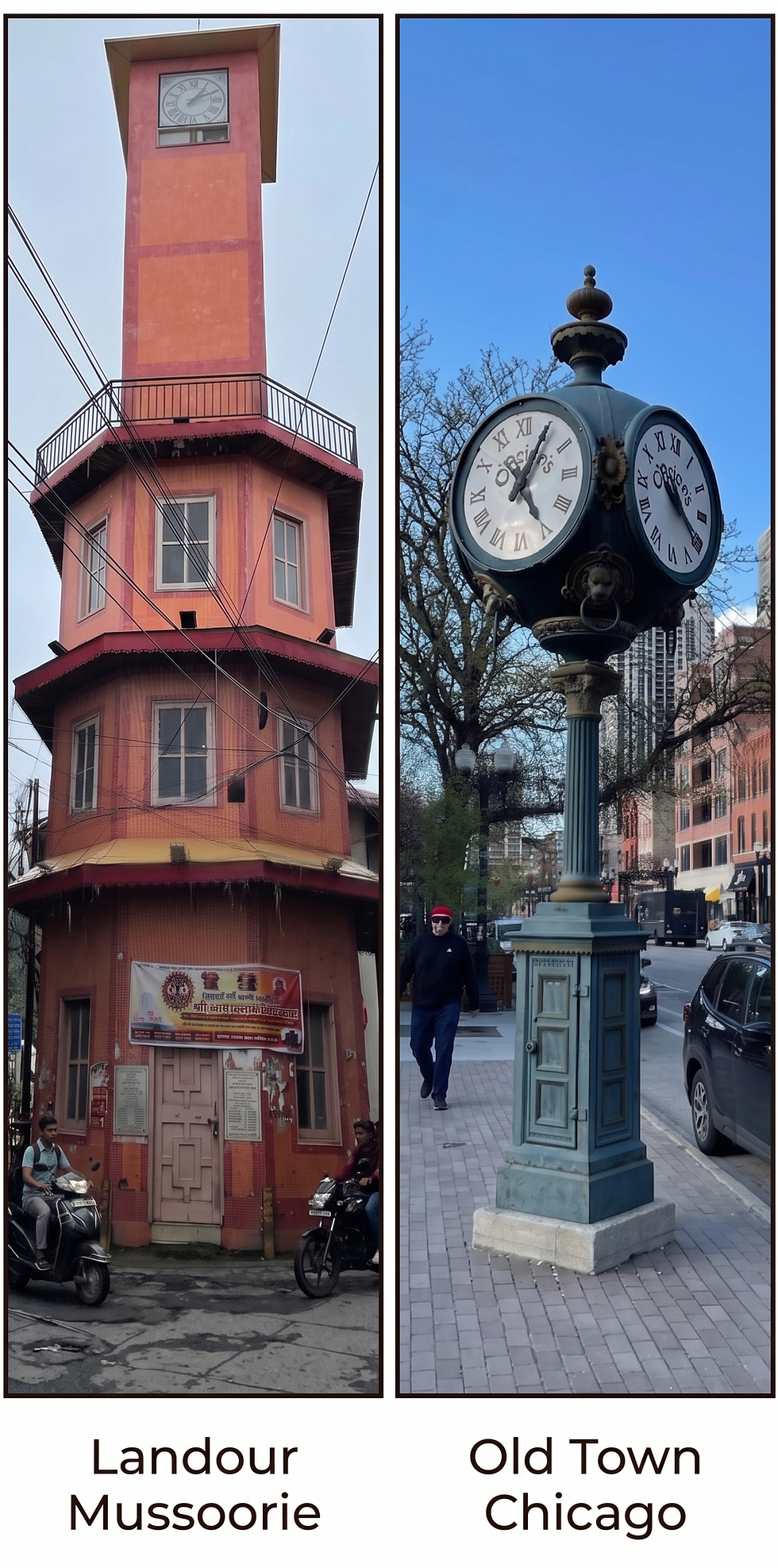
The land below the Darjeeling Clock Tower was once part of the Beechwood Estate, where Dr. Campbell planted the tea bushes from which Captain Samler is said to have stolen the stock for the Makaibari Estate.
The Clock Tower forms part of the Town Hall:

Readers of my Shimla post will know that, in the British Raj, a Town Hall was a large, multipurpose civic building used for administration, public meetings, social gatherings, and ceremonial events. The comparative view below between the Town Halls of Shimla and Darjeeling throws the latter's dilapidated state into sharp relief:

According to E. C. Dozey, the foundation stone for the Darjeeling Town Hall was laid in 1917, and the building was inaugurated in 1921. Apart from housing the municipality, it also contained a community hall, a reading room, and recreational facilities.
Dozey notes that one of the speakers at the Town Hall was the American temperance advocate William Eugene "Pussyfoot" Johnson, who campaigned for Prohibition in British India.
An account of Johnson's address at the Darjeeling Town Hall on the evening of October 17, 1921, is provided by Tarini Prasad Sinha in "Pussyfoot" Johnson and His Campaign in Hindustan. Judging by its hagiographic tone, the book appears to be what we would now politely call self-published.
One member of the supposedly standing-room-only audience asked whether Americans had become morose and cheerless since the introduction of Prohibition. The zealous Mr. Johnson replied by quoting a letter from the owner of New York's Lyceum Theatre:
Prohibition has added to the prosperity of the theatre. Instead of passing an evening around the festive board at public restaurants for such amusements as the social glass might offer, people are prone to seek entertainment elsewhere. The theatre is an institution that under normal conditions makes for the happiness of mankind. Thus it also makes anti-prohibitionists forget their deprivations.
The theatre magnate, it seems, had discovered that every cork left unopened meant another ticket sold. Some uncharitable critics of contemporary Bollywood, however, might contend that watching its films with the cork open is the only reliable way to endure the experience.
Those who find the idea of a book chronicling an American's temperance campaign in India laughable may be surprised to discover an endorsement from a Nobel laureate:

Image Source: "Pussyfoot" Johnson and His Campaign in Hindustan (1921)
In Kipling's poem The Betrothed, the narrator must choose between his beloved cigars and his fiancée. He writes:

Dozey is far more diplomatic in his assessment of "Pussyfoot" Johnson's campaign for Prohibition in British India. He simply writes that "such a condition is an impossibility from a climatic point of view, as also from the personal inclinations of its populace."
Summing Up
Returning from the walk, I went back to my favorite spot in the Windamere waiting for the mists to clear so that I could get a view of the Kanchenjunga:
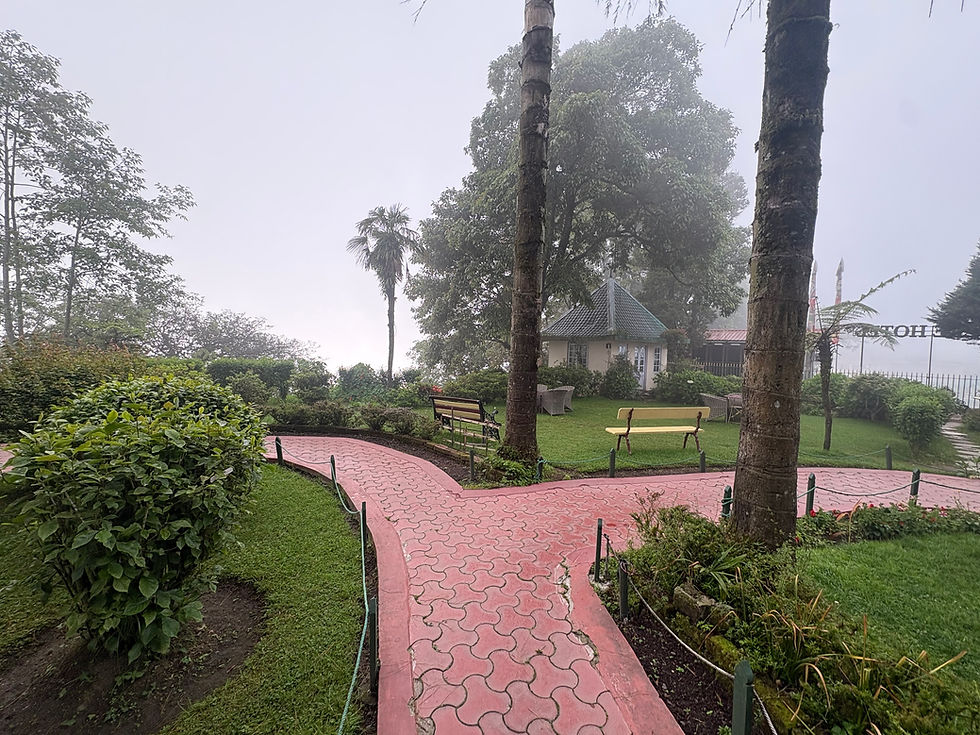
When the mists finally cleared, I found myself at a loss for words to describe the transcendent quality of Kanchenjunga. Lowell Thomas captures that mute wonder best.In India: The Land of the Black Pagoda, writing of the Himalayas from the vantage point of Tiger Hill, the highest point near Darjeeling, he observed:

I closed my notebook for the day and returned to the world of Kipling. There was nowhere else I would rather have been: masala chai in hand, reading Kipling in Darjeeling.


Comments