Reading Kipling in Darjeeling: Part 1
Updated: Aug 15
This three-part essay series records my impressions of Darjeeling during a week-long stay there. I was in Kolkata at the time, and with May bringing its customary humidity, I took the short flight to Bagdogra and was driven up to the Windamere Hotel overlooking the Darjeeling Chowrasta. I arrived with no agenda beyond reading Kipling, whose works had captured my interest during an earlier trip to Shimla.

At the heart of Darjeeling lies the Chowrasta, the town's historic public square:
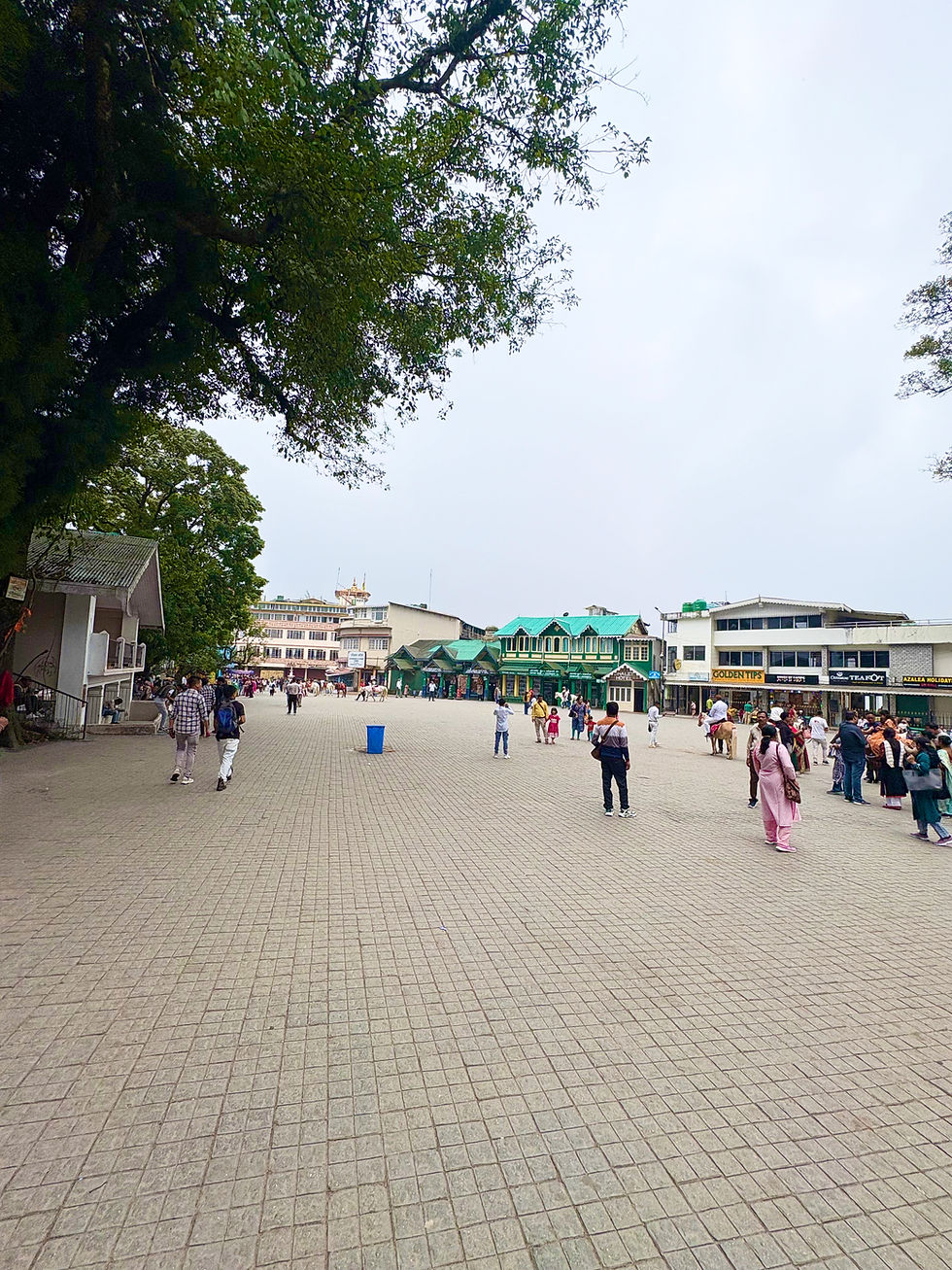
The Chowrasta forms one side of the circular Mall Road that surrounds Observatory Hill. In Part 1 of this series, I take a chukker on the road, beginning and ending at the Chowrasta.
Four books enriched my Darjeeling trip: A Concise History of Darjeeling District since 1835 by E.C. Dozey (1922), The Road of Destiny: Darjeeling Letters 1839 by Fred Pinn (1986), The Story of Darjeeling by Basant B. Lama (2009), and Smash and Grab: Annexation of Sikkim by Sunanda K. Datta-Ray (2013). Facts cited in the essay are attributed to these works and other online materials from which they are drawn.
The Chowrasta
The history of Darjeeling as a hill station is rooted in the Anglo-Gorkha Wars of the early nineteenth century. At the time, the Gorkhas, a tribe hailing from a place near Kathmandu, were aggressively expanding their territory. This brought them into conflict with the East India Company on both India's western and eastern frontiers. My Shimla post alluded to the British victory over the Gorkhas in 1815, which brought much of the western Himalayas under British influence.
On the eastern front, following British victory in 1816, under the Treaty of Sugauli, the Gorkhas surrendered roughly 4,000 square miles of territory, including lands they had seized from Sikkim. While they relinquished "Greater Nepal", the Gorkhas retained "Core Nepal", which, for the most part, defines the country's present borders.
The East India Company returned most of this territory to the Chogyal (King) of Sikkim, whose forces had fought alongside the British against the Gorkhas, under a separate treaty signed at Titalya in 1817. The lands restored to the Chogyal included Darjeeling.
The story of how Darjeeling passed from the Chogyal to the British has a Rashomon-like quality. At least three versions exist: E. C. Dozey's British account, Basant B. Lama's Indian perspective, and the more measured narrative of Fred Pinn, a German-Jewish scholar.
All agree on three basic facts.
First, the British had been searching for a hill station in eastern India. In his introduction to The Road of Destiny: Darjeeling Letters 1839, Fred Pinn explains Darjeeling's appeal as follows:
"There was Simla for Delhi with extensions at Landour, Mussoorie and Almora; Bombay had Mahabaleswar and Poona, and Madras developed Ootacamund in the Nilgiri Hills. Only the chief city of British India had nowhere to go during the hot weather and had to sweat it out in Calcutta."
Second, while mediating a border dispute between Sikkim and Nepal in 1828, Captain George William Aylmer Lloyd and the civil servant J. W. Grant stumbled upon the hills around Darjeeling, then a sparsely populated region that had once hosted a Gorkha military outpost. What began as a diplomatic mission quickly turned into a real-estate inspection. Darjeeling seemed ideal for the convalescence of British soldiers and for relieving weary civilians from the sweltering plains.
Third, a Deed of Grant dated February 1, 1835, "gifted" a small slice of present-day Darjeeling to the East India Company. Through this document, the hills of Darjeeling became part of Bengal and have remained so to this day.

Image: The Deed of Grant written in Lepcha language
Source: Wikimedia Commons
It is in the circumstances surrounding the acquisition of the Deed of Grant that the three scribes diverge.
In Dozey's telling, the acquisition was secured through "the personal influence and efforts of Lt. General Lloyd with Sikkimputti, the aged Rajah".
Predictably, the Indian account differs from Dozey's somewhat hagiographic narrative. Basant B. Lama argues the deed was obtained through deceit, noting that its stated date—February 1, 1835—is impossible: Lloyd, negotiating for the East India Company, did not even meet the Chogyal until February 19.
According to Lama, the Chogyal agreed to cede Darjeeling only after extracting three promises from Lloyd, which included a border adjustment with Nepal. Relying on Lloyd's confident—and perhaps good-faith—assurance that these demands would be met, the Chogyal's office affixed the royal seal on the draft prepared by the Englishman and dispatched it to him.
Lloyd failed to persuade his superiors to accept the Chogyal's terms. Instructed by his bosses to abandon the negotiations, Lloyd—already holding the deed—simply sat on it without disclosing its existence to British authorities. Receiving no word for months, an impatient Chogyal wrote to Lloyd:
"You have also many times written about Darjeeling but last year the grant of Darjeeling under my red seal was delivered to you through my vakeels and there never can be any departure from that (gift) by my Government. If you have understood it differently I cannot help it"
Read out of context, the above letter seems to show Darjeeling gifted unconditionally. But against the backdrop of prior negotiations, the Chogyal is simply saying: "I have upheld my side of the bargain; now you must uphold yours."
Lloyd promptly forwarded the correspondence to East India Company officials as proof that the Chogyal viewed the cession as an unconditional gift. Lama contends that Lloyd then hurriedly backdated the deed, allegedly miscalculating the conversion from the Hindu lunar calendar to arrive at the Gregorian date of February 1, 1835.
By then, the British establishment, in Lama’s view, was willfully blind to these discrepancies. W.H. Macnaghten, a civil servant, wrote to the Chogyal thanking him for the "unconditional transfer," regretted that the original demands could not be met, and offered an assortment of appreciation gifts:
"a double-barrelled gun, a rifle, 20 yards of red broadcloth, a pair of shawls superior and a pair of shawls inferior."
The inventory is so oddly specific it reads less like a diplomatic offering and more like the scavenged contents of a departing civil servant's luggage.

Image: reproduction of the 1835 Deed of Grant of Darjeeling; not a photograph of the original document
Beyond the date discrepancy, Lama advances a more controversial claim regarding the 138 square miles ceded via the deed. He contends that Lloyd and the Chogyal had agreed only to transfer a small tract around Observatory Hill to build a sanatorium. Lama argues that Lloyd later unilaterally inserted the sweeping boundary clause after the comma: “that is all the land South of the Great Rangit river, east of the Balasun, Kahail and Little Rangit rivers and west of Rungno (Tista) and Mahanadi rivers.”
This raises an obvious question: why would the Chogyal affix his seal to such a document? Lama points to the seal's anomalous position at the top of the page rather than the bottom. He insinuates that this top placement allowed Lloyd to insert the unauthorized geographical text beneath the seal at a later date.
While Pinn's account is more simpatico with Lama's than to Dozey's, he differs on two points.
First, he interprets Lloyd’s decision to forward the Chogyal's letter not as a willful misreading, but as a lack of emotional intelligence. In Pinn’s view, the Chogyal omitted his three demands in the letter, out of an "oriental delicacy" that regarded explicit quid pro quo arrangements as vulgar.
Yet even Pinn holds a low opinion of Lloyd, citing, among other examples of his caddish behavior, Lloyd’s claim to be the sole European to have seen Darjeeling. This conveniently overlooked J. W. Grant, an avid explorer who had originally championed Darjeeling's suitability as a British hill station.
Second, Pinn believes East India Company officials genuinely accepted Lloyd's version of events, arguing that the Governor-General's Council assumed Lloyd was negotiating strictly for the area around Observatory Hill.
This narrative, however, strains historical precedent. In 1843, after conquering Sindh against explicit orders, General Napier sent a defiant, one-word dispatch to London: "Peccavi" (Latin for "I have sinned"). Though the telegram story is apocryphal, Napier was rewarded for his insubordination.
The lesson from Napier is that imperial authorities routinely forgave those who exceeded their instructions, provided the result was a useful addition to the map. Ultimately, Pinn’s version of events requires us to believe that Lloyd's superiors were simply too naïve to notice the massive territory he had appended.
In his incredibly classist Fore and Aft, Kipling romanticizes British middle- and upper-class officers, crediting them with superior "backbone, brains, and bowels." He paints the picture of a naïve eighteen-year-old officer standing fully exposed under enemy fire with only a ceremonial sword, guided by an upbringing that equates dying for one's country with ultimate honor. Should he survive being shot, the young officer dismisses his wounds, deceives medical boards, and manipulates superiors—all to rush back to the front lines for more glory.
Perhaps Lloyd was all those things Kipling says. But if Lama is to be believed, the decisive weapon in this campaign was neither backbone nor sword, but ink. The pen is mightier than the sword indeed!
The entire area around Observatory Hill, including the Chowrasta, was part of the territory the British acquired in 1835.
The Chowrasta hosts a prominent open-air theater (pictured below) that became my bane one morning at 5 a.m., when a man singing over a loudspeaker rudely shattered my sleep. He was leading a group dance class for schoolchildren. One wing of the Windamere stands directly behind the amphitheater, and my room unfortunately occupied that very wing. It was the sort of authentic local experience hotels usually charge extra to arrange.

Driving in from Bagdogra Airport—one of the nastiest I have passed through, if I might add—I observed, just as I had in Shantiniketan, the economic backwardness and dilapidation of Bengal. The scenery improves as you approach the hills, though if steep switchbacks make you queasy, the journey remains stressful. The route climbs directly through the garbage-strewn decrepit main thoroughfares of towns like Kurseong, Sonada, and Mirik.
The distance from Bagdogra to Darjeeling is barely fifty kilometers. Google Maps projects a three-hour trip, but traffic gridlock in the final five kilometers can easily stretch the journey to four or even six. Mine took four and a half hours—a duration the driver assured me was lucky, likely a perk of a midweek arrival despite the peak May season.
Beyond the hairpin turns, an enveloping mist adds to the hazard. My personal travel hack when booking premium hotels is to have the property arrange the transit. The fare carries a twenty percent premium, but the markup buys a safer driver. Mind you, I am using a localized, Himalayan definition of safety here: a "safe driver" is simply one who checks WhatsApp occasionally rather than treating it as a co-pilot. In these hills, the concept of hands-free calling remains as elusive as a view of Kanchenjunga in the mists.
More than a century later, I could relate to Mark Twain’s description of his journey from Darjeeling back to the plains in the spring of 1896:

In Dozey's account, the foundations of modern Darjeeling Town (as distinct from the Darjeeling district) were laid during the twenty-two-year tenure of its first Superintendent, Dr. Archibald D. Campbell of the Indian Medical Service, appointed in 1839. Campbell replaced Lloyd, who was fired from his civilian role and dispatched back to his original military unit.
Readers with a passion for retributive justice (in other words, the sort who join lynch mobs) will find some satisfaction in Fred Pinn’s book. On the eve of his 1839 dismissal, Lloyd petitioned for "640 acres, or one square mile, of land at Kurseonggurry." The request was summarily denied. An embarrassed Campbell informed his predecessor that the government would graciously assign him a house "with a bit of garden around." The architect of Darjeeling's most sweeping land transfer could not secure a comparatively trivial plot for himself.
During Campbell's administration, numerous roads were constructed, most critically the artery connecting Darjeeling to the plains around Siliguri. Judging by the gridlock and the state of roads I encountered, one could be forgiven for thinking that not much road building has taken place since.
The Chowrasta has two anchor stores that lend character to the square. One is the Oxford Book and Stationery Co.:

The first floor houses a hotel while the bookstore occupies the ground level:

The collection is at the Goldilocks level, with a selection of books devoted to the Eastern Himalayan region as well as works by local Darjeeling authors that are unavailable on Amazon.
The second anchor store on the Chowrasta is a curio shop dating to 1890, located beside the bookstore:

The proprietor has shared an account of its history here, which I summarize below.
The family's Darjeeling story began during a famine that struck Kashmir in the late 1870s. Facing starvation, Habeeb Mullick undertook a perilous journey of hundreds of kilometres to Amritsar, where wealthy relatives provided him with ₹300 and a consignment of Kashmiri woollen patkas to sell to British troops stationed in Darjeeling. He travelled 2,000 kilometres to Darjeeling, a journey that took more than two months. The gamble paid off. British officers eagerly bought the patkas, enabling Mullick to establish a thriving business and open a shop in Darjeeling's Judge Bazaar.
The enterprise prospered over the following decades. After returning to Kashmir, Habeeb left the business to his only son, Ahmed, who broadened the range of wares on offer. At a time when the Chowrasta was largely reserved for Europeans, Ahmed cultivated relationships with British customers and achieved the rare distinction of relocating the family business there shortly before Indian independence.
I spent some time browsing the store and found trinkets at every price point. Unlike many mom-and-pop shops in India, the proprietor allows customers to browse in peace.
Habeeb Mullick had only one son. Hence the store's name, "Habeeb Mullick & Son", much like Dickens's Dombey and Son. Fortunately for Mr. Mullick, he did indeed have a son. Paul Dombey, by contrast, was obsessed with producing a male heir who could fulfill the literal promise of the family firm's name. When his sickly little boy dies, the singular name of the business becomes a ghost that haunts him for the rest of his life.
The Windamere Hotel
Walking clockwise from the Chowrasta along the Mall Road, the Windamere Hotel appears on the right:

As you walk up the driveway, the hotel comes into view on the horizon:

The hotel began life in 1841 as Ada Villa, an English boarding house that hosted colonial officials, aristocrats, royalty, and, later, tea planters visiting Darjeeling. The building pictured above—and shown in closer detail below—is the only structure at the Windamere that dates to 1841:

Few buildings from that era survive. Most are eventually demolished or lost to fire. It is therefore rare to find a structure of such vintage, let alone one so beautifully restored.
Below are some of the common areas inside the original 1841 boarding house:

In 1939, a group of friends acquired the property and converted it into a hotel company. One of the shareholders, Gertrude Bearpark, hailed from Windermere in England's Lake District. When her associates proposed naming the hotel after the well-known Windermere Hotel in her hometown, she objected that using the same name would create confusion. As a compromise, the "er" in Windermere was replaced with an "a", giving the hotel its distinctive name: Windamere.
In 1958, the hotel expanded by acquiring the adjoining Snuggery estate, which had once belonged to the Maharaja of Cooch Behar.
The hotel oozes old-world colonial charm:

Each building has its own name, as do the rooms, most of which are named after guests who once stayed at the hotel:

One of the Windamere's claims to fame is that it was here, in 1959, that the last Chogyal of Sikkim, Palden Thondup Namgyal, met his second wife, Hope Cooke, a nineteen-year-old American student of Tibetology whom he eventually marred in 1963. His first wife had died a few years earlier.
Palden Thondup was the Chogyal's second son. He spent his youth training in Buddhist monasteries and was expected to become a monk. Fate, however, had other plans. In 1941, his elder brother, the Crown Prince, died in a tragic air crash while serving as a pilot in the Royal Indian Air Force. Consequently, when his father died in 1963, the trainee monk acceded to the throne.
Some attribute the Crown Prince's death to a curse said to hang over the Namgyal royal family. To understand the origins of this curse, some historical context is required.
The Kingdom of Sikkim was founded in 1642. In Smash and Grab: Annexation of Sikkim, Sunanda K. Datta-Ray provides a brief account of the founding legend. Three Tibetan lamas—Lhatsun Chempo, Sempah Chempo, and Rigdsin Chempo—met in the seventeenth century to spread Buddhism in Sikkim. They had arrived from the north, west, and south respectively.
Believing that the country needed a ruler, the lamas debated who should become king. Two of the lamas advanced their own claims to the throne, each citing his distinguished ancestry. But Lhatsun Chempo put a spanner in the works by recalling a prophecy of a holy man who had foretold the arrival of three lamas from three directions and a fourth noble figure, named Phuntsog, from the east who would establish Sikkim's government.
Following the prophecy, the lamas searched for Phuntsog and, upon finding a nobleman of that name, bestowed upon him the title of Chogyal, meaning a ruler who upholds righteousness and Buddhism. The Fifth Dalai Lama recognized him and sent sacred gifts, marking the beginning of the Namgyal dynasty in Sikkim.
Given that the dynasty lasted more than three centuries, their recruitment process seems to have been more effective than modern-day executive search.
The newly formed kingdom was the product of the so called Lho–Men–Tsong pact between three ethnic groups.
First, the Lepchas, the aboriginal inhabitants of the region.
Second, the Bhutias, Buddhist migrants from Tibet who had been settling there for several centuries.
Third, the Limbus, who inhabited the eastern part of present-day Nepal and joined the new kingdom for strategic reasons.
The name of the pact derives from Tibetan ethnonyms—Lho for the Bhutias, Men for the Lepchas, and Tsong for the Limbus—reflecting the Tibetan cultural and political milieu in which the Sikkimese kingdom emerged.
Unfortunately for the Namgyals, while the monks found a prophecy endorsing their candidate, they seem to have overlooked an older agreement forbidding his descendants from ruling. According to tradition, the ancestors of the first Chogyal had pledged to a Lepcha chief that they would never rule Sikkim. The Lepchas therefore placed a curse upon the Namgyals: the firstborn son would never ascend the throne. Later, a second curse was added—that whoever did ascend the throne would suffer a physical deformity. The Lepchas seem to have had a marked preference for supernatural remedies over constitutional amendments.
The curse notwithstanding, the Bhutia royal family shared power with the Lepchas, and even today much of Sikkim's traditional aristocracy comes from the Bhutia and Lepcha clans.
It is remarkable that the man who was smitten by the young American woman at the Windamere was the heir to a three-centuries' old dynasty with such a mystical history. Standing in the lounge (pictured below) I found myself imagining the Chogyal and Hope Cooke encountering one another there, though we cannot really know which corner of the Windamere witnessed their first meeting.

Sunanda K. Datta-Ray offers the following unflattering description of Hope:
"an awkward young girl in a daringly brief mini skirt with straggling shoulder length hair and a heavy smearing of mascara and eye shadow heightening her pasty complexion. Hope was no beauty, certainly not a patch on the radiant Sangey Deki who had died in 1957 leaving three children, Tenzing, Wangchuck and a daughter, Yangchen. But the widower was enamoured of the young girl, and, like so many Americans, Hope Cooke anxious to be a queen"
The story of the Chogyal and the American Gyalmo is so compelling that it is surprising no Netflix series has yet been made about it. Some accused Hope Cooke of being a CIA spy, but the aspersion should be taken with a sack of salt. Blaming the proverbial "foreign hand" was a reflex of the Indira Gandhi establishment.
To appreciate the story, we need to pick up the historical thread of the British in Darjeeling where we left it in 1835—the year of the "gift".
Following the events of 1835, the Chogyal had been stewing over the fact that a deed for a sanatorium, itself obtained through dubious means, had led to the creation of a sovereign principality within his kingdom. Since the hill station was landlocked within Sikkimese territory, the East India Company began paying the Chogyal rent to keep him in tolerable humor.
In a display of lateral thinking, the British solved their irate landlord problem in 1850 by forcibly acquiring more of his land.
In Dozey's version of events, Dr. Archibald Campbell, the Superintendent of Darjeeling, and Sir Joseph Hooker, the celebrated botanist, were arrested in 1849 while traveling in Sikkim with official permission. The detention order came from Tokhang Donyer Namgyal—the Pagla Dewan—who also happened to be the aging king's son-in-law. Campbell and Hooker were reportedly mistreated during their confinement.
When diplomatic protests failed to secure their release, the British sent a military force. The episode ended with the annexation of an additional 640 square miles of territory. Unlike the 1835 deed, which covered only hilly tracts, this acquisition included both hills and the plains around Siliguri. The British placed the entire territory under Dr. Campbell's administration. As we will see later, this administrative decision planted the seeds of the Gorkhaland agitation.
Since this is Rashomon: Darjeeling Edition, there is, of course, an alternative account. According to B. B. Lama, the dubious legality of the deed made annexation an attractive solution because it rendered the deed irrelevant. The British therefore needed a casus belli.
In Lama's telling, Campbell encouraged Hooker to enter Sikkimese territory surreptitiously through Nepal. Initially, the Sikkimese refused to take the bait. The two gentlemen therefore raised the stakes by crossing a Tibetan checkpoint without the permission of the Sikkim Durbar. It was this act, Lama argues, that led to their arrest.
The incursion into Tibet was particularly galling because the Tibetans were already wary of British acquisitiveness. They had been alarmed by reports of mountains being blasted in Darjeeling for real-estate development and blamed the Chogyal for his callousness in letting Darjeeling slip into British hands, thereby placing Tibetan autonomy in jeopardy.
Datta-Ray recounts an amusing, though possibly apocryphal, incident immediately following the arrest. Campbell, bound hand and foot, reportedly shouted, "Hooker! Hooker! The savages are murdering me!" Hearing this, one of his captors generously ordered: "If he wants a hookah, let him have one."
From the history of Darjeeling, it appears that the arrival of two upright English gentlemen often had a curious tendency to be followed by maps being redrawn in favor of the East India Company: Captain Lloyd and Mr. Grant in 1828, and Dr. Campbell and Sir Hooker in 1849.
Two Englishmen from a different social class, though no less mercenary, appear in Kipling's The Man Who Would Be King. The narrator encounters Peachey Carnehan and Daniel Dravot, who travel to Kafiristan, a remote, mountainous, and largely uncharted corner of Afghanistan, intending to become kings.
Unlike the "respectable" Darjeeling duos, these men were working-class rogues who made money by blackmailing rulers of Indian princely states while posing as muckraking correspondents for British newspapers. One line from Peachey Carnehan captures the ideology of the Darjeeling usurpers: "a man who knows how to drill men can always be a King". Had Peachey Carnehan been present at the lamas' council, the debate over who should be Sikkim's king would have ended differently. In a sense, the British were merely correcting the lamas' original mistake.
Dozey's narrative continues with an ebullient account of British expansionism.
A small British expeditionary force was dispatched to annex a portion of Sikkim in November 1860, ostensibly because the kingdom was not adhering to the 1817 Treaty of Titalya. The force suffered a swift defeat and beat a hasty retreat. The setback caused panic in Darjeeling, where residents feared a Sikkimese advance, while officials in Sikkim reportedly mocked the British humiliation.
In response to this blow to their prestige, the British mobilized a much larger force in February 1861. The army quickly overwhelmed the Sikkimese and advanced into Tumlong, then the capital, by March. The campaign concluded with the Treaty of Tumlong, signed on March 28, 1861, which compelled the eighty-year-old Chogyal to abdicate in favor of his son and expel the pagla dewan.
The Treaty of Tumlong governed relations between British India and Sikkim until Indian independence. Sikkim became a British protectorate. The Empire assumed control of the kingdom's foreign affairs and defense, while the Chogyal retained internal autonomy. After independence, however, the legal status of treaties inherited from the British Raj was uncertain. Consequently, India signed a new treaty with Sikkim in 1950 that effectively preserved the core terms of Tumlong.
All this history brings us back to the last Chogyal of Sikkim and his American wife, suspected by some of being a CIA agent:

Image: Hope Cooke with prince in 1965
Source: Library of Congress
The Chogyal wanted Sikkim to remain an autonomous Himalayan kingdom, like Bhutan, rather than a protectorate deprived of control over its foreign policy and defense. Unfortunately for him, the British influence on Sikkim's economy had set in motion a profound demographic transformation.
Waves of Nepali migrants arrived in both Sikkim and Darjeeling to enjoy the fruits of Pax Britannica. The British welcomed these settlers because they were seen as a bulwark against any Tibetan incursion. As a result, by the time of Indian independence, roughly seventy-five percent of Sikkim's population was Nepali. Many were poor and felt little attachment to the Buddhist monarchy. The Bhutias, Lepchas and Limbus had become minorities in their own kingdom.
The attached link provides an overview of the post-1947 political dynamics. Many Nepalis in Sikkim favored integration with India. The Indian government, however, was cautious because their ethnic kin in the Darjeeling hills were demanding a separate Gorkhaland. Incorporating a large additional Nepali population into India risked strengthening that movement.
On the other hand, the 1962 Sino-Indian War altered the strategic calculus. It became increasingly attractive to incorporate Sikkim into India before China could assert claims over the kingdom as an extension of Tibet. By the early 1970s, according to Datta-Ray, RAW had begun "assisting" the resistance in Sikkim.
Ultimately, the Chogyal was unable to contain the growing demand for democratic rights among the ethnic Nepali majority. On May 16, 1975, Sikkim became part of India following a referendum in which 97 percent of voters opted for integration.
Two broad critiques have been advanced regarding the role Hope Cooke played in the political upheavals that followed.
The first concerns her indirect and perhaps unintended influence. Dismissed as a gold digger by the royal family, Hope cultivated a coterie of simpatico friends. In Sunanda K Datta-Ray's telling, the American Gyalmo gradually distanced her husband from his earlier social circle, leaving him increasingly detached from political realities. As he writes: “The new Gyalmo was a strange unhappy woman, unable to reciprocate her husband’s doting love, neurotically conscious of her loneliness in a court that found her faintly ridiculous.”

Image: Hope Cooke and the Chogyal
Source:Wikimedia Commons
Her celebrity in the Western press also transformed the palace into a rival to India House—the residence and office of the Political Officer, India's chief representative in Sikkim until 1975.
Datta-Ray writes:
"his wife ordered Scandinavian silver, bought crested crockery from England, imported linen from New York, and raised palace entertainment to a level of elegance where it challenged India House’s established supremacy. As distinguished foreigners flocked to Gangtok, the palace and India House squabbled over them like ambitiously climbing hostesses.”
The coup de grâce for the Political Officer came when the American ambassador, Kenneth Keating, chose to stay at the palace rather than India House.
A second charge, involving more direct influence, appears in Sikkim: A History of Intrigue and Alliance, in which Preet Mohan Singh Malik recounts the political games he believes Hope was playing.
The Chogyal had established a Study Group to advise him on policy. In practice, Malik argues, it was an echo chamber that fed the monarch increasingly fanciful notions of what was politically achievable. Hope, according to Malik, was a member of the group and played a leading role in formulating its recommendations.
Matters came to a head in 1967 when the Gyalmo argued, in an opinion piece, that all land in Sikkim belonged eternally to the Chogyal and could be reclaimed at his demand. On that basis, she called for the restoration of Darjeeling to Sikkim and the revocation of the 1835 deed signed with the East India Company. Malik suggests that this "Queen's Gambit" envisioned Darjeeling as a bargaining chip in negotiations between Sikkim and India.
The Western press went gaga over yet another American woman, after Grace Kelly, marrying into royalty. Datta-Ray quotes The Washington Post: “Americans are well aware that Monaco is touched with Grace; now Sikkim is radiant with Hope.”
An article on the Chogyal and Hope Cooke in The New Yorker's September 1964 issue is instructive on the public-relations value of an American queen.
The New Yorker correspondent visits the couple in New York. While the writer faithfully adheres to the magazine's sceptical style, he is plainly star-struck, and the royal couple are clearly putting on a show. The Chogyal helps fasten the back of his wife's traditional Sikkimese dress and prepares snacks as the interviewer looks on. Hope paints a picture of middle-class domesticity, planning meals while her husband tends the garden. In 1980, the two divorced after a bitter custody battle and a financial settlement dragged through the American courts. Domestic bliss indeed!
In the New Yorker interview, Hope recounts how they met at the Windamere in 1959 and how he proposed to her in 1961 when she returned to Darjeeling for the summer. It was only their second meeting. He proposed on the dance floor. Perhaps the piano that now sits in the hotel's Wuthering Bites restaurant was being played when he asked the question:

She insists that she did not marry Palden Thondup because he was a king. Rather, she was captivated by his personality. "I just fell in love with his sad, sad eyes and sad smile and disjointed and beautifully courteous manner." One is left to wonder whether those sad eyes would have proved quite so captivating had they belonged to an accountant from Queens.
Hope professes a poor grasp of geography, confessing to the New Yorker reporter that she had once thought North Carolina was part of the Deep South. Geography, however, is not her only blind spot. She cannot tell one flower from another and finds judging flower shows a great ordeal.
The conversation eventually turns to politics. When the King complains that Sikkim lacked representation at the United Nations despite being three times the size of Luxembourg, Hope corrects him, noting that the Grand Duchy covered precisely 999 square miles. She may not have been a CIA agent, but the portrait of an ordinary housewife grows a little less convincing when one can produce the square mileage of Luxembourg from memory.
One would think there is already enough material here for a Netflix series: a centuries-old curse on a royal family, land acquired through deception, a honey trap at a grand hotel, a monk who acquired a Ferrari, a contentious divorce, and geopolitical intrigue involving the CIA and RAW. Not quite. There is more drama.

The bête noire of the Chogyal was a Lepcha aristocrat, L. D. Kazi. Like the Chogyal, he had married a much younger Western woman after the death of his first wife: the British-born Elisa Maria, who lived in Kalimpong. No one seemed quite sure of her antecedents or how she had come to settle there.
In support of her husband's cause, Elisa wrote critical articles about the Sikkim durbar from across the border in Kalimpong. In Smash and Grab: Annexation of Sikkim, Sunanda K. Datta-Ray recounts an incident in which guests at the wedding of the Chogyal and Hope Cooke awoke to find a derisive verse about the American bride. Its author was Elisa Maria, herself an unwelcome guest, who had penned the lines before making a dash back to Kalimpong.
Like the original acquisition of Darjeeling in 1835, Sikkim's incorporation into India in 1975 is probably a veritable Rashomon. Beyond the narratives I have quoted here, I am sure Hope Cooke's autobiography—which I have not read—offers a very different version of events.
In 1978, a young man was killed when his Mercedes swerved to avoid a truck climbing the hill and plunged into the ravine below. The youth was the Chogyal's eldest son, Crown Prince Tenzing. The curse on the Namgyals had struck again.
Saint Andrews Church
Continuing along the Mall Road past the Windamere, one comes upon a colonial-era building known as the Government Office, Darjeeling:

On the opposite side stands a dilapidated building housing the Deshbandhu District Library, which during the British era was home to the Carlton House Hotel:

My next stop on this circular walk was St. Andrew's Church:

E. C. Dozey writes that the original St. Andrew's Church was housed in a building called Bryanstone, where Joseph Hooker—the botanist whose imprisonment led to the annexation of additional Sikkimese territory—lived in 1848.
The foundation stone of the original church was laid in 1843, and services began the following year. Dozey notes that the building lacked a clock tower. The government informed the faithful that there was no money for one and that they would have to content themselves with a sundial donated by a generous visitor. In a town famous for its mist, a sundial was a triumph of optimism over meteorology.
In 1867, the spire was struck by lightning and the building, now deemed unsafe, was abandoned. In 1879, the foundation stone of the church we see today was laid, and the new building opened in 1882. The clock tower followed soon after.
Walking up the hill, I arrived at the church's front façade:

Peering through the church's open doors, I took a moment to reflect on the joys and sorrows of the thousands of congregants who have passed through them over the past century and more:

Inside the church is a memorial tablet to Lt. Gen. George William Aylmer Lloyd, whom we encountered earlier as the chief negotiator of the 1835 annexation. The British describe him as the "Discoverer of Darjeeling" in much the same way Columbus is said to have "discovered" the Americas. As noted earlier, the Lepchas were the original inhabitants of Sikkim, of which Darjeeling was then a part.
From St. Andrew's Church, one enjoys expansive views of the Government Office, Darjeeling, building that we passed earlier:

From the church, one can also see St. Robert's School:
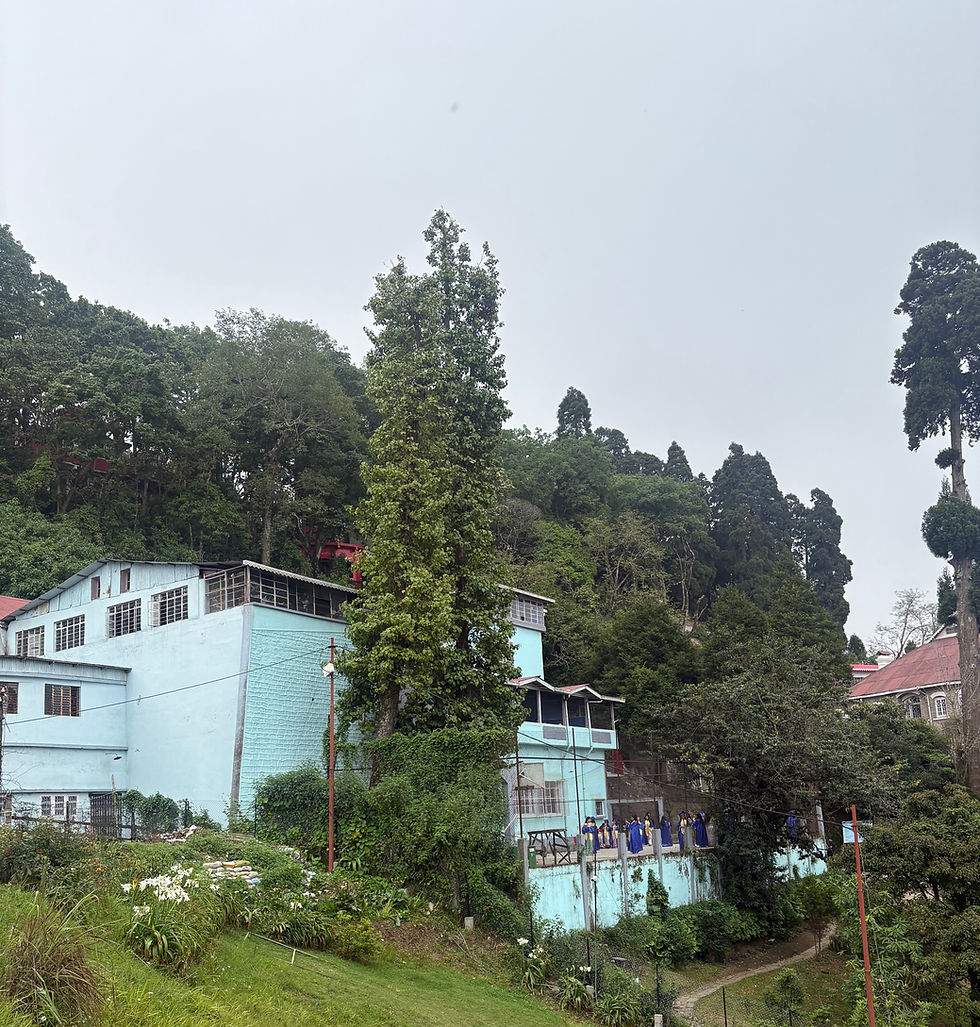
Walking downhill from St. Andrew's Church toward the Mall Road, one cannot help but notice the grand Bhanu Bhawan:

Officially called the Gorkha Rangamanch Bhawan, it hosts cultural events. The words "Gorkhaland Territorial Administration" emblazoned prominently above it merit some historical explanation.
Darjeeling is both the name of the town and of the district in which it lies. The hill portions of the Darjeeling district are an amalgamation of three territorial acquisitions. Two of these have already been mentioned: the deed of 1835 and the military annexation of 1850 following the fracas surrounding the imprisonment of two prominent British civilians.
The third expansion of Darjeeling occurred in 1865. Following the Anglo-Bhutanese War, the British annexed Kalimpong from Bhutan under the Treaty of Sinchula. Although Kalimpong had historically been Sikkimese territory, Sikkim had lost it to a Bhutanese invasion around 1700. Sikkim never regained it, but neither was it transferred directly from Sikkim to the British in 1865.
In 1866, the district of Darjeeling was created by combining all three acquisitions. TLDR: the Darjeeling district of British India was carved out of Sikkim and Bhutan. Though these areas had never historically formed part of Bengal, they were now firmly within the Bengal Presidency and, later, West Bengal. Kalimpong was carved out as a separate district in 2017.
As mentioned earlier, the pre-East India Company inhabitants of undivided Sikkim—including Darjeeling and Kalimpong—were the Lepchas, indigenous to the region; the Bhutias, who had migrated from Tibet; and the Limbus from the eastern part of present-day Nepal. It has likewise been noted that Pax Britannica drew large numbers of ethnic Nepali migrants to the region, a process actively encouraged by the British.
Today, the Nepali share of the population in the hill subdivisions of Darjeeling district is even higher than in Sikkim, standing at roughly 90 percent. The picture changes, however, when the plains are included, reducing that share to about 40 percent. This demographic reality lies at the root of the sometimes-violent Gorkhaland agitation, through which many ethnic Nepalis have sought a separate state within the Indian federation.
The origins of this demographic problem, as hinted earlier, can be traced to the British annexation of the Siliguri plains in 1850 and the decision to administer the hills and plains as a single unit. At the time, the plains were sparsely populated and the arrangement carried little demographic significance.
In the late nineteenth century, however, the British began importing tribal laborers, including Mundas and Santhals from present-day Jharkhand and Odisha, to clear forests and work tea plantations. Unlike the Nepalese, these tribes were not used to the cold of the hills and hence they stuck to the plantations around the plains. A second wave of migration came with Bengali settlers following the upheavals of 1947 and 1971.
The term Gorkhaland itself reflects a semantic broadening of the word "Gorkha" (spelled "Gurkha" by the British), which originally referred specifically to the tribe that populated the Gorkha kingdom. Today, the term is commonly used for people of Nepali hill ancestry more generally.
It is ironic that the Gorkhas, who had displaced the Lepchas in the Darjeeling Hills, now found themselves complaining of minority status within the Darjeeling district.
The Gorkhaland Territorial Administration (GTA) represents a political compromise. It is a local governing body that administers the hill subdivisions of Darjeeling district as well as Kalimpong, occupying a middle ground between a conventional municipality and a full-fledged state government.
The Bengal Presidency itself gave rise to Assam, Odisha, and Bihar. Smaller states such as Uttarakhand, Jharkhand, and Chhattisgarh were later carved out as well. Yet the Indian government was unwilling to create Gorkhaland. The hesitation is understandable.
At 50,000 feet, what happened in Sikkim can be summarized bluntly: nineteenth-century economic migrants from a neighboring country, in collaboration with a foreign power (India at the time), came to dominate the political future of the land of the Lho–Men–Tsong. It would be wrong to view Indian citizens of Nepali ancestry as a fifth column. Nevertheless, the geopolitical anxieties such histories evoke are not unique to India; comparable concerns have surfaced elsewhere, including in debates surrounding Crimea and the Donbas.
Given the state of the hills' infrastructure, the most visible success of Gorkha mobilization may not be the GTA but the election of Prashant Tamang as Indian Idol. Sadly, Tamang passed away in 2026 following a cardiac arrest. He was forty-three.
The Darjeeling Gymkhana Club
Just beyond St. Andrew's Church stands the Darjeeling Gymkhana:

The word "gymkhana" possibly derives from gend-khāna, where gend means ball and khāna means house. Originally, a gend-khāna was simply a racket court or a place for ball games. The British replaced gend with gym and broadened the term to encompass sporting events such as equestrian meets and track competitions. Thus, in the story Bank Fraud, Kipling describes Reggie Burke as being "ready for anything from a hot-weather gymkhana to a riding-picnic."
E. C. Dozey writes that the building housing the Gymkhana Club dates to the earliest days of British Darjeeling. In 1840, it served as the courthouse and was one of only thirty-odd buildings in the town. Thus, although the club itself was founded in 1909, the building long predates it.
On the western edge of the Mall Road circle stands Raj Bhavan, the summer residence of the Governor of Bengal:

E. C. Dozey records that the site was originally occupied by a private residence called Solitaire. On October 31, 1877, the government purchased it from the Maharaja of Cooch Behar. Extensive alterations were undertaken to convert it into the residence of the Lieutenant Governor of Bengal, and it was renamed Shrubbery. Further improvements followed during the British era, and the building eventually became known as Government House.
The house is now heavily guarded and nothing is visible from outside. Today it bears the name of Lok Bhavan; the security arrangements suggest that democracy is best appreciated from a distance.
I recommenced my clockwise walk on the Mall Road and arrived at Observation Point:

The eastern wing of the Mall Road opens onto grand vistas of Kanchenjunga, but you must be patient for the mist to lift. Throughout the day, it rolls in and recedes, playing a game of hide-and-seek. In the opening scene of Satyajit Ray's Kanchenjunga, the protagonist complains to a fellow guest at the Windamere that he has not seen the mountain even once during his stay.
Be patient. The moment the mist parts and Kanchenjunga reveals itself feels like a divine revelation (see picture below):

The eastern side of the Mall Road remains remarkably pristine:

Between the trees, one catches fleeting glimpses of the vast landscape as the mist plays hide-and-seek:

Mahakal Temple
Walking along the eastern stretch, one comes to the pathway leading to the Mahakal Temple:

This path to the temple passes by the Windamere Hotel. In fact, guests can walk directly to the temple from the hotel's Wuthering Bites restaurant.
An alternative route (pictured below) begins just beyond the Gymkhana Club. It climbs uphill from the western side of the Mall Road, running parallel to and above the eastern stretch. I found this upper path somewhat unnerving because of the loud chatter of monkeys and the sparse foot traffic. It is better to get as close to the temple as possible on the lower road before making the steep ascent by the Windamere:

While the complex contains many smaller temples, its focal point is the Mahakal shrine. After leaving your shoes in the seating area, you walk up toward the shrine:

As you walk up, on the left, multicolored Buddhist prayer flags are strung overhead, while the right side is lined with stones painted in vibrant colors, some hand-inscribed with sacred Hindu chants.
At the end of the path stands a bright orange gateway:

It is revealing how much we can absorb when we slow down, observe, and then research what we have seen to fill the gaps in our knowledge. At first glance, the temple entrance pictured above does not seem very different from thousands of others. That may be true at one level, but consider the symbolism contained within a single frame.
In the image above, Nandi the bull stands facing the entrance. Inside, Shiva, worshipped here as Mahakal, translates literally as the "Great Lord of Time" or "Beyond Time." Guarding the foot of the steps on either side are Snow Lions, mythical creatures that symbolize fearlessness in Buddhist lore.
Atop the orange gateway sits a golden Wheel of Dharma flanked by two kneeling deer, representing the Buddha's first sermon in the Deer Park at Sarnath. On either side of the staircase, large cylindrical Buddhist prayer wheels are built into red concrete structures. Devotees spin them clockwise as they enter, sending prayers into the wind.
B. B. Lama recounts four events that shaped the temple's history.
The first occurred in 1763, when the Pemiongchi Monastery of Sikkim established an outpost on this site. One of several theories regarding the origin of the name Darjeeling is that it derives from the chief abbot of the new shrine, Rinzing Dorji Legden La. The Bhutias called the place Dorji-ling, with ling meaning house or abode. In this interpretation, Dorjiling means the House of Dorji.
The second event occurred in 1788, when occupying Gorkha troops destroyed the monastery and the Gorkha commander Johar Singh appointed the Lepcha chief Roop Chiring as the local feudal lord.
The third unfolded in the years following the British acquisition of Darjeeling in 1835. Dozey records that the monastery was relocated around 1861 to a site adjoining St. Andrew's Church and then, in 1878, moved farther from the Observatory Hill area to Bhutia Basti, a run-down Bhutanese neighborhood of Darjeeling. B. B. Lama attributes this final relocation to Sir Ashley Eden, the Lieutenant-Governor of Bengal, whose distaste for "heathens" allegedly made the monastery's presence near the town center unwelcome.
Perhaps Eden might have acted differently had he read Kipling's The Mark of the Beast, but alas it was written more than a decade after the deed was done.
In that story, Fleete, a drunken Englishman, grinds the ashes of his cigar butt into the forehead of a Hanuman idol. A leper emerges from behind the idol and drops his head upon Fleete's chest, at the precise spot where leopard-like markings later appear. Fleete develops an unnaturally keen sense of smell, begins eating raw meat, terrifies horses, and prefers to remain outdoors in the biting cold of Shimla.
Unfortunately for believers in poetic justice, the historical record is silent on whether Eden later took to alarming horses or prowling Darjeeling after dark.
The fourth development was the growing prominence of Hindu deities at the site. Lama writes that by the early twentieth century three Hindu ascetics had taken up residence there, though Buddhists continued to worship at the site into the 1880s even after the monastery's relocation. The ascetics claimed that three Shiva lingams had self-manifested on the hill.
Any religious animosity that may once have existed has thankfully faded. Today, the temple is replete with both Buddhist and Hindu motifs and remains a sacred site for followers of both faiths.
As it felt disrespectful to photograph the sanctum sanctorum, I used AI to recreate what I saw inside:

In the foreground, three ornate gold-plated brass arches cover the sacred stones representing the swayambhu (self-manifested) lingams. Behind them rises a black rock, possibly part of Observatory Hill itself. In the upper right stands a statue of the Buddha, reflecting the syncretic nature of worship at the site.
Inside the alter area, a Buddhist monk and a Hindu priest jointly conduct the services. Opposite the chamber holding the lingams is a traditional Himalayan outdoor incense furnace (pictured below). Devotees can deposit incense incense materials. The smoke is believed to cleanse the physical environment and the minds of the devotees from negative energy:
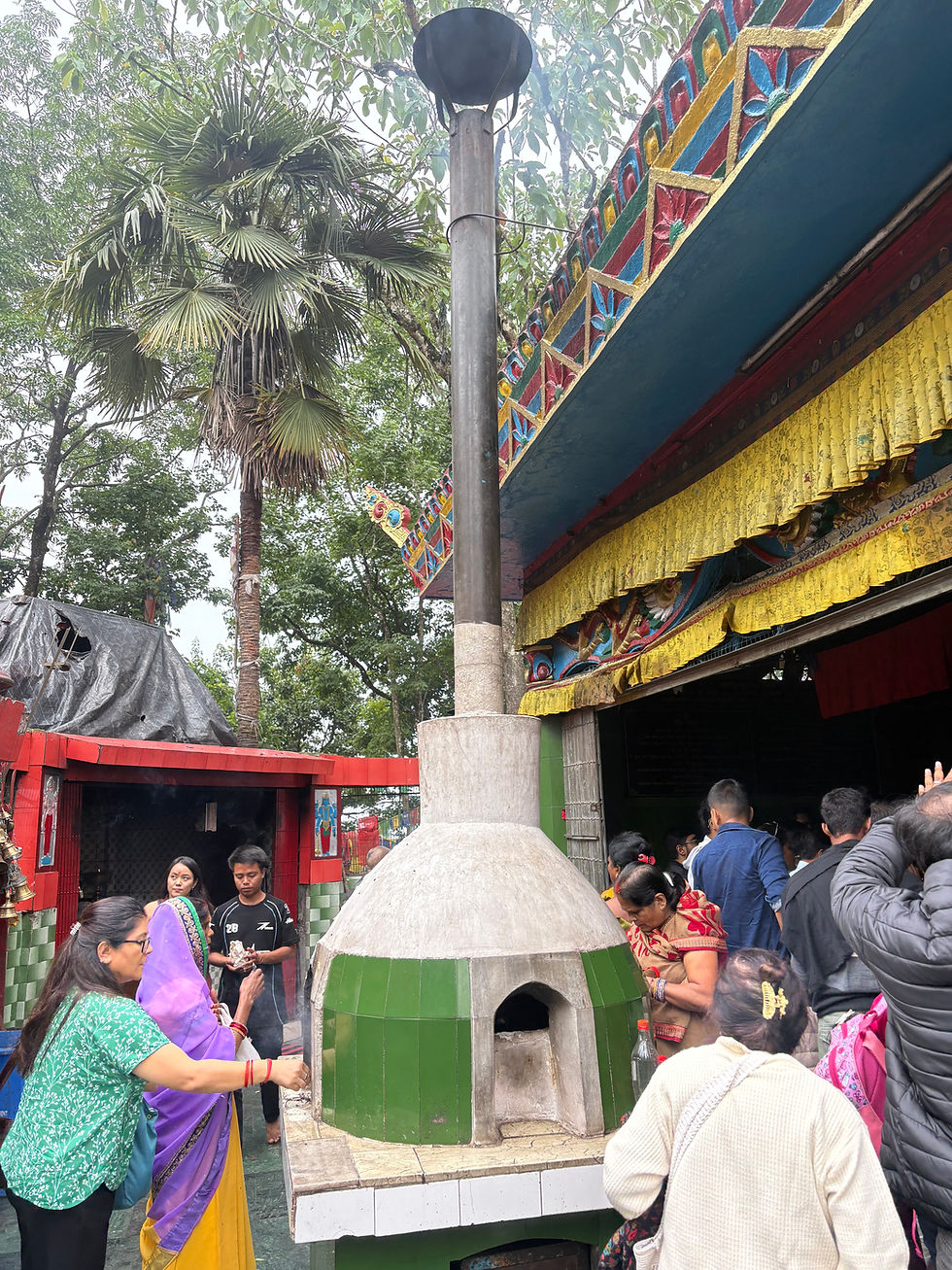
On my way out, I stopped at the Kali Temple and received a blessing from a Buddhist monk—the high point of my day:

Mahakal and its iconography provide a good illustration of the ideas in Manu Pillai's Gods, Guns and Missionaries, which I described in my earlier post on Shantiniketan. Pillai argues that, like any clergy, Vedic Brahmins were invested in advancing their theology. Yet, unlike the later evangelists of Islam and Christianity—whose arrival in India was often backed by military and political power—the Brahmins relied largely on persuasion.
According to Pillai, this persuasion took the form of accommodation. Brahmins co-opted the practices and myths of local communities. The gods of the Rig Veda, such as Indra and Agni, gradually yielded to Shiva and Vishnu.
Pillai notes that Brahmins frequently forged connections between local deities and the evolving Hindu pantheon. He cites the Chenchu tribe of Andhra, who were incorporated into the Brahmanical narrative through a myth describing the union of a Vishnu avatar and a Chenchu woman.
Across the subcontinent, many tribal communities worshipped fierce, dark-skinned guardian deities who required appeasement through animal sacrifice to ward off disease and protect the harvest. As Puranic religion absorbed these communities, such deities were often recast as Mahakal and new myths emerged around them.
For instance, the Mahakal Temple in Ujjain is associated with the legend of King Chandrasena, a devoted worshipper of Shiva. When rival kings invaded the city and persecuted Shiva's followers, Shiva responded by manifesting in his fierce Mahakala form, defeating the invaders and, at the devotees' request, agreeing to reside permanently in Ujjain as the self-manifested Mahakaleshwar Lingam.
Such myths allowed local communities to continue many of their existing forms of worship, albeit within a new theological framework.
The prayer wheels pictured below line the temple's parikrama path and are flanked by images of various enlightened figures from the Buddhist pantheon:

While the temple's sanctity for Buddhists stems from its origins as a monastery, Mahakal is also a deity within Buddhism. Buddhist deities are not worshipped as supernatural beings who grant worldly wishes. Rather, they symbolize enlightened qualities within ourselves, and meditation upon them is a means of awakening those same qualities in the mind.
Because practitioners from both Hindu and Buddhist traditions drew upon the same underlying indigenous traditions, Mahakal—the wrathful protector—was incorporated into both. In Buddhist traditions, however, Mahakal is typically depicted in anthropomorphic form, whereas the Darjeeling temple contains only the Hindu representation of the deity as a lingam.
Summing Up
My chukker around Observatory Hill was complete. The eastern and western sides of the Mall Road, pictured below, possess very different energies:

The western side is rather unattractive, with litter, crowds, and an abundance of concrete. The eastern side, by contrast, is pristine and green, offering expansive views of Kanchenjunga whenever the mists clear.
The next morning, I awoke to find some visitors perched on the window ledge:
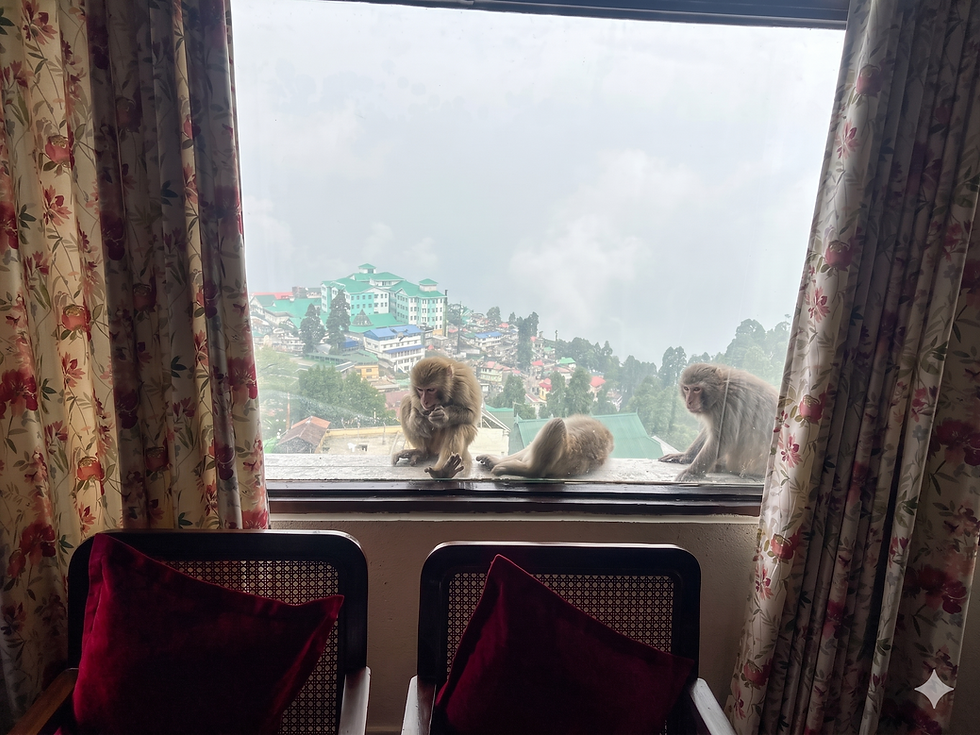
I cannot blame them for ignoring the Do Not Disturb sign; unfortunately, it was hanging on the other side of the door. They were not exactly the three wise monkeys. One seemed lost in deep philosophical reflection, another was asleep on the job, and the third looked as though it had serious reservations about my life choices.
Making my way to the eastern side of the hotel, I paused to marvel at Kanchenjunga:
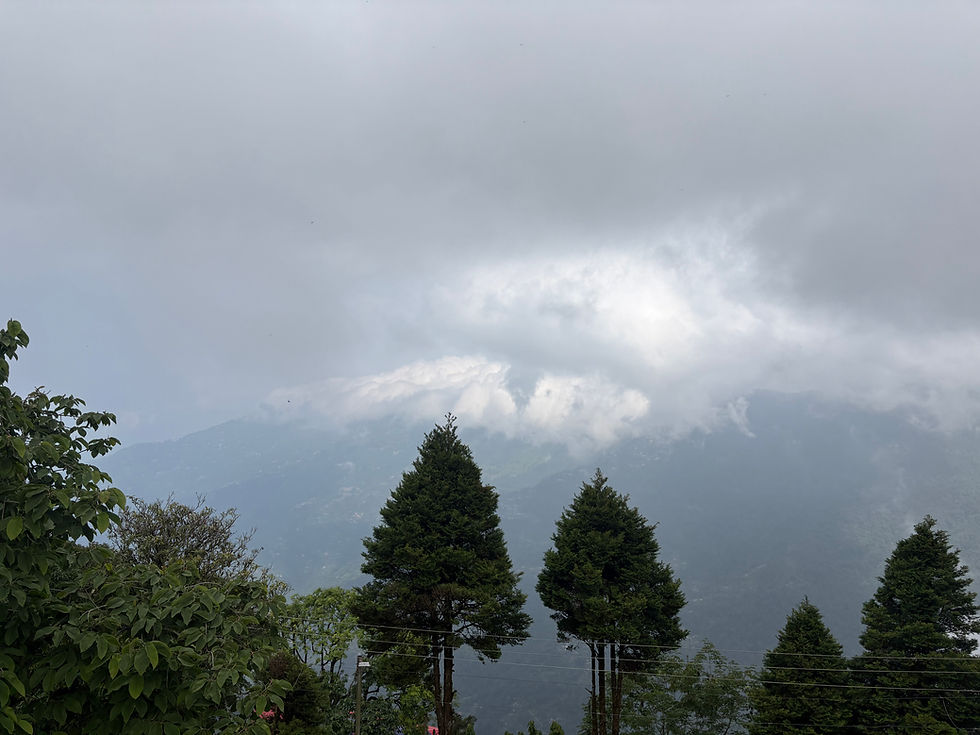
The Lepchas believe that after death, the soul returns to Kanchenjunga—the place from which it first came. Whether or not such stories are true, they gladden the heart. Perhaps those we have loved and lost are there still, hidden behind the clouds that veil the mountains in the above picture.
Kanchenjunga and its ever-shifting mists lend Darjeeling a mystical, spiritual quality despite the degradations of poor governance that now benight the town. So what makes a place sacred?
In Kipling's The Bridge Builders, Chief Engineer Findlayson, after three gruelling years, stands on the precipice of his career's crowning achievement—the completion of the Kashi Bridge over the Ganges. The delicate equilibrium of the construction schedule is shattered by telegrams warning of massive, unseasonal floods upstream. To combat the creeping fever and mental paralysis brought on by the crisis, Findlayson accepts a dose of opium.
In the opium-induced trance, he witnesses a Panchayat of the Gods, in which Ganga Ma complains that her ancient waters have been trapped and humiliated by the engineers' iron shackles. While Kali boasts of unleashing devastating epidemics of smallpox and cholera upon the construction camps, Ganesha counters with a pragmatic defense of human ingenuity.
Krishna confronts the assembly with a chilling prophecy: mankind's deepest devotion is shifting away from the heavens and toward the tangible marvels of human achievement. Hanuman and Ganesh attempt to minimize the threat, arguing that they have watched humanity change the names of its deities a thousand times throughout history.
Indra resolves the debate by reminding the anxious council that all of existence—including the heavens, the hells, and humanity's inventions—endures only because Brahma continues to dream. As long as that cosmic dream persists, the old gods will mutate rather than die.
I can only add that, as long as Brahma continues to dream and Kanchenjunga keeps watch over the hills, Darjeeling will remain a sacred place.
Fortunately, Hindu tradition provides ample precedent for making offerings of alcohol. So, back at the hotel, before turning in for the night, I raised a toast to the sacredness of Kanchenjunga, the comfort of a hot toddy, and the joys of reading Kipling in Darjeeling.


Comments