The Shimla Mall: Part 1
Updated: May 11
This two-part essay draws on my four-day stay at the Mall in Shimla.

Mall Road stretches about three kilometers, from the Vidhan Sabha in the west to the Marina Hotel in the east. This essay is centered on the busy one-kilometer tourist stretch popularly known as the “Mall.”
The layout of the Mall can be confusing. It unfolds across three levels: the Ridge at the top, followed by the Upper Mall, then the Lower Mall. Lakkar Bazaar and Kali Bari Road form a higher fourth tier. Together, these make up what is commonly experienced as a “Mall Road” excursion, though strictly speaking only the Upper Mall is the Mall Road. For most visitors, the Upper Mall and the Ridge form the bare minimum of a visit. In the first part of this two-part essay, I trace my walk along the Upper Mall and conclude with an exploration of the Ridge.
In his 1904 book Simla, Past and Present, Edward John Buck writes of a past era :
"in many parts of the Mall only two horses could go abreast, and this not without some danger to the riders, as in early day ponies were generally unruly, squealing beasts, always ready to kick or bite"
If Buck thought the ponies of yore were unruly, he clearly never met the modern Indian driver. The Government, in a wise decision, has pedestrianized the tourist stretch of the Mall. The walk described in this essay is eastward from the western boundary (see picture below) of the pedestrianized segment:

To appreciate a visit to Shimla more fully, a brief historical background helps.
The formal association of the British state with this region began in 1815, when their army defeated the Gurkhas, who had ruled the area for over a decade. After the victory, the British restored most Gurkha-held territories to the hill chiefs who had allied with them. They retained some lands belonging to princely states that had offered no material assistance; these escheated lands were sold to the Maharaja of Patiala to partly defray the costs of the Gurkha campaign. The association of the Patiala royal family with Shimla dates to this moment.
By the 1820s, European civilians had begun settling here to escape the heat and epidemics of the plains. Hence, in 1830, the British negotiated a land exchange with Raja Sansar Sen, chief of the Keonthal princely state, and Karam Singh, the Maharaja of Patiala, shaping the modern hill station of Shimla. The name itself came from a village whose land was subsumed within the municipal area.
The exchange was overseen by Charles Pratt Kennedy, the East India Company’s liaison with the region’s princely states—some twenty-seven in number, with names like Nalagarh, Jubbal, and Baghal, surrounding Shimla. The Kennedy name appears often in Shimla, confusing first-time visitors who assume an American association. Kennedy’s home (pictured below), built circa 1820, is considered the first pucca house in Shimla:

Image: drawn by Major J. Luard in 1825, Printed by Graf & Soret in 1833
Source: Wikimedia Commons
By the time of the Sepoy Mutiny, Shimla, like many hill stations, had become a popular sanitarium for sick and injured soldiers of the British army.

Image: Wounded Officers at Simla in 1857, from the book 'The Campaign in India, 1857-8', published 1859
Source: Wikimedia Commons
In 1864, Shimla was designated the summer capital of British India; the Punjab Government followed in 1871. Shimla is thus a contrived capital city, akin to Brasília, Islamabad, and Canberra.
The British spelled the city “Simla,” though it was always pronounced Shimla in Hindi. The spelling was officially changed in 1972, when Himachal Pradesh became a state, yet the city’s character remains overwhelmingly British.
The CTO Building
I walked west to east along Mall Road. The first structure marking the western edge of the pedestrianized zone is the Central Telegraph Office (CTO) building:

The building, designed by the Scottish architect Scott Begg, was completed in 1922. It replaced an earlier structure found too small to meet the demands of this rapidly expanding technology.

Image: Old Simla Telegraph Office
Source: Wikimedia Commons
The CTO building is now occupied by Bharat Sanchar Nigam Limited (BSNL), India’s government-owned telecom provider.
On May 11, 1857, an eighteen-year-old signaller, William Brendish, sent a message from the Delhi Telegraph Office: “We must leave office. All the bungalows are being burnt down by the Sepoys from Meerut. They came in this morning... We are off.” Robert Montgomery, a British administrator, later remarked, “The electric telegraph has saved India.”
Communications technology was essential to European colonialism. Earlier empires relied on the loyalty of vassals, but to govern a realm so vast that one could say “the sun never sets on the British Empire,” rapid communication was a decisive advantage. The commercial inauguration of the electric telegraph in 1844—marked by the message “What hath God wrought?” sent in Morse code over insulated copper wires—was a game-changer. In the age of empire, the answer to that question lay in the quiet acceleration of colonial extraction.
While by mid-1850s British India was crisscrossed with thousands of miles of telegraph wire, the Sepoy Mutiny led to near instantaneous link between the subcontinent and Whitehall through undersea cables. By the time the CTO was constructed, technology that enabled communication over radio waves instead of wires had been introduced in British India.
Those of a certain vintage remember that the telegram was a harbinger of bad news. Telegrams were expensive and charged by the word; brevity was essential. A famous Raj-era dispatch is the one-word telegram “Peccavi.” As the story goes, Charles Napier sent it in 1841 after conquering Sindh. In Latin, peccavi means “I have sinned.” The pun carried extra bite because Napier’s annexation of Sindh was morally and legally questionable. His pithy “Peccavi” would also have made economic sense—though, having just annexed a province, economizing on the telegram budget is a case of being “penny wise, pound wise.”
Delicious as the Napier story is, it is almost certainly apocryphal: the first telegraph line in India was established only in 1851, a decade after the Sindh campaign.
While the CTO building may not be as grand as some other colonial-era structures in Shimla, its green-and-red palette and mix of rectangular and arched windows are striking. You can see the rear of the building from Kali Bari Road:

On July 14, 2013, Indians rushed to Central Telegraph Offices across the country to send messages to their loved ones. The last message of the day from the Shimla CTO was sent by Bala Dogra to her son Anshul: “Tearful farewell to the telegram, which had done splendid service to human beings for the last 163 years.” BSNL had announced the closure of the telegram service that day.
The Scandal Point
As you walk along Mall Road, you encounter public art scattered across the street:

The artwork above, titled The Dancing Couple, was installed in 2017 and is the work of sculptor Homi Chatterjee. Its ballroom scene evokes a Jane Austen–like vision of nineteenth-century social life among British expatriates. Many colorful personalities graced the drawing rooms of colonial-era Shimla.
In the summer of 1839, one visitor caused a stir with her beauty and went on to become a notorious seductress, embroiled in scandals across Europe and America: Lola Montez, widely believed to have inspired Irene Adler in the Sherlock Holmes stories.
A less glamorous but equally celebrated summer guest was Helena Blavatsky, who claimed psychic powers. In Simla, Past and Present, Edward John Buck recounts two such feats. At a dinner party, when a hostess mentioned a brooch lost a year earlier, Blavatsky led guests into the garden, indicated a spot beneath a bush, and—remarkably—the brooch was found there. On another occasion, at a picnic short of a teacup, she “found” a matching one buried under another bush.
Shimla though, on the whole, was not a great place for her because the British were sceptic. She was better off hobnobbing with the natives. After all what is occult to Europeans is treated as an everyday possibility in India.
Walking along, one passes the Jankidas Building, which once housed the Jankidas Departmental Store:

The Jankidas store is part of a set of six shops, beginning with the India Coffee House, that together form Northbrook Terrace:

Northbrook Terrace marked the first cluster of shops on the Upper Mall. According to Edward John Buck, the site once housed the primary place of worship for the British until Christ Church was consecrated in 1857.
Notice the storefront roofs above: you will see gables—triangular structures—some topped with small steeples. This is a common architectural feature along the Mall, and some of these gables contain attic windows:

Archimedes said "Don't disturb my circles". The colonial architects of the Shimla Mall might well have replied, “Don’t disturb my triangles.”:

Some more triangles pictured below:

Beyond the geometric aesthetic, the sloping structures serve the functional purpose of allowing rain and snow to drain down them.
I stopped by the Indian Coffee House for a snack. It is a run-down 1950s-era café where waiters still wear livery:

The Indian Coffee House chain differs from Starbucks and Barista in being owned by a workers’ cooperative. Its run-down look traces back to its origins as a government-run enterprise. The British Raj predecessor of the Coffee Board of India—a state agency tasked with promoting Indian coffee—opened the first outlet in 1936 to dispose of surplus beans. As exports rose after the Second World War, the Coffee Board began shutting these cafés in the 1950s. A. K. Gopalan, a member of the first Lok Sabha (1952), then organized the workers into cooperatives that took over the surviving outlets.
It is curious that a colonial government would open coffee houses, given their reputation for fomenting dissent. On July 12, 1789, Camille Desmoulins leapt onto a table at the Café de Foy in Paris and delivered a speech that ignited a crowd which stormed Bastille two days later. Quite wisely, Sanjay Gandhi, Indira Gandhi's gangster son, bulldozed the Indian Coffee House at Connaught Place during the Emergency.
Beyond the grand anchor buildings, the storefronts are the main attraction of Mall Road. Some retain traces of their antecedents. For instance, the inscription on the store below likely alludes to the British merchant for whom it was originally built:

Some, like the custom-designed footwear store pictured below, seem to defy the passage of time with their implausible business models:

Another store bucking the Kindle era is Maria Brothers:

In the 19th century, the Mall featured the store of a jeweler named Alexander Jacob, on whom Rudyard Kipling based the character of Lurgan Sahib in Kim. According to Wikipedia, Jacob was sold into slavery at the age of ten, educated by a pasha, embraced Islam, and moved through many cities before establishing himself in Shimla in the 1870s as a dealer in gemstones and curios.
His biographer, John Zubrzycki—who questions Jacob’s account of his origins and suggests he was a Syrian Christian born in what is now Turkey—writes that it was once said that to visit Shimla without seeing Jacob was like going to India without seeing the Taj Mahal.
Jacob was involved in the sensational Imperial Diamond Case of 1891, centred on the ill-fated sale of the “Imperial” Diamond to the sixth Nizam of Hyderabad. The diamond—valued in 2008 at £100 million—was mined in Africa and sold to a syndicate in Amsterdam. Jacob mediated the deal between the syndicate’s London agent and the Nizam. The transaction faltered when the Nizam declared the gem napasand upon delivery and demanded the return of his advance.
Because Jacob had already used the funds to secure the diamond, he could not refund the money, leading to a high-profile criminal trial for fraud and misappropriation in the Calcutta High Court. Although he was ultimately acquitted, the legal costs and the ruin of his reputation bankrupted him.
The Nizam retained the diamond in an out-of-court settlement with the ruined jeweler. It was later used as a paperweight by his heir. The Government of India eventually acquired the gem, now kept in a vault at the Reserve Bank of India and displayed on special occasions at the Salar Jung Museum. While Alexander Malcolm Jacob died in obscurity, the gem now bears his name—the Jacob Diamond—and is far larger than the more famous Koh-i-Noor.
Incidentally, Jacob, like Helena Blavatsky, claimed mystical powers. The two met in Shimla and, apparently, did not get along—perhaps neither could quite see eye to third eye.
Walking along the Mall feels like sauntering through an open-air gallery. Several murals along the route, sculpted by M. C. Saxena, share a distinctive style and evoke themes from local hill culture:

The relief pictured above, The Pashmina Lady, is displayed without any accompanying description—surprising, given the tender care with which the Himachal government maintains the area. Perhaps the intent is to invite closer looking, to let viewers decipher its meaning for themselves. Seen up close, the Pashmina Lady reveals four figures:

The woman on the far left appears to hold a spindle used to spin the raw fibre shed by goats into yarn. On the far right, another woman seems to be cleaning the wool, assisted by her daughter. The young boy with a flute evokes the pastoral shepherd culture of the hills. The grouping—two adults and two children—suggests the intergenerational transfer of skills.
Apart from reliefs, the Mall also features numerous wall paintings, like the one below:

According to Edward Buck, Barrett & Co. are likely to have been the first European merchants in Simla, supplying nearly everything Europeans needed. This included beef—once restricted due to local religious sensitivities but increasingly tolerated in practice so long as it was done discreetly. Beyond food, the firm also catered to social life, offering a library, reading room, newspapers, and even billiard tables, making it central to early European life in the town.
Walking on from Northbrook Terrace, one arrives at Scandal Point—the junction where the Ridge meets the Mall Road:

The 1903 photograph below is taken from the same spot as the one above. The prominent building on the extreme right, with its multiple conical roofs, is the General Post Office (more on that later):

Source: Library of Congress
The name Scandal Point is often linked to a dramatic—though likely apocryphal—story involving the Maharaja of Patiala. To place this in context, after the decline of the Mughal Empire, eighteenth-century Punjab was divided among rival factions, including twelve Sikh confederacies. The princely state of Patiala belonged to one of these confederacies.
The most prominent of these groups was the Sukerchakia Confederacy that counted Maharaja Ranjit Singh as a member. He gained fame after defeating the Afghans who had invaded territories falling under the Sukerchakias at the Battle of Amritsar in 1798. After capturing Lahore from a rival Sikh confederacy, he declared himself the Maharaja of Punjab in 1801 and went on an expansionary spree annexing rival Sikh factions. In 1806, he signed the Treaty of Amritsar (1806) with the East India Company, agreeing to remain east of the Sutlej, while Patiala—aligned with the British—lay to the west.
The Patiala family’s connection with Shimla began, as mentioned previously, in 1815 when land in the area was sold to Karam Singh. The “scandal” itself is attributed to his descendant, Maharaja Bhupinder Singh. According to the popular lore, he eloped with the Viceroy’s daughter, with Scandal Point serving as their rendezvous place. The British supposedly banned him from Shimla, prompting him to establish his summer capital at Chail.
However, the story does not hold up well. It is dated to 1892, when Bhupinder Singh was only one year old, suggesting that—if anything occurred—it may have involved his father, Maharaja Rajindra Singh, who incidentally had a foreign wife but even she was Irish and certainly not a Viceroy's daughter.
There are more prosaic explanations. According to one account, “Scandal Point” first appeared as a metaphorical reference to a character’s home in Kipling'sThe Education of Otis Yeere set in Shimla. The elopement story may well be a later invention—an entertaining backstory built upon the subliminal association between “Scandal Point” and Shimla that Kipling’s story had already established.
Scandal Point is also home to a statue of Lala Lajpat Rai:

Lala Lajpat Rai died in Lahore on November 17, 1928, from injuries sustained during a police lathi charge on a peaceful protest against the Simon Commission. The assault, led by Superintendent James A. Scott, left him critically wounded; he died eighteen days later, though the British disputed the link between the assault and his death.
A statue of Rai was installed in Lahore in 1930. After Partition, as Hindus fled the city, Congress workers removed the statue, brought it to India by train, and reinstalled it at Scandal Point in 1948.
There is a well-known epilogue to Lala Lajpat Rai's death. Bhagat Singh, Shivaram Rajguru, Sukhdev Thapar, and Chandrashekhar Azad set out to kill Scott but, in a case of mistaken identity, shot John Saunders instead. The bullet was misdirected, but the message was delivered!
Some historians contend that Udham Singh’s 1940 assassination of Michael O'Dwyer—twenty-one years after the Jallianwala Bagh massacre—may have been a case of mistaken identity too. The officer who ordered the shooting was Reginald Dyer. O’Dwyer, the Lieutenant-Governor of the Punjab, though not present at the scene, had defended Dyer’s actions later. There is some evidence that Singh may have conflated the two Irishmen. The moral, perhaps, is that a state intent on questionable acts should begin by ensuring its officials’ names are not easily confused.
From Scandal Point, you can see the General Post Office (GPO), though when I visited it was under renovation, hidden behind scaffolding and covers. Hence, the image below is sourced from the web:

The building, completed in 1883, originally featured a green-and-white palette with a red roof (see picture below). In 2009, it was repainted red and white to align with India Post branding:

In 1854, the British organized the postal system as an Imperial Department. Until then, India’s postal network had been fragmented: communication between major administrative centres was handled centrally, while District Magistrates oversaw routes linking district headquarters with the hinterland.
The Post Office Act of 1854 introduced two innovations—postage stamps and distance-agnostic rates. More importantly, it transformed the postal service from an instrument of administrative and military communication into a mass-market utility.
Geoffrey Clarke, an ICS officer, published a history of the Indian Postal Service in 1920. His book is an engaging read—provided you are not easily triggered by condescending racism.
He writes "Postal runners are largely drawn from the less civilized races of India, many of whom are animists by religion. They will face wild beasts and wandering criminals, but will go miles to avoid an evil spirit in a tree. With them the mail bag is a kind of fetish which must be protected and got to its destination at all costs."
Clarke also notes, with some ruefulness, that “there is an idea that a letter on which postage has to be collected is much more certain to reach its destination than a prepaid one.” Recipients, it seems, would read unpaid postcards and return them as refused; the government eventually abolished post-paid postcards for this reason. If empire ran on extraction, the postpaid postcard became a tiny site of restitution.
In India, even a postman’s job could be perilous. Clarke recounts a runner who, aware that a man-eating tiger prowled his route, carried the mail anyway and was killed en route. The Audit Office objected to granting his family a gratuity, arguing that he had merely died performing his routine duty, not in any “special” act of bravery. The auditors, in this case, were mercifully overruled.
More recently, the Shimla Post Office has piloted drone delivery of mail in remote hilly areas. Clearly, there has been progress!
In 2010, India Post issued six commemorative stamps celebrating heritage GPO buildings in Lucknow, Cooch Behar, Nagpur, Udhagamandalam, Delhi, and Shimla.

Source: Wikimedia Commons
Another striking building at Scandal Point is the Bank House, in operation since 1877:

I envied the employees who work in such a beautiful building in so charming a setting. How do they get any work done!
Here I must put in a word for the Shimla Municipality. The Mall and its surroundings are sparkling clean. Though I visited in the off-season in April, it was still quite crowded. The city is easily accessible from Chandigarh: the drive takes under three hours, much of it on a four-lane highway, with the treacherous mountain stretch limited to the last twenty kilometers. It is to the local government’s credit that such cleanliness has been maintained despite this easy access.

The Town Hall
A few steps from Scandal Point stands the majestic Town Hall:
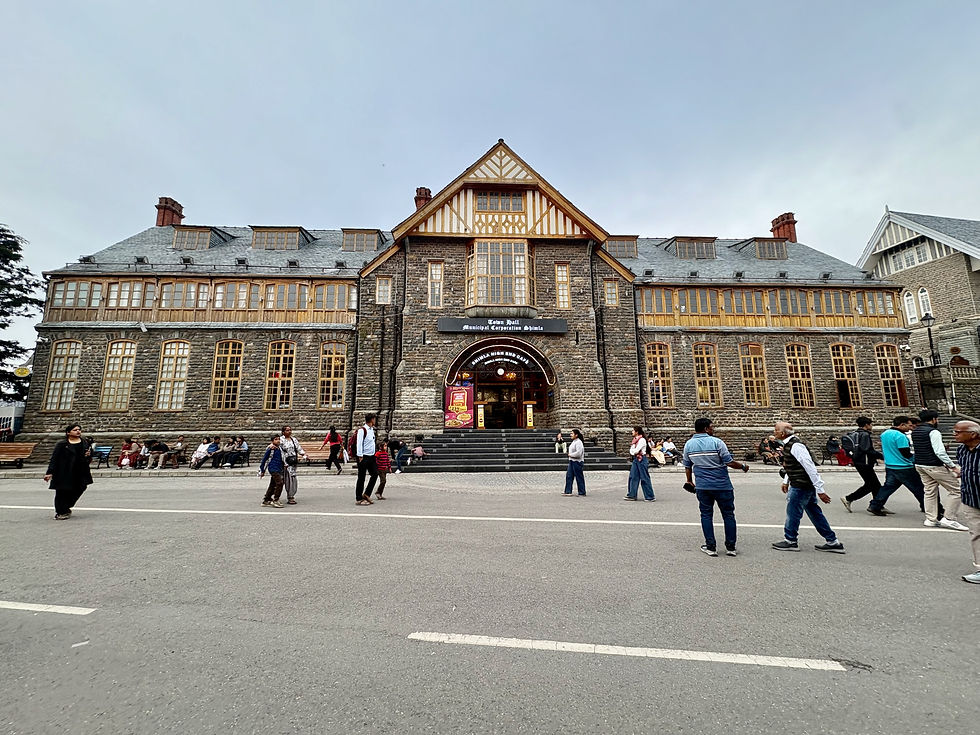
Though now called the “Town Hall,” the British knew it simply as the “Municipal Building.” Built in 1908 as a library, it was soon taken over by the Simla Municipality for office use. In the British Raj, a Town Hall referred to a larger, multipurpose civic building used for administration, public meetings, social gatherings, and ceremonial events. This structure bears the name because it stands on the site of the original Town Hall.
The original Town Hall, built in 1887, offered the amenities of an English club—rooms for cards and billiards, a library, a reading room, and a ballroom. The adjacent Gaiety Theater and Police Assistance Room formed part of the same complex.

Image: The Old Town Hall
Source: Wikimedia Commons
The picture below, dated 1903, offers a bird’s-eye view of the old Town Hall from the General Post Office:

Source: Library of Congress
A cherished annual event at the Town Hall was the ball hosted by the Freemasons.
The group began in the Middle Ages as guilds of stonemasons who built Europe’s cathedrals and castles. They used secret signs and passwords to prove their skill and protect trade secrets while traveling for work.
The term “lodge” carries a dual meaning: it refers both to a local chapter of the Freemasons and to the physical space where they meet. By the late 1600s, as demand for grand cathedrals waned, lodges began admitting “gentlemen” who were not builders. These members reinterpreted the tools of the trade—the square, compass, and level—as metaphors for building character rather than structures.
India’s first lodge was established in 1729 in Calcutta. The Masonic Lodge Himalayan Brotherhood was founded in Shimla in 1838. Edward Buck quotes a Brother recalling a celebratory parade in 1839:
“The natives and others thronged in numbers to witness it; some called us ‘Jagoodurs,’ or magicians, while others, with equal wisdom and sagacity, said we must have dealings with the devil.”
The Himalayan Brotherhood occupied several buildings before settling in a basement room of the old Town Hall, where it remained for over two decades until the building’s demolition. Interestingly, the site of the Masonic Lodge (1846–1855) later became the headquarters (pictured below) of the Commander-in-Chief of the Indian Army in 1885. The building now houses the headquarters of Army Training Command (ARTRAC), the Indian Army’s think tank, and stands diagonally opposite the CTO by the lower Mall.

Fans of Sherlock Holmes stories will find Shimla’s Masonic associations thrilling. Arthur Conan Doyle was himself a Freemason. Most famously, in The Red-Headed League, Holmes identifies Jabez Wilson as a Freemason within moments of meeting him. When Wilson asks how, Holmes points to his “arc-and-compass breastpin,” noting it is worn “rather against the strict rules of your order.” In The Adventure of the Norwood Builder, Holmes similarly identifies John Hector McFarlane as a Freemason by noticing a Masonic watch-charm.

Image: Jabez Wilson in Strand Magazine
Source: Wikimedia Commons
The Town Hall embodied the social life of the hill station. In Magic Mountains: Hill Stations and the British Raj, Dane Kennedy describes hill stations as “places where the British went to play… the colonial equivalents of Bath or Brighton, cliquish resorts where rakish officers, vampish ladies, ambitious bureaucrats, and bored housewives engaged in endless parties and gossip.”
Yet the amusements of hill-station life were not for everyone. As Emma, the heroine of Jane Austen's eponymous novel, observes, one half of the world cannot understand the pleasures of the other. Its gossamer glitter held little charm for some. In Simla, Past and Present, Edward John Buck quotes the wife of Viceroy John Lawrence, who, on returning to Calcutta, wrote: “The perpetual round of gaieties, both here and in Simla, though we tried to vary them with Shakespeare readings and tableaux, was trying to us both.”
That hedonistic social rhythm was briefly interrupted in the summer of 1857, when the Sepoy Mutiny broke out. Buck notes that British residents, gripped by panic, left Shimla for a few weeks, taking refuge with hill chiefs, in military barracks, and in homes deeper in the hills. Their fears proved unfounded; Shimla remained free of violence.
By the turn of the century, the Town Hall had fallen into disrepair. The entire building—except the Gaiety Theater—was demolished and replaced by the present structure. Today, after a recent renovation, parts of it house a food court, perhaps one of the most beautiful fast-food settings in the world.

It is also worth seeing the Town Hall in the night:

The rear façade of the Town Hall, seen from the Ridge at night, is mesmerizing:

Right next to the Town Hall stands the Police Assistance Room, established in 1887 and still in use—its services often needed to “manage” inebriated tourists on the Mall:

The sculpture Duty with Love stands just outside the Police Assistance Room:
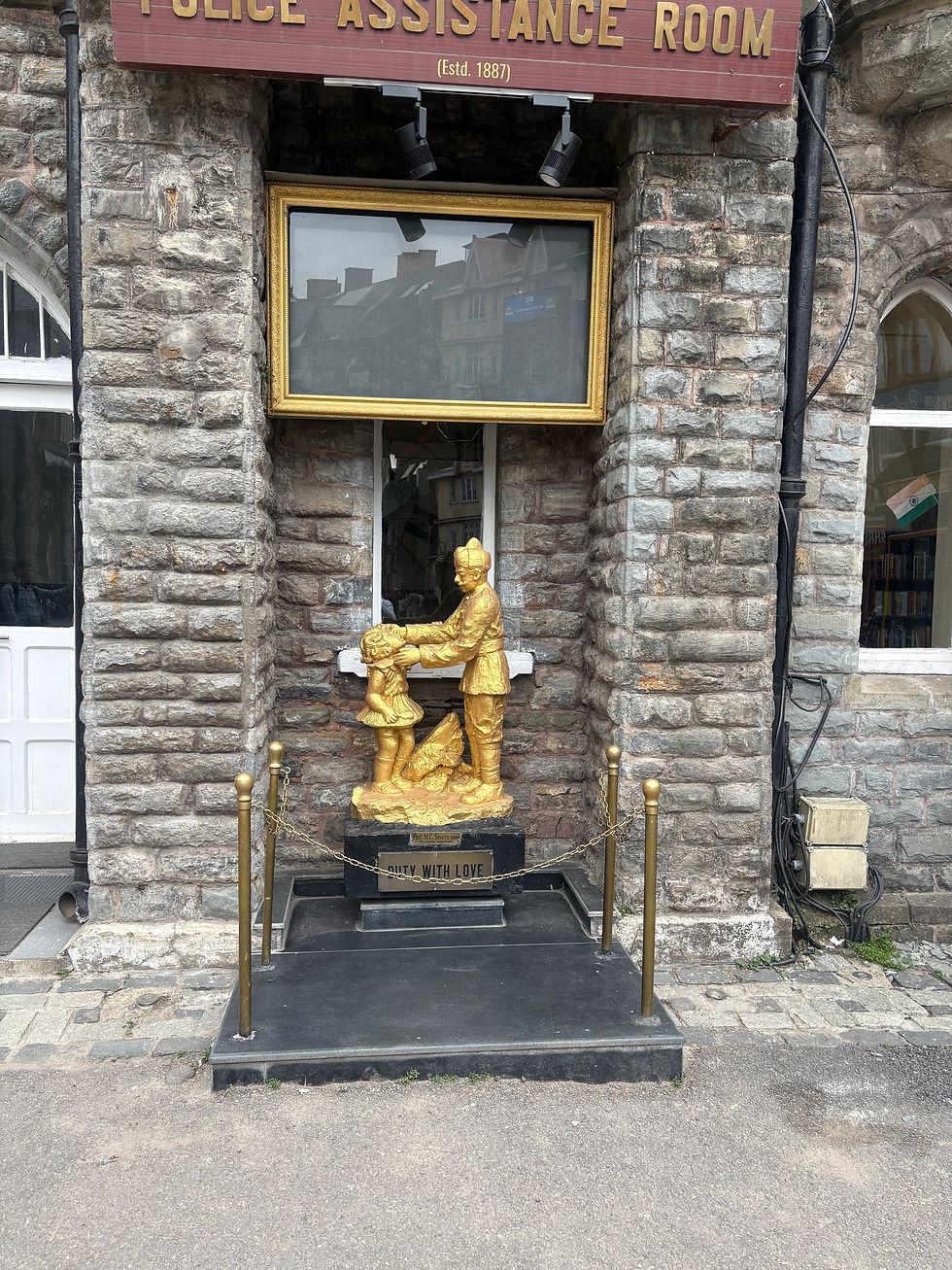
The artwork is aesthetically distinct from M.C. Saxena’s other works on the Mall, which share a black metallic finish. However, even that appearance may not reflect the original aesthetic, as the artist complained in 2017 that renovations had altered his intended look.
The sculpture commemorates the Shimla Agreement. Shimla has also been the site of two earlier war-related moments of consequence: the Simla Manifesto of 1838 and the Simla Convention of 1914.
The 1972 agreement, signed by Indira Gandhi and Zulfikar Ali Bhutto, marked the end of war. The Simla Manifesto, issued on October 1, 1838, by Lord Auckland, served as the British Empire’s justification for launching the First Anglo-Afghan War.
British strategists feared that Russian control of Afghanistan would open a direct route into India. This rivalry led to three major conflicts, collectively known as the Anglo-Afghan Wars. The manifesto declared Dost Mohammad Khan—seen as too close to Russia—unfit to rule, and proposed replacing him with the exiled Shah Shuja Durrani. The British initially captured Kabul and installed Shah Shuja, but the occupation proved deeply unpopular. Uprisings followed, culminating in the catastrophic retreat of 1842, which reinforced Afghanistan’s reputation as the “graveyard of empires.”
An interesting aside: the Second Anglo-Afghan War included an army surgeon wounded at the Battle of Maiwand, forcing him back to London. His name was Dr. John Watson, the beloved sidekick to Sherlock Holmes!
The political reverberations of these conflicts, and of the Sikh confederacies mentioned earlier, persist. Ranjit Singh reversed centuries of Afghan incursions into Punjab and Delhi, capturing territories such as Multan (1818) and Peshawar (1834). When the British annexed Punjab from the Sikhs in 1849, these lands became part of British India. The Durand Line they later drew largely followed territories Ranjit Singh had already taken from the Afghans.
Today, the Tehrik-i-Taliban Pakistan rejects the Durand Line, arguing that it fractures the unity of Pashtun tribes and contesting Pakistan’s control over Khyber Pakhtunkhwa. Those less inclined toward political history can still encounter the region sensorially—at the Bukhara in Delhi which serves a refined version of the campfire cooking of the tribal belt along that frontier.
The second major geopolitical event in Shimla was the Simla Convention of 1914, whose most enduring outcome was the McMahon Line. Although a draft was initialled by China, India, and Tibet, China did not sign the final agreement. It continues to reject both the accord and the McMahon Line, arguing that Tibet lacked treaty-making authority—a stance that underpins its claim over Arunachal Pradesh as “South Tibet.”
Viewed in totality, Shimla emerges as an unlikely cartographic crucible—its name tied to three boundary-making moments: the Durand Line (foreshadowed in 1838), the McMahon Line (drawn in 1914), and the Radcliffe Line (reframed in 1972). Shimla’s quiet deliberations have had a noisy afterlife—in the enduring frictions of Afghanistan–Pakistan, India–Pakistan, and India–China.
While the front of the Police Assistance Room overlooks Scandal Point, the side façade pictured below faces the Mall:

At the corner between the Town Hall and the Police Control Room is a mural popular with the Instagram crowd:

The mural depicts people performing a local Himachali dance, while the man on the far left blows a traditional trumpet. Unlike classical dance, which prioritizes technique, folk dance emphasizes ease and collective expression. Many such dances are tied to seasons and the agricultural cycle—for instance, Bhangra begins with the sowing of wheat and culminates in the Baisakhi.
In the final scene of Seven Samurai, farmers joyfully plant rice, accompanied by music, singing, and dance, while the three surviving samurai look on. Their lives embody two contrasting paradigms. The farmers live cyclically: with the paddy season they sow, nurture, and harvest, then move with equal reverence to the next crop, repeating the rhythm. The samurai, like the corporate warrior, follow Joseph Campbell’s linear “hero’s journey.”
Our encounter with local culture while travelling in India resembles the samurai’s gaze upon the farmers: we observe as spectators, without inhabiting the emotions of a different way of life.
Gaiety Theater
Right next to the Police Control Room on the Mall Road is the 1887 built Gaiety Theater:

The rear façade of the theatre can be seen from the Ridge:

The Gaiety Theater houses multiple halls, including an art gallery and a bookstore. The main performance hall can be accessed for a very modest fee:

The boxes along the sides were often occupied by Maharajas and Viceroys. According to Edward John Buck, the first play staged at the Gaiety on May 30, 1887, was Time Will Tell. The performance was preceded by the recitation of the following lines:
No fool should thus his time in suffering waste.
The stage here offers an amusement chaste,
Which in its proper use, may surely try
To help the lessons of the Church close by.
So let us strive each other to excel,
Shall we succeed or not ? Why—
Time will tell.
If you are into this kind of thing, you can get a picture of yourself on the stage. I, for one, was content to stand on a stage where Rudyard Kipling is said to have once performed:

The gilded panels throughout the theatre are made of papier-mâché. Inside, take a moment to notice the pillars with their gilded capitals:

All the theatre’s design elements remain as they were in 1887.
Leaving the Gaiety Theatre, I continued my eastward walk, taking in the artwork along the Mall:

The wall art below is M. C. Saxena’s Gaddi:

The women on either side are plucking tea leaves while the boy in the middle is a Gaddi shepherd. The Gaddis are a pastoral tribe who travel with their goats and sheep from the plains to the hills in the summer and make the reverse trek in the winter. You can see some extraordinary pictures of them in this link.
The Gaddis are followers of Shiva. In Gods, Guns and Missionaries, Manu Pillai describes how Indo-Aryan Brahmins, in their bid to evangelise the Vedic faith, co-opted local practices and myths. Like any clergy, they sought to advance their theology; yet, unlike the later evangelists of Islam and Christianity—often backed by military and political power—the Brahmins relied largely on persuasion.
Pillai notes that Aryan Brahmins frequently forged connections between local deities to the evolving Hindu pantheon. He cites the Chenchu tribe of Andhra, incorporated into the Brahmanical narrative through a myth describing the union of a Vishnu avatar with a Chenchu woman. Another example is the myth of Parashurama, devised to explain the matrilineal societies Vedic Brahmins encountered in Kerala: in this telling, Parashurama urges his followers to pass land to their sisters’ sons rather than their own, as penance for killing his mother at his father’s command over alleged adultery.
The Gaddis’ association with Shiva reflects the same dynamic. Their migration also illustrates what Pillai, drawing on Diana Eck, calls “sacred geography”—the idea that the landscape is not merely a set of political borders or physical features, but a dense, living network of myths, memories, and meaning.
Gaddi folklore holds that Shiva undergoes a seasonal migration that sets the rhythm of the universe. From Maha Shivaratri (late winter) to Janmashtami (late summer), he resides in the high peaks; on Janmashtami, he is believed to depart for the lower realms or plains.
In reality, the Gaddis’ migratory pattern follows seasonal cycles—no different, in essence, from the annual movement of British officials between Simla and Calcutta. Yet such stories lends transcendence to the mundane, allowing people to see their lives as part of something larger.
Lest I sound condescending, the modern creed of self-optimization—where every hour must be leveraged, every habit engineered, and every metric improved—functions no differently: it recasts ordinary cycles of effort and rest as a moral imperative, as if an invisible order were demanding perpetual ascent.
The Gaddi explanation of migration, set against its “practical” cause, points to the enduring tension between mythos and logos. Mythos offers meaning through story and ritual; logos privileges reason and evidence. Returning to India after two decades in the United States, I notice how strongly mythos still animates daily life, often coexisting with logos in curious ways. I once saw the security guard in my building chase a monkey with a stick while addressing it as “Hanuman ji.”
The tourism department has done a commendable job of providing seating along the road. During the day, I often saw senior citizens pausing on the benches to rest from the strain of walking uphill:

Walking further east along the Mall, you will see the Khadi store on your right:
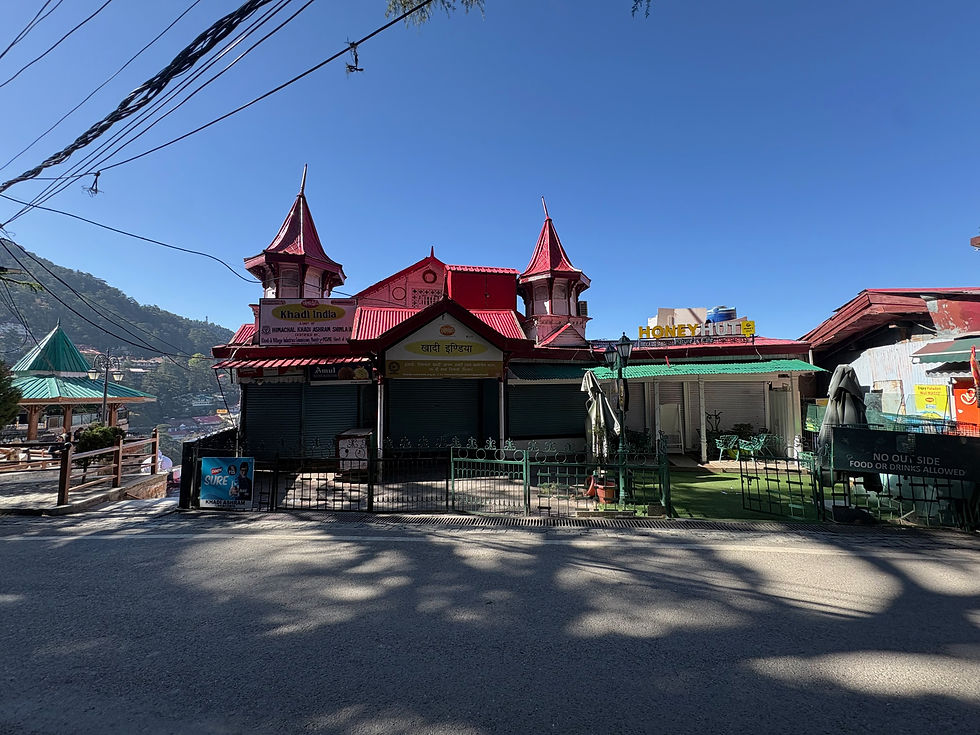
The Khadi store was once a residence gifted to the Indian nationalist movement, and it housed a printing press used to publish what the British would have deemed “seditious” material.
One of the small pleasures of walking along the Mall is watching local senior citizens in their Himachali topi. I wore one myself—what I hope was a harmless bit of cultural appropriation:

The M. C. Saxena sculpture Swarnim Himachal, pictured below, commemorates fifty years of Himachal Pradesh’s statehood:

At the time of my visit in 2026, Jammu and Kashmir was a Union Territory, making Himachal Pradesh the northernmost “state” of India. From the vantage of the metros, it is easy to forget that India has nine hill states, in addition to Jammu and Kashmir.
For a brief period in the 1950s, Himachal was designated a Part C state. Under the original 1950 Constitution, states were grouped into four categories—Part A, B, C, and D—based on their administrative history under British rule. This system was replaced in 1956 by a simpler two-tier structure: states and Union Territories. Himachal, like most Part C states, became a Union Territory.
In 1966, the hilly regions of Punjab—including Kangra, Kullu, and Shimla—were merged into Himachal Pradesh, nearly doubling its size. Full statehood followed in 1971.
Swarnim Himachal celebrates statehood by portraying multiple facets of Himachali life:
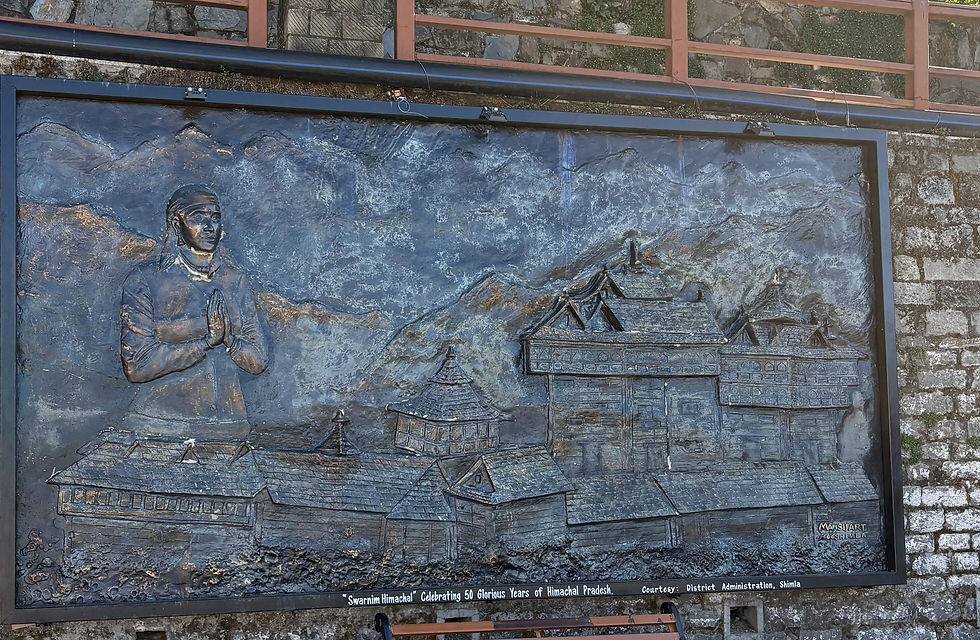
On the left, the mural shows a woman with her hands folded in a namaste gesture, wearing a dhatu (a traditional headscarf) and a heavy, buttoned jacket. The central and right sections depict single and tiered, multi-storey buildings with sloping slate roofs that shed rain and snow. Behind them rise jagged, overlapping mountain peaks. The conical rooftops, set against these peaks, evoke a quiet harmony with the landscape.
Right below the Khadi store is the Rotary Club of Shimla:

Walking further along, one encounters M. C. Saxena’s Apple Pickers installation:

While Himachal is now synonymous with apples, fruit cultivation in the state is relatively recent. Captain R. C. Lee of the British Army planted India’s first apple orchard in Kullu in 1870. In the mural, the woman on the left plucks apples from the trees, while the one on the right sorts them. Though many orchards now use grading machines, apples were traditionally sorted by eye into Grade A (large) and Grade B (small) and packed into wooden crates. The children in the middle seem content to skip the supply chain and move straight to consumption. The mural thus captures the three stages of picking, packing, and eating.
Another mural (pictured below), installed as part of the Golden Jubilee celebrations of Himachal’s statehood, is M. C. Saxena’s Dev Bhumi:

At the centre, the palanquin carries multiple mohras—ceremonial metal masks representing deities, from pan-Indian figures like Vishnu to local village gods. Designed for portability, these mohras are used in religious processions. The deities are sheltered beneath an ornate, tiered umbrella adorned with hanging bells. On the left, an attendant blows a narsingha, a long, curved S-shaped horn, announcing the deity’s arrival; beside him, a man beats a dhol. On the right, one figure performs aarti with a lamp, while another holds a ceremonial staff. All four men wear the Himachali cap.
The distinction between mythos and logos seeps into worship as well. Even for believers, devotion can take two forms: one in which the divine is felt as immediate and shared through lived ritual, and another in which it is held at a distance, approached with order and abstraction. In Dev Bhumi humans and gods move together in a rhythmic procession—an unmistakably mythos-driven vision. My own instinct leans toward logos: God remains at a remove, an altar-bound presence to be looked up to rather than walked alongside.
Walking further along, I passed the hotel where I was staying:

Many people come to the hills in search of tranquillity. I, however, prefer the juxtaposition of urban bustle and mountain scenery. Staying on the Mall was therefore an easy choice, especially given the city’s cleanliness.
Willow Banks is an excellent hotel, though not ideal for senior citizens, who may find the pedestrian-only Mall difficult to navigate. Even reaching the hotel requires a walk from the tourism lift. Inside, the bathrooms lack shower stalls, and the high bathtubs could pose a fall risk for the elderly or infirm.
The hotel also has an outdoor café and bar:

Despite the many monkeys around the Mall, you can sit undisturbed at the café and soak in the beautiful night views:

Hill station hotels in India often warn that open balcony doors invite monkeys. At Willow Banks, however, a room with a balcony is worth it. I spent hours there reading and sipping endless cups of masala chai:

At the café entrance is a gelateria:

The gelateria is housed in a mock-up of the Kalka–Shimla Railway, which began service in 1903 and is now a UNESCO World Heritage site.
The British decision to make Shimla the summer capital in 1864 was controversial, largely because of the difficulty of reaching it from the plains. Travelers had to disembark at Ambala and continue to Kalka, at the foot of the hills, by horse-drawn carriage. From there, they took a tonga—a two-wheeled cart drawn by a pair of ponies—to reach Shimla. Before 1856, when a cart road was built, men rode up on horseback, while women were carried by coolies in palanquins called jampans.

Image: Painting of Lady with a Parasol in a Jampan by Henry Ambrose Oldfield 1848
Source: Wikimedia Commons
The inauguration of passenger train services on November 9, 1903, marked a step change in accessibility.
Walking further along, past Willow Banks, you reach the rear of Clarkes Hotel:

The hotel, under renovation during my visit, was established in 1898 as the Carlton. In the 1920s, Ernest Clarke and Gertrude Clarke arrived as managers of the famed Cecil Hotel but aspired to run a property of their own, taking a lease on the Carlton. Impressed by the talent of an Indian employee at the Cecil, they entrusted him with managing the hotel.
When the Clarkes returned to England, they offered to sell him the property. He did not have the money, but they told him to pay when he could. In gratitude, he renamed the hotel Clarkes. That employee was Mohan Singh Oberoi, founder of the luxury hotel chain.

Image: Clarkes Hotel Front View
Source: Wikimedia Commons
Past the Clarkes Hotel on the left is the Day School at the Chalet:

During the Raj, it formed part of the United Services Club and was nicknamed the “henhouse,” as it was the only section of the club where male members could entertain ladies.
Branching off Mall Road and walking uphill toward Jakho, I stopped at the United Services Club—a private institution for “members of the service” (civil and military officers) that also offered residential quarters for out-of-state visitors:

Raaja Bhasin, in Shimla on Foot, writes that the boundaries of India and Pakistan were being worked out here in the run-up to Partition. He recounts the possibly apocryphal story of a draftsman who, drinking and mumbling through the night in one of the club’s residential quarters, drew the actual lines on the map— proof that occasionally geopolitics has been shaped less by grand strategy than by a well-stocked bar.
The climb was exhausting; I admire those who walk all the way up to the temple at Jakhoo. I returned to my hotel and called it a day.
Ridge
The high point of any Shimla visit is, of course, the Ridge, best accessed from Scandal Point—the intersection of the Ridge and the Mall:

At the Scandal Point intersection stands a somewhat dilapidated yet quaint building housing the Tourism Department:

The Ridge offers the most expansive views of the mountains around the Mall area:

As you walk up, you come upon the historic State Library building, which dates to 1860:

The entrance is on the building’s side façade:

On the day I visited, a parade was underway on the Ridge:

It is hard to imagine now, but the Ridge once hosted a bustling market—the Upper Bazaar—along with residential housing. A fire in 1876 destroyed much of it, after which the British redeveloped the area to their own taste.
Christ Church
The anchor building of the Ridge—and indeed of the Mall—is Christ Church:

The foundation stone of the church was laid in 1844, though it was not consecrated until 1857. Its nighttime glow is integral to the Shimla experience:

Walking into the building, I paused to absorb the atmosphere:

The stained glass windows depict the virtues of Faith, Hope, Charity, Fortitude, Patience, and Humility:

Reading the wall plaques inside is fascinating. Who were these people, and what were their lives like!

A photograph from 1902 offers a glimpse of British social life around the church:

Source: Library of Congress
Inside the church is a quaint annexe, likely housing the priests’ residential quarters and administrative offices:

It is worth taking a moment to admire the beautiful street lamps on the Ridge:

Summing Up
Max Weber coined the term Entzauberung (“disenchantment”) to describe the transition into the modern age. In an enchanted world, events—storms, harvests, illnesses—are understood as the work of spirits, gods, or cosmic purpose; life is a drama in which the individual participates. The disenchanted world, by contrast, is governed by rationality and calculation. The stretch of the Shimla Mall chronicled here—barely a kilometer—belongs unmistakably to Weber’s enchanted world.
Tourism in India is not for those seeking mere diversion; there are countless places better suited for that. But it rewards those willing to slow down and observe the mythos behind the logos. Incredible India indeed!
Click here for Part 2 of these Shimla Mall chronicles.


Comments