Reading Kipling in Darjeeling Part 3
This three-part essay series records my impressions of Darjeeling during a week-long stay. My mornings were spent on long solitary walks, followed by afternoons on the hotel terrace, reading Kipling while waiting for a sighting of the elusive Kanchenjunga.
In Part 1 I took a chukker around Observatory Hill and in Part 2, I walked from the Windamere Hotel, where I was staying, to the Town Hall. I conclude the series with a long, meandering walk from the Windamere to the Old Cemetery.

Old Post Office
I started from the Windamere and reached the Town Hall by the route described in the previous post. With the Town Hall on my left, I continued along Laden La Road (pictured below):
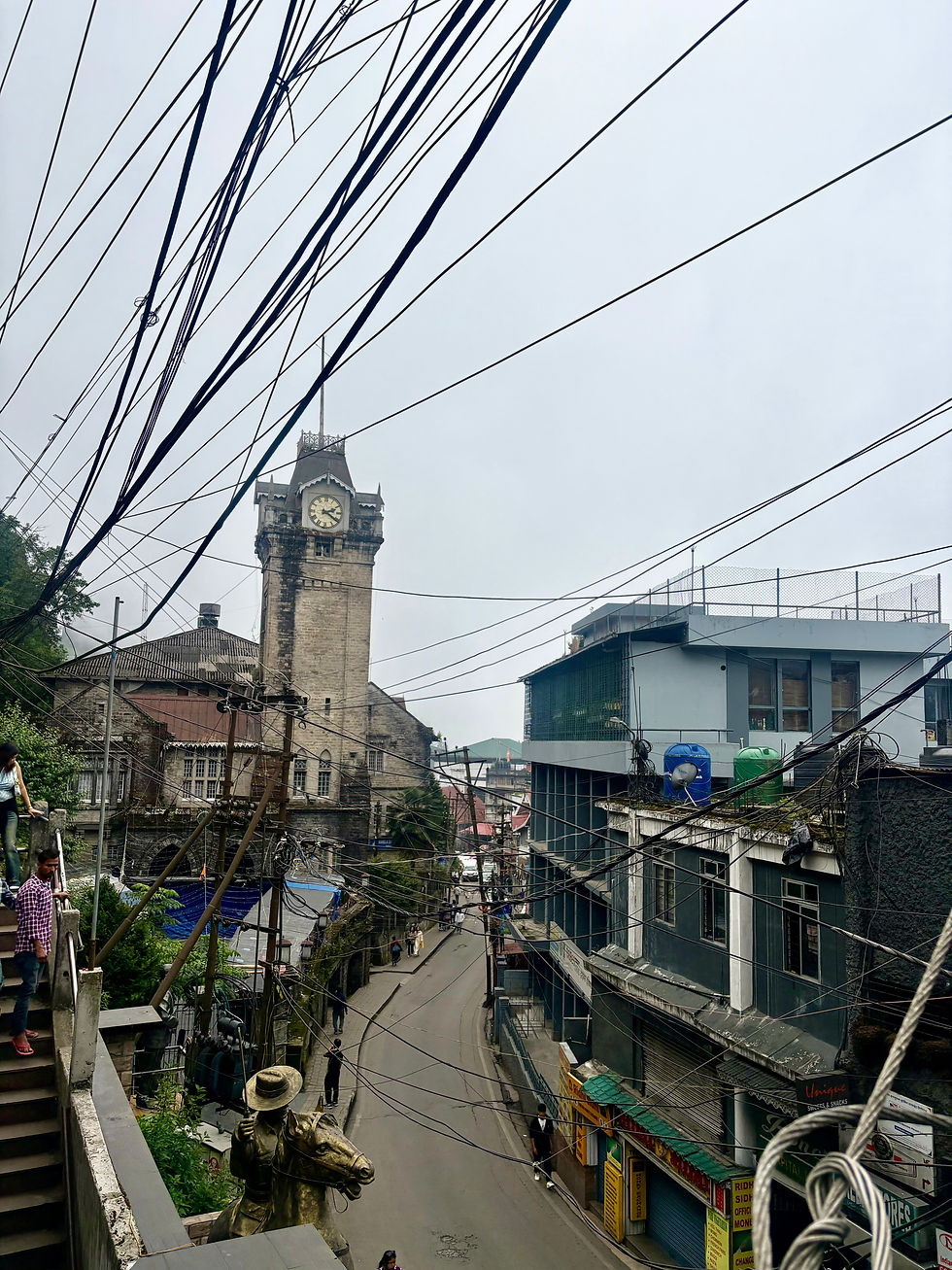
Walking past the Town Hall, the Superintendent of Police building is on the right:

I could not find much about this building, except to infer from the inscription that its original name was possibly “Ruby Hall.”
Fred Pinn notes in The Road of Destiny: Darjeeling Letters 1839 that the Darjeeling police force was established in 1839, when the Government of Bengal sanctioned a small corps of five people. The competent but wily Superintendent of Darjeeling, Doctor Archibald Campbell, whom we met in Posts 1 and 2, persuaded his superiors to allow a local police force after he was vested with magisterial powers. Campbell therefore argued that without a police force, he could not discharge his duties.
Doctor Campbell seems to have been a remarkably busy man when he was not annexing Sikkimese territory. A report prepared by Judge Jackson for the British government in 1854 records:

In Darjeeling, it seems, if Doctor Campbell could not tax it, judge it, marry it, or post it, it did not exist.
If you did commit a crime, worry not. Judge Jackson reports that of the 452 criminal cases tried by Campbell in 1852, he acquitted 272. The good people of Darjeeling, evidently well versed in statistical reasoning, seem to have interpreted the 60 percent acquittal rate as an encouragement to keep Doctor Campbell and his police force busy.
In 1852 alone, nearly a hundred crimes were reported. The leading category was “petty affray”, which is defined as "a minor public disturbance involving violence in a public space, causing alarm to others". Judge Jackson breezily observes that one contributor to the crime roster was the local code of honor whereby adultery required the male offender to be killed.
Thankfully, in independent India, District Collectors have been stripped of their judicial powers. The police are bad enough without having the man who got you arrested also deciding your culpability.
Doctor Campbell wielded such sweeping powers because Darjeeling was a non-regulation area, implying that the standard laws of the Raj did not automatically apply. Judge Jackson, however, saw Campbell’s expansive authority as a virtue, claiming that the natives were “indebted to him for the blessings of a just and paternal Government, under which they at this moment enjoy a degree of liberty as well as of protection of property and person, unknown to them under their former masters; and they are fully sensible of this advantage.”

Image: photo of Doctor Archibald Campbell
Source: Wikimedia Commons
The trope of the frontline British officer bearing the “white man’s burden” was hardly unique to Darjeeling. In The Tomb of His Ancestors, Kipling seems to suggest that the legitimacy of colonial authority derived from the enlightened paternalism of English officers rather than military conquest.
In the story, three generations of a family see service in India as a hereditary duty to “civilise” its indigenous peoples. When John Chinn returns to India after finishing school in England, the Bhils become convinced that he is the reincarnation of his grandfather, who had learned their language, protected them from tigers, and encouraged them to take up farming and government service.
They come to him with questions such as: how many cows should a bachelor be fined when he runs away with another man’s wife? Kipling does not reveal John Chinn’s answer, but many husbands, one suspects, might have regarded the bachelor as a benefactor rather than a culprit. Doctor Campbell was Darjeeling’s John Chinn for more than two decades.
In the climax of the story, Chinn uses his personal stature, not his uniform, to persuade the Bhils to release a government vaccinator whom they regard, much like modern-day vaccine conspiracy theorists, as the devil incarnate. Kipling’s fantasy that men like Chinn—or Campbell—commanded obedience by virtue of their personal moral authority is laughable. Rather, one could say of these men what Paul Krugman said of modern currencies: they have value because men with guns say they do.
Walking further ahead, I came to the SBI building, adjacent to the Town Hall:

The Imperial Bank of India was established in 1921 through the merger of the Bank of Bengal (1806), Bank of Bombay (1840), and Bank of Madras (1843)—the three Presidency Banks. As India's largest commercial bank, it also performed many central banking functions until the creation of the Reserve Bank of India in 1935. In 1955, Imperial Bank was nationalized and renamed the State Bank of India (SBI). The Darjeeling branch opened in 1922 from a makeshift space and then moved to this building constructed on Beechwood Estate, which as mentioned in the previous post was once owned by Dr. Campbell.
Opposite the bank is a bright red storefront, adding a splash of colour to the blues and greys that predominate in the neighborhood:

One difference between the markets of Shimla and Darjeeling is that the former is more colourful, apart from being remarkably cleaner:

A short walk ahead brings one to the Old Post Office:

The building was inaugurated in 1921, the same year as the Town Hall across the road.
The history of postal services in the Darjeeling hills is, as one would expect, closely intertwined with the evolution of transport.
In the years after the hill station was established in 1835, no road connected it to the plains. The harsh conditions faced by the laborers building the road are evident in the following excerpt from a report written in 1839 by Major Garstin, a British official sent on a fact-finding mission to assess the state of public works in the then-nascent hill station of Darjeeling:

That same year, in a letter to a newspaper editor, an anonymous writer signing as “A Wanderer” observed:

The following extract from the Darjeeling Bye-Laws and Office Rules, published by Campbell in August 1841, describes the post office system then in operation:

Campbell categorizes mail into three types: “post-paid,” where the recipient paid; “bearing,” which was prepaid; and “service” letters, which were official government correspondence. Since postage stamps were not introduced in British India until 1854, the system described above worked much like a modern FedEx store: people paid for postage rather than affixing a stamp.
Geoffrey Clarke, the Director General of Posts and Telegraph for British India narrates an unintended impact of post-paid postcards in The Post Office of India and its Story. Recipients routinely read and then refused them so that they did not have to pay postage. Clarke bemoans, “there is an idea that a letter on which postage has to be collected is much more certain to reach its destination than a prepaid one.”
When the Old Military Road opened in 1842 it was too steep for wheeled traffic and could be traversed only on horseback, on foot, or by palanquin. Mail to and from Darjeeling therefore depended on the legendary dak runner, about whom Geoffrey Clarke writes:

Clarke’s hirkara is pursued by tigers, avalanches, floods, and swamps; one suspects that the the average mail delivery was somewhat less eventful.
Rudyard Kipling expresses Clarke’s sentiment more lyrically in The Overland Mail:

Costly signaling theory posits that for a signal to be credible, it must impose a high cost on the signaler. For instance, if an inaccessible pilgrimage destination becomes motorable, one might switch to fasting; and if GLP-1 drugs make fasting bearable, one might take to sleeping on a bed of nails. When Clarke and Kipling were waxing eloquent, postage was expensive and writings letters was a thoughtful activity. It is less stirring to imagine the same heroism expended on a bank’s latest credit-card offer.
The East India Company’s territories, which in 1784 comprised scattered settlements around the presidency towns of Calcutta, Madras, and Bombay, grew vastly over the following five decades. As the empire spread, so too did its mail routes, forcing dak runners to traverse dense forests and exposing them to the risk of tiger attacks.
Professor Chitra Joshi, in the essay Dak Roads, Dak Runners, and the Reordering of Communication Networks, argues that far from being the mythologized archetypes of Clarke and Kipling, dak runners were rational economic agents with very human anxieties. They travelled in groups, brandished firebrands to ward off predators, and sought protective charms from local deities. Sometimes they refused to travel at night, demanded armed protection from tigers, or simply deserted.

Image: portrait of a harkara (dak runner) from 1846
Source: Wikimedia Commons
The British postal officers, in turn, were far less starry-eyed in their actual conduct than the idealized image of the dak runner they peddled in writing. Administrators often viewed claims of tiger attacks as ploys to extort higher wages, avoid the hardships of night shifts, or resist colonial encroachment of the forests. Yet they reluctantly conceded to the runners’ demands, funding armed guards, providing equipment such as torches, and eventually institutionalizing compensation for the families of those killed.
It may seem odd now, but the Post Office was the primary facilitator of travel during the British Raj. Geoffrey Clarke describes the dak travel system that prevailed in the mid-19th century. Travelers were required to apply to their local postmaster, typically giving two to three days’ notice and specifying their itinerary. Horse dak was available only on metalled roads; on other routes, such as the Old Military Road to Darjeeling, travelers relied on the palkee—a wooden box fitted with sliding shutters and carried on poles.
Palkee travel was a highly coordinated operation. The traveller provided the palanquin, the postmaster supplied a specialized crew of twelve: eight palkee-burdars (bearers), two mussalchees (torchbearers), and two bhangy-burdars (luggage porters). To maintain uninterrupted progress, fresh relays were stationed at ten-mile intervals along the route. Each crew covered its stage in about three hours before being replaced by the next, a relay system used for both palanquin and horse dak services.

Image: European woman on a palanquin in Darjeeling
Source: Wikimedia Commons
Like everything else, palkees varied in their level of luxury, with some equipped with beds and pillows for comfortable sleep. Even after the arrival of the Darjeeling Himalayan Railway (DHR), they remained in use for local transportation. Mark Twain, who travelled to Darjeeling in 1896, writes: “At the railway station at Darjeeling you find plenty of cab-substitutes—open coffins, in which you sit, and are then borne on men’s shoulders up the steep roads into the town.”
The English fascination with the palanquin is reflected in the central role the contraption plays in Kipling’s The Incarnation of Krishna Mulvaney.
In the story, a hard-drinking roguish British soldier Mulvaney discovers a rigged gambling scam in which an officer, Dearsley, forces 2,000 railway workers to participate in a monthly raffle, with the ticket cost deducted from their wages. Whoever wins the prize returns it because it is too large to take home, allowing Dearsley to raffle it again the following month. The prize: an enormous, richly decorated royal palanquin adorned with silk, gold, silver, enamel, and intricate Hindu artwork. Mulvaney manages to “win” the palanquin from Dearsley in a fight and, through a series of improbable events, finds himself seated inside it in a temple in Benares, claiming to be Lord Krishna while wrapped in the pink silk that lined the palanquin.
In the years following the acquisition of Darjeeling, finding dak runners and palanquin bearers was challenging because locals feared the Chogyal’s wrath if they accepted wages from the British. Their apprehension arose from the treacherous manner, described in Post 1, in which Darjeeling was annexed from Sikkim in 1835.
The weather, difficult terrain, lack of sheltered accommodation, and sickness made the labour shortage even worse. A write-up published in the February and March 1839 issues of The Englishman by Darjeeling’s medical officer, J. T. Pearson, describes the challenge of ascending to Darjeeling:

Dr. Campbell mitigated the labour shortage by recruiting Mechi dak runners. Campbell, an amateur anthropologist, writes that the Mechis, who inhabited the forested Himalayan foothills across Nepal, Sikkim, and Bhutan, lived in low-elevation forests below 800–1,000 feet, were highly resistant to forest malaria, and moved within the forests after every three crop seasons. The dak route from the foothills at Pankhabari (about 20 km from Siliguri) to Darjeeling passed through dense forests, making the Mechis ideal for the job.
In Himalayan Journals, or Notes of a Naturalist, Joseph Hooker—whose imprisonment by the Sikkimese authorities in November 1849 was recounted in Post 1—describes the wildlife that postal workers would have encountered en-route to Darjeeling: “Elephants, tigers, and occasionally the rhinoceros, inhabit the foot of these hills, with wild boars, leopards, etc.; but none are numerous.”
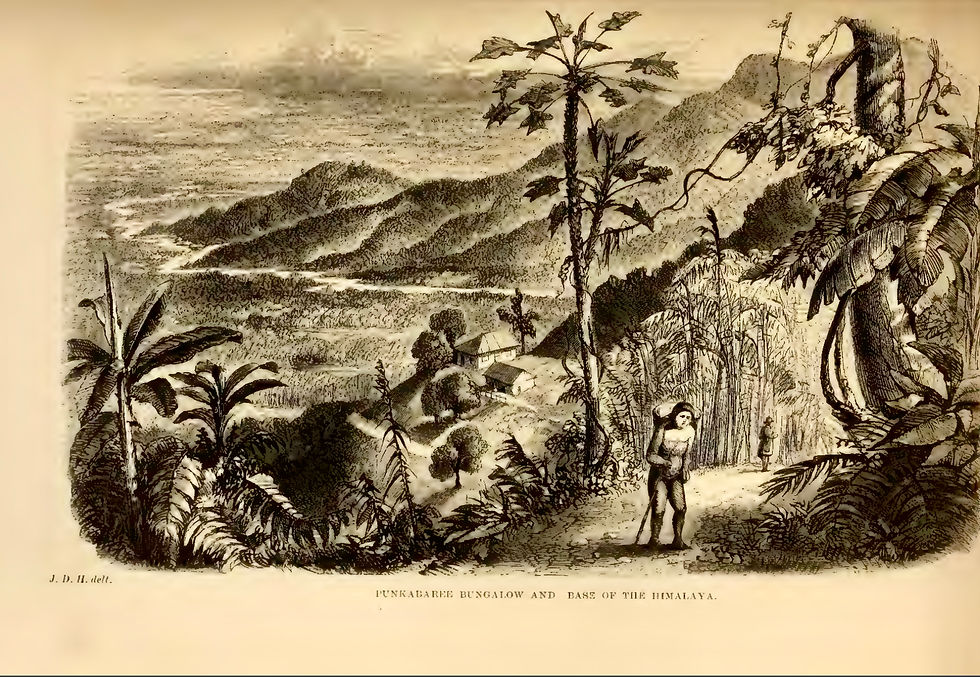
Source: Himalayan Journals, Joseph Dalton Hooker
In the picture above, you can also see the dak bungalow at Pankhabari, where Hooker stayed before ascending to Darjeeling on horseback.
Originally, dak bungalows were built at regular intervals along major highways and postal routes—typically every 10 to 20 miles—to provide lodging for runners and horsemen carrying official mail. As the colonial bureaucracy expanded, they also accommodated civil servants and military officers on tour. These were typically thatched, single-storey buildings with two or three rooms, each with an attached bathroom. Staffed by a khidmatgar and a porter, they charged a fixed lodging fee, while meals, provisions, firewood, and water were supplied separately at additional cost. The network of dak bungalows was managed by the Postal Department.
While the idea of dak bungalows seems romantic today, those who used them might have disagreed. Kipling famously wrote a poem lamenting the food served there, with the refrain “khodawund siruf murghi hai.”

Hooker, while not poetic like Kipling, writes disparagingly of the Pacheem Dak Bungalow—widely believed to have stood within what is now Chimney Heritage Park in Kurseong —where he stayed overnight on the uphill journey to Darjeeling:

It is delightful that Hooker, too, was served “roast fowl,” just as Kipling lamented.
Many believe that the 23-foot chimney pictured below was part of the dak bungalow, built in 1839, that Hooker disparages above:

Source: Wikimedia Commons
While Joseph Hooker ascended the Old Military Road on horseback during his aforementioned 1848 journey to Darjeeling, horse dak services were seldom used at the time. Professor Chitra Joshi explains that dak runners were typically employed by contractors who had been granted concessions by the East India Company to carry mail along specified routes. One such contractor was Girish Chandra Banerjee, whom we encountered in the previous post as the purchaser of the Makaibari Tea Estate from Captain Samler. Banerjee, at the time, held the mail contract for the Darjeeling hills.
Contractors were paid higher rates for operating horse dak services but, in return, were required to meet stricter delivery schedules, with fines imposed for delays. In practice, however, horse daks often failed to achieve higher speeds because horses struggled to negotiate forested terrain at night.
The mail service to Darjeeling received a major boost with the construction of the Hill Cart Road between 1864 and 1869, which made wheeled transport by horse- and bullock-drawn carts feasible. The road’s name alludes to the use of bullock carts to traverse it. The picture below dates from 1865, when the road was still being built:

Source: Wikimedia Commons
Today, the Pankhabari Road, which follows the alignment of the Old Military Road, and the Hill Cart Road provide alternative routes from the plains to Kurseong and onward to Darjeeling.
The introduction of the steam railway to Darjeeling in 1881 added a rail link to the postal network:

Source: Wikimedia Commons
Geoffrey Clarke records that the Darjeeling Tramway received a fixed annual payment of Rs. 10,260 for hauling a postal service van—the same amount previously spent on the tonga service between Siliguri and Darjeeling. This dedicated mail coach, known as a Traveling Post Office, has an interesting history.
Clarke explains that before 1863, light mail traffic was carried in the railway guard's van, while heavier consignments occupied a dedicated compartment attended by a mail guard. As there was no intermediate sorting, every post office had to prepare a separate mail bag for every post office farther along the route. These bags were received, carried, and delivered by the mail guard at successive stations.
Imagine a train traveling from Delhi to Bombay with stops at Mathura, Kota, and Vadodara. The Delhi postmaster would prepare four bags—one each for Mathura, Kota, Vadodara, and Bombay—and hand them to the guard. At Mathura, the guard would unload the Mathura bag, while the Mathura postmaster would add three more bags destined for Kota, Vadodara, and Bombay. On an actual Delhi–Bombay route, however, a train might stop at nearly a hundred stations. The number of mail bags would quickly become unmanageable.
To solve this problem, a sorting section was established on the Great Indian Peninsula Railway between Allahabad and Kanpur in 1863. This evolved into the Traveling Post Office (TPO)—a fancy name for a railway mail coach where postal clerks sorted and processed letters while the train was in motion, enabling faster delivery on arrival.
Today, mail is no longer sorted aboard railway coaches but at major railway stations. Those with a fondness for mobile post offices can visit one that operates from a houseboat on Dal Lake.
While the TPO was an elegant technocratic solution, the railways were not a fan of it. At the time, most railway lines, including the Darjeeling Himalayan Railway, were privately owned, and disputes over reimbursement for the costs associated with these postal bogies led to stormy relations between the two departments.
For all the logistical headaches and accounting disputes that occupied 19th-century railway and postal managers, none of them diminishes the enduring romance of a message carried by a steam locomotive chugging across the subcontinent.
In Kipling’s The Man Who Would Be King, the narrator, travelling in a low-priced railway carriage, encounters Peachy Carnehan, who makes a living blackmailing the rulers of Native States. Peachy persuades the narrator to alter his journey to deliver a cryptic message to his partner. Days later, at Marwar Junction, the narrator intercepts a midnight train and finds the sleeping, red-bearded giant Daniel Dravot, to whom he passes the phrase: “He has gone South for the week.”
The postal service during the Raj played an important role in supporting British military operations. A field office was a temporary post office established to serve a military force operating away from its permanent base. During conflicts such as the Anglo-Afghan Wars and the First World War, field post offices accompanied troops, facilitating both personal and official communication.

Image: 150 Years of the Field Post Office
Source: Wikimedia Commons
The Darjeeling postal service was called upon to support the Sikkim Expedition of 1888. Some historical context is useful here.
The previous post described the intertwined history of Darjeeling, Sikkim, and Tibet. H. E. Richardson notes in Tibet and Its History that by the late 19th century, Britain had established considerable influence across the Indian Himalayas, from Kashmir in the west to Bhutan in the east. To the British, Tibet remained an enigmatic land, from which occasional visitors emerged into the Tibetan cultural sphere within the British orbit—Ladakh, Sikkim, and Bhutan.
The British were eager to establish trade with Tibet. In the closing decades of the 19th century, although Tibet was widely regarded as a protectorate of China, the Qing (pronounced Ching) dynasty had become so weakened that its paramountcy was largely notional. In 1885, after securing a concession from the Qing emperor, the British assembled a Tibet-bound trade mission under Colman Macaulay in Darjeeling. The illusion of Chinese authority over Tibet quickly evaporated when the Tibetans, refusing to cooperate, dispatched 300 soldiers to Lingtu, inside Sikkim, to block the mission’s advance.
Although the British abandoned the trade mission, the broader situation was unacceptable to them. By sending troops into Sikkim, the Tibetans were effectively asserting a claim over a state that Britain regarded as its protectorate. The dispute ultimately culminated in the first armed conflict between Britain and Tibet in 1888, when British forces drove the Tibetans out.

Image: The Illustrated London News edition of November 1888 with engravings of the Sikkim expedition
Source: Wikimedia Commons
Before the war, the postal route from Siliguri to Pedong, on the Bengal–Sikkim border, ran via Darjeeling. To support the Sikkim Expedition, a direct runner line was established from Siliguri to Kalimpong for mail destined for Pedong, while parcels continued to follow the old route.

Beyond serving as the base for the new mail route, Darjeeling played another role in the events leading up to the Sikkim Expedition: it was home to Sarat Chandra Das, whom many believe served as a British spy.
In his introduction to Journey to Lhasa and Central Tibet, which Das had published in 1902, Parimal Bhattacharya sketches the life of this remarkable man. Das, a Bengali Brahmin, graduated as a civil engineer from Calcutta's prestigious Presidency College and arrived in Darjeeling in 1874 as the headmaster of a boarding school. With the assistance of Ugyen Gyatso, a lama and fellow teacher at the school, he secured a passport to travel to Tibet.
Das spent four months in Tibet in 1879 and returned for a second journey, lasting fourteen months, in 1881. By the time he returned to Darjeeling, he had established himself as one of the foremost authorities on Tibet. Thus, when Colman Macaulay arrived in Darjeeling to explore the trade mission mentioned above, Das became an obvious source of advice. His knowledge of Tibet informed both the Sikkim Expedition of 1888 and, later, the British invasion of Tibet in 1903.
When the true nature of Das’s mission became known, Tibetans who had unknowingly assisted him were charged with sedition. One of his closest associates, the Panchen Lama’s Prime Minister, was sentenced to death and drowned in a river.
Das’s now-dilapidated house in Darjeeling (pictured below) stands on the outskirts of town along Hill Cart Road. Although I could not visit it, the house attracted scholars from around the world during his lifetime, who made a beeline to meet him.

Source: Wikimedia Commons
Parimal Bhattacharya notes that the character of the Bengali spy Hurree Chunder Mookerjee in Kipling’s Kim was most likely based on Das. In the novel, Kimball O’Hara, an orphaned Irish boy raised on the streets of Lahore, is recruited by the British as a spy. His mastery of Indian languages and customs, despite being ethnically white, makes him an ideal intelligence operative. As part of his training, Kim meets Hurree Chunder at the shop of Lurgan Sahib, who was featured in my Shimla post.
Kipling’s portrayal of Hurree Chunder Mookerjee is perhaps a good gauge of how the British perceived the Bengali Babu—overly talkative, fond of displaying his education, and speaking in an exaggerated, bookish English that borders on the comic. In one scene, two European men unfamiliar with the British decorum of dealing with natives become too familiar with Hurree and get him drunk. Kipling describes the effect of alcohol on Hurree Babu thus:

For all his racism, Kipling may have been prescient in his portrayal of Hurree Babu. Sarat Chandra Das grew increasingly bitter towards the British in the latter part of his life and eventually sued the colonial government over pension-related matters.
Gazing at the Old Post Office, I marveled at the vast gulf between modern communications and the world of the dak runners:

Arthur C. Clarke’s third law—“Any sufficiently advanced technology is indistinguishable from magic”—faces a much higher bar today. ChatGPT’s viral debut quickly gave way to routine complaints about its hallucinations. In the late nineteenth and early twentieth centuries, however, innovations in communication were far more likely to inspire awe.
In Kipling’s short story In the House of Suddhoo, Bhagwan Dass exploits this gap in understanding. Armed with telegraphic updates about Suddhoo’s gravely ill son, he claims supernatural powers. Because his predictions invariably match the letters that later arrive, Suddhoo—unaware of the new technology—is convinced that the scamster possesses occult knowledge.
The following series of stamps issued by the princely state of Chamba, now in Himachal Pradesh, illustrates how postal services evolved alongside technology:

Source: Wikimedia Commons
The image above creates an impression of linear progress. But since India inhabits multiple centuries at once, it should come as no surprise that the dak runner still survives.
The Hindustan Times recounts a remarkable postal exchange that continues across the India–China border at Nathu La Pass in Sikkim. Every Thursday, an Indian dak runner trudges 7 kilometers through the snow at an altitude of 14,000 feet from his village to a shed inside Chinese territory, where he exchanges mail bags with his Chinese counterpart. A similar exchange takes place inside Indian territory every Sunday. The service connects Tibetan families separated by the international border. Even when there is no mail, an empty bag is ceremonially exchanged.
Another account describes a post office in Padum, in Ladakh's Zanskar Valley. During winter, the town and its surrounding villages are cut off from the rest of India. Dak runners deliver the mail by walking across the frozen chadar on the Zanskar River. One of the runners profiled in the essay reflects that while the expanding road network brings convenience, it may also hasten the irreversible loss of the region's culture, language, and traditions.
Jama Masjid
Walking past the Old Post Office, I lost my bearings and began following Google Maps towards Jama Masjid. On the way was the Central Hotel:

While the hotel appears unassuming today, it is one of the oldest in Darjeeling and is mentioned in E.C. Dozey’s A Concise History of Darjeeling District since 1835 (1922). Built in 1905 with five rooms, it added another ten in 1910, accommodating a total of forty boarders. Along with the Windamere, it remains one of the city’s oldest hotels. The oldest was the Dorjeeling Family Hotel, which opened in 1839 but is no longer operational.
Trying to follow Google Maps with an intermittent signal, I found myself lost in Darjeeling’s labyrinthine streets:

At last, I beheld the Jama Masjid:

It is a well-maintained mosque whose elegant domes, minarets, and white-and-green colour scheme make it a striking landmark amid the dense urban surroundings.
In The Story of Darjeeling, Basant B. Lama writes that after the British took control of Darjeeling, Nepalese formed the largest immigrant group, but people also arrived from numerous princely states across India. Many of these newcomers, particularly from Lucknow, then part of Oudh, a British protectorate, were Muslim.

Standing in front of the gate, one can appreciate the building’s elegant symmetry. The black inscription above the main arch is the Shahada, the Islamic declaration of faith, which translates as, “There is no god but God, and Muhammad is the messenger of God.” Just a short walk away stands an institution inspired by a radically different conception of the divine:

Housed in a bright orange building, the institution inspired by the above text is the Brahmo Samaj of Darjeeling:

The founder of the Brahmo Samaj drew inspiration from the Upanishadic conception of God as Nirguna Brahman—the formless, attributeless, infinite Supreme Being. The name Brahmo Samaj derives from the Bengali adjectival form of Brahman, not to be confused with Brahmā, the four-headed creator deity who appears in later Hindu texts known as the Puranas. The Brahmos challenged traditional Hindu practices such as idol worship and superstition, as well as social injustices including the rigid caste system, child marriage, and sati. I provide more context on the Brahmo Samaj in my essay on Shantiniketan.
Old Cemetery
Leaving the Brahmo Temple, I walked towards Loreto Convent:

The school was founded in 1846 by three Irish nuns who were despatched from the parent Loreto House in Calcutta. The Sisters of Loreto is a Catholic religious congregation that traces its origins to Mary Ward, a British nun who founded the Institute of the Blessed Virgin Mary (IBVM) in 1609. Some historical context is useful to understand its antecedents.
Persecution of Catholics in England began in earnest in 1534, when King Henry VIII famously broke with Rome to secure his divorce and required all public officials and clergy to recognize him, rather than the Pope, as head of the Church of England. Initially, the victims were prominent figures, most famously Henry’s former Lord Chancellor, Sir Thomas More, who was beheaded in 1535.
Pope Pius V raised the stakes in 1570 when he excommunicated Henry’s daughter, Queen Elizabeth I, and ordered English Catholics not to obey her laws. In response, the English government came to regard every Catholic in the country as a potential agent of the Vatican and, therefore, a traitor. Parliament imposed steep fines on anyone who refused to attend Church of England services—a “recusant.” For a Catholic priest, merely setting foot in England became an act of high treason.
While the vast majority of Catholics became “Church Papists,” outwardly conforming to Protestant rituals but secretly adhering to Catholic beliefs at home, Catholics amongst the aristocracy played a more active role in preserving the faith. They gave safe harbor to priests in their sprawling manor houses and even incorporated “priest holes”—ingenious hiding spaces built behind walls and beneath floors where priests could disappear during raids by priest hunters (pursuivants).

Image: Priest-hole on first floor of Boscobel House, Shropshire, England
Source: Wikimedia Commons
Mary Ward was born into one such aristocratic family. Two of her paternal uncles, John “Jack” Wright and Christopher “Kit” Wright, were conspirators in the Gunpowder Plot of 1605, in which Guy Fawkes and his fellow plotters attempted to blow up Parliament and establish Catholic rule in England. They may have been less attentive to the part about turning the other cheek.
Around this time, Mary felt called by God to take religious vows. With no Catholic seminaries left in England, young English men and women who wished to become priests or nuns had to flee to mainland Europe. Nuns in this era often came from wealthy families because they were required to pay a “spiritual dowry” to the convent. In 1606, at the age of 21, Mary set out for a convent in Europe.
On arriving in France, she learnt that the convent did not accept foreign women, so she could be admitted only as a lay sister, whose duties centred on manual labour rather than full participation in the convent’s liturgical life. Mary left the order within a few months and established an English convent nearby. In 1609, she went on to establish a boarding school for English girls and modelled her organization on the Jesuits.
Mary Ward’s model of allowing nuns to work among people outside the convent, and her willingness to speak with authority on spiritual matters, drew opposition from the Church hierarchy, which had her convicted of heresy and briefly imprisoned. Yet despite persecution from both the Catholic Church, for being uncloistered, and the English state, for being Catholic, the movement she founded survived. Branches of her order opened across Europe.
Mary Ward’s establishment of the IBVM set in motion a chain of events that would eventually lead to the opening of Loreto Convent in Darjeeling:

The next link in this chain came in 1686, when Frances Bedingfield, a member of Mary Ward’s order, opened the Bar Convent, a boarding school for Catholic girls in York, England:

Image: The Bar Convent at York in England
Source: Wikimedia Commons
The story continued in 1822, when Frances Mary Teresa Ball, an alumna of the Bar Convent from a wealthy Irish family, established a branch of the IBVM outside Dublin at Rathfarnam House. In the 1920s, a novice named Agnes Bojaxhiu arrived there to learn English before becoming better known in India as Mother Teresa.

Image: Rathfarnham House near Dublin
Source: Wikimedia Commons
Frances renamed the Rathfarnham building Loreto House, after the Italian town of religious significance. According to legend, the house where Jesus, Mary, and Joseph lived in Nazareth (pictured below) was miraculously transported to Loreto in 1295:

Image: the three walled structure believed to be the holy family house in Loreto Italy. In ancient Nazareth, the fourth wall was the opening of a cave.
Source: Wikimedia Commons
The Loreto Sisters opened their first Loreto House in Calcutta in 1841. E. C. Dozey records that Mother Teresa Mons, assisted by Sister Gabriel, was sent from Calcutta to establish the Loreto Convent at “Snowy View,” north of Birch Hill, on October 10, 1846. By the end of that year, the convent had moved to its present site.

A short walk from Loreto Convent brought me to the Old Cemetery on Lebong Cart Road:

The cemetery is divided into two horizontal terraces, stacked vertically like giant steps. The upper level lies close to the road and contains the older, heavily weathered graves. To enter it, one must step off the main road and pass through a narrow gate. Another set of narrow, steep stone steps leads down to the lower level, which descends further into the hillside:

The gates to the upper level were locked and it was not clear to me on how to descend to the lower level. Not being Christian, even death offered no prospect of entry.

Apart from its inaccessibility, much of the cemetery remains heavily overgrown and weathered. It was the same apathy from West Bengal Tourism that I had observed in Shantiniketan, despite the cemetery being under the care of the Archaeological Survey of India (ASI) as a "Monument of National Importance."
Despite its inaccessibility, the Old Cemetery was well worth the walk for the wonderful views of the valley it affords:

The Old Cemetery holds the grave of Lieutenant General George William Aylmer Lloyd, whose alleged deceitful role in the British annexation of Darjeeling in 1835 was described in Post 1. Since the cemetery was locked, I could only glimpse his gravesite from street level:

While Lloyd was not a nice man, the portrait of him that emerges from the letters published in Fred Pinn’s The Road of Destiny: Darjeeling Letters 1839 is oddly endearing. He was what we would today call a difficult employee.
Among the many infractions that led to his firing in 1839 was a proclamation he had issued that everyone in Darjeeling was now a subject of the East India Company, not of the Kingdom of Sikkim. Through the proclamation, Lloyd was trying to resolve a labor shortage issue: as mentioned earlier, the natives, mostly Lepchas, feared punishment from the Chogyal and refused to work for the British. However, by issuing this directive, he had effectively converted land meant for a sanatorium into a sovereign state within Sikkim.
His superiors objected to this overreach—one can safely assume not because annexing territory offended their sensibilities, but because even imperial expansion was expected to follow proper bureaucratic procedure, and Lloyd had neglected to obtain their approval first.
Lloyd’s proclamation also directed Darjeeling residents to pay taxes to the British instead of the Chogyal. The problem was that in Sikkim, taxes were levied on people, not land. The Lepchas were nomadic cultivators who moved every three years, and the “taxes” they paid were primarily in the form of manual labour (construction, military service) for the state. Hence, asking them to pay “taxes” to the British made little sense.
The rules for allocating building plots, notified in September 1839, stipulated that anyone occupying land without a title issued by the British would be evicted. While the rules made an exception for residents who had settled there before the British occupation, most property in Darjeeling today is owned by “outsiders,” since the aboriginal residents, the Lepchas, were pastoralists.
The land-ownership rules issued in Darjeeling are reminiscent of 1066, the year of the Norman Conquest—the legal reset point for English land. William the Conqueror, the first Norman king, asserted ultimate ownership of the entire realm and re-granted it under a new feudal order, so any subsequent claim was valid only if it could be traced to a post-Conquest grant. For Darjeeling, February 1, 1835, was thus analogous to 1066.
Legal fictions have a curious habit of begetting one another: when one fiction creates a problem, the law simply invents another to solve it. In England, the fiction of universal dispossession of all pre-Conquest property rights led to the fiction of time immemorial. In 1275, King Edward I issued the Statute of Westminster, which, among many other provisions, required anyone claiming a land-related right based on long-standing custom—whether grazing privileges on common land or private ownership of a parcel—to prove that the right existed as of July 6, 1189.
Before this new statute, a claimant had to trace title back to 1066. By the 13th century, however, producing records from two centuries earlier had become impractical. Edward therefore chose, somewhat arbitrarily, the date his ancestor ascended the throne. July 6, 1189 marks the boundary: time immemorial ends and legal memory begins.
What is your personal time immemorial—the furthest back you can reach to establish a right? Perhaps the dinner decades ago at which a friend promised to return the money they borrowed.

The countdown to Lloyd’s dismissal began with Major Garstin’s report, referenced earlier, which delivered a scathing indictment of the public works then underway. One striking detail was that the Old Military Road was being built from the top down, forcing workers to haul materials uphill before there was even a road to use—an absurdity that slowed construction of the new hill station’s lifeline.
A more serious issue concerned a bazaar whose construction had been abandoned midway by the contractor, Mr. Perry, to whom Lloyd had advanced Rs. 8,000 in government funds without a contract. The fates of the road and the bazaar were closely intertwined: without a road passable to pack animals, merchandise could reach the bazaar only on foot.

Image: guava sellers at Darjeeling Bazaar in 1860
Source: Library of Congress
On June 5, 1839, the office in Calcutta fired Lloyd, now nearing fifty, with a terse note:

After a decade-long association with Darjeeling, Lloyd left for military service in China. He loved the mountains, however, and was bitterly disappointed when his application for a one-square-mile plot in Kurseong was declined. Perhaps, as a civil servant, Lloyd earned a modest salary and could not compete with the well-heeled Calcutta residents buying summer homes in the up-and-coming hill station.
What makes Lloyd relatable is his lack of emotional intelligence. After being forced out of his civilian post, a wiser man might have let bygones be bygones. Instead, Lloyd wrote a long-winded letter to the Englishman refuting an editorial it had published. After a lengthy rebuttal, he concludes:

Fred Pinn’s compilation contains many of Lloyd’s callow letters, which unexpectedly make him likeable—at least to us, who did not have to deal with him as a colleague.
It is worth noting the role of Robert Napier, a young engineer who was sent to Darjeeling in the summer of 1839 to complete the Old Military Road, whose construction had been bungled under Colonel Lloyd’s supervision. After the road opened, Napier left Darjeeling in June 1840 and went on to a brilliant military career, eventually becoming Commander-in-Chief of the Army in India in 1870.

Image: Viceroy's Executive Council, Simla, 1864, Robert Napier seated fifth from left
Source: Wikimedia Commons
Lloyd left for China in 1840, where he fought in the First Opium War. The connection between Darjeeling’s tea industry and the Opium Wars was explored in the previous post. After returning to India, he moved between different regiments across the country, including one involved in the suppression of the Santhal uprising referenced in my Shantiniketan post.
There is a tragic postscript to Lloyd’s career, the kind one would particularly wish to avoid when nearing retirement. Yet grand events in history, like the Sepoy Mutiny, care little for our life trajectories. As John Lennon said, life happens when you are busy making other plans.

Image: A scene from the 1857 Indian Rebellion (Bengal Army)
Source: Wikimedia Commons
At the time the mutiny broke out at Meerut in May 1857, Major General Lloyd was serving as divisional commander at Dinapore (modern-day Danapur, near Patna). The imperial government had left the decision to disarm native soldiers to local commanders. Calcutta headquarters therefore sent the 5th Fusiliers to Dinapore, authorizing Lloyd to use the British regiment to disarm the native troops—but only if he deemed it necessary.
When the 5th Fusiliers arrived by ship on the Ganges, Lloyd lost his nerve. At first, he refused to let them disembark. Later, after allowing them ashore, he attempted a compromise. Rather than fully disarming the native soldiers, he ordered the confiscation of their percussion caps—the small metal fittings placed on a musket without which it could not be fired. The percussion cap was the yin to the yang of the paper-covered greased cartridges that had set off the mutiny.
Lloyd secured the percussion caps in the soldiers’ ammunition pouches, but not those already fitted to their muskets. Believing he had resolved the crisis, he dismissed the 5th Fusiliers and went to lunch. In his absence, his officers tried to persuade the native soldiers to surrender the caps in their muskets. The sepoys mutinied and marched away. By the time the 5th Fusiliers were called back, the mutineers had headed for Arrah, where they joined the irregular forces of Kunwar Singh, a local 80-year-old zamindar leading the regional rebellion against the British.
At Arrah, the Indian rebels laid siege to a small group of British civilians and fifty Sikh soldiers who had barricaded themselves inside the annexe of a house. Among the civilians were Hereward Wake, the district magistrate, and Richard Vicars Boyle, the East India Company’s district engineer.

Image: Defence of the Arrah House, 1857" by William Tayler
Source: Wikimedia
The British prevailed after eight days of fighting on August 3, 1857, though they suffered heavy casualties. My sole companion on the Darjeeling trip, Kipling, later visited the Arrah house and wrote about it in The Little House of Arrah published in The Pioneer on February 24, 1888. He concludes with his signature racial arrogance:

The massacre of hundreds of British soldiers was attributed to Lloyd’s incompetence. On August 8, 1857, the Governor-General’s office sent the following message:

Fred Pinn cites a letter Lloyd wrote to his brother, later published in the press, in which he defends himself. Lloyd claimed he was suffering from gout and was physically unwell on the calamitous day, which affected his outward firmness. He nevertheless insisted that his judgment was sound and blamed the press for unfairly vilifying him. Lloyd was removed from the army and returned to Darjeeling to retire. When he died in 1865, there was no one to mourn him but his family (possibly applies to all of us).
While the cemetery was locked during my visit, I was able to find a photograph of Lloyd’s grave online:

Source: Wikimedia
At the time of his death at 76, Lloyd had spent more than four decades in India. Unlike Campbell, who returned to London after retiring in 1862, Lloyd, an Irishman, chose to remain in India and return to the hills he so loved.
Another notable relic in the Old Cemetery is the tomb of the Hungarian scholar Alexander Csoma de Koros.

As with Lloyd’s grave, I had to rely on the web to see it. Unlike Lloyd’s, however, Csoma de Koros’s grave is well maintained, thanks to the Hungarian Embassy:

Source: Wikimedia
Details of Alexander Csoma’s life are recorded in a biography published in 1885 by Theodore Duka. In 1816, at the age of 32, Csoma arrived at the University of Göttingen in Germany on a scholarship, where he became convinced that the Hungarian people were descended from the Uyghurs of Central Asia (modern-day Xinjiang in western China). He resolved to travel to Asia to test this hypothesis, learning Oriental languages so he could read original manuscripts and trace their linguistic kinship with Hungarian.
Being middle class, he needed some time to arrange the finances for his journey. In 1819, he finally set out for the land of the Uyghurs. Over the next three years, he travelled mostly on foot, following a sweeping route through Romania, Bulgaria, Turkey, Greece, Egypt, Cyprus, Lebanon, Syria, Iraq, Iran, Uzbekistan, Afghanistan, Pakistan, and India, before finally arriving in Leh in the summer of 1822.
From Leh, Alexander set out towards his presumed ancestral homeland in Xinjiang but abandoned the journey less than a month later, deeming it too expensive and dangerous for a European Christian. On the return journey to Leh, he befriended the British explorer William Moorcroft, who introduced him to the Tibetan language. This encounter proved to be the pivot that defined the rest of Csoma’s life. Tibetology, rather than Magyar ancestry, became what Patrick O’Shaughnessy describes as “life’s work”: a lifelong quest to build something for others that expresses who you are.
Ikigai tells us to operate at the intersection of what we love, what we are good at, what the world needs, and what we can be paid for. There were no sponsors, however, for research into the Hungarian hypothesis of Uyghur ancestry, which has since been debunked. The East India Company (EIC), as mentioned above, was keen to open trade routes into Tibet and valued Tibetan scholars such as Sarat Chandra Das. So when Alexander proposed that the British fund his living expenses while he mastered Tibetan, the EIC readily agreed, offering him a modest stipend.
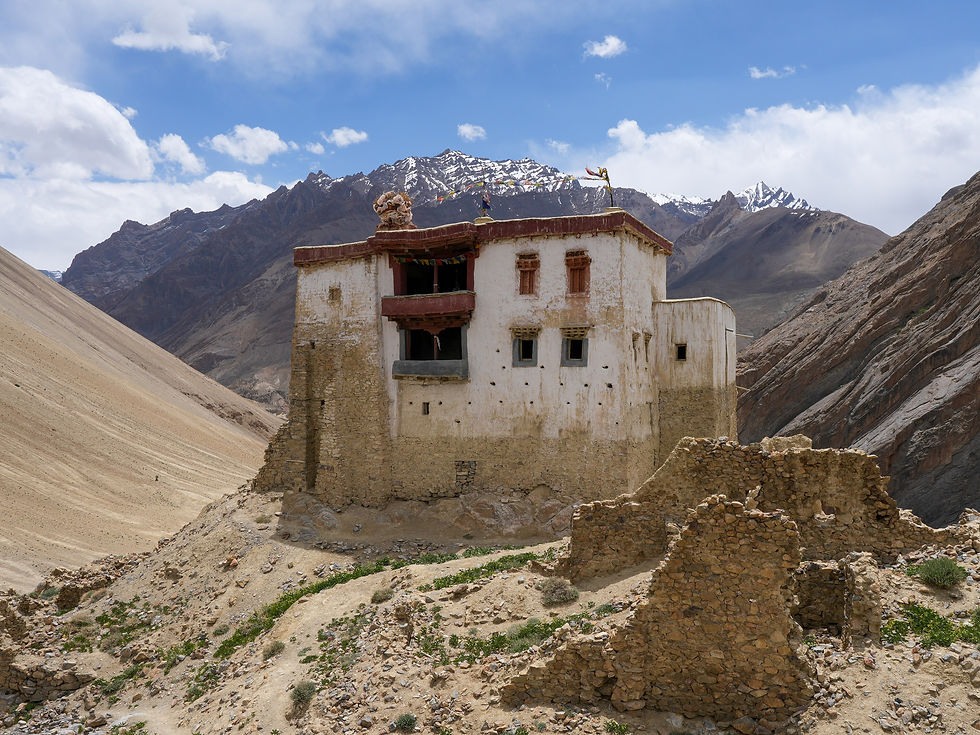
Image: Zangla Monastery in Ladakh where Alexander Csoma spent more than a year
Source: Wikimedia
After publishing his magnum opus, the dictionary, in 1834, Alexander stayed on in Calcutta, learning Indian languages such as Sanskrit and Bengali while continuing his Tibetan studies. He lived in near isolation, completely absorbed in his studies. The portrait below, painted by a Hungarian artist during his Calcutta years, is the only surviving image of him.

Image: Portrait of Alexander Csoma de Koros
Source: Wikimedia Commons
The dictionary vastly understates the staggering depth of Alexander Csoma’s scholarship. He read, for instance, the entire Tibetan Buddhist Canon, comprising more than 200,000 pages, in the original. The depth of his commitment can be gauged from the account of a doctor friend who visited him in Ladakh in the autumn of 1829:

He appears to have taken himself with a solemnity that admitted neither spirits nor even the suspicion of them. The good doctor goes on to say:

One cannot help wondering whether a modest dram of Scotch, in the Ladakhi winter, might have done more for both his circulation and his scholarship.
In 1842, the fifty-eight-year-old Alexander set out on an expedition to fulfill his longstanding dream of reaching Lhasa but died of malaria in Darjeeling. Dr. Campbell had been trying to secure permission for the scholar to enter Tibet through his influence with the Sikkim court. Instead, he found himself conducting the funeral service at the Old Cemetery. Five days before his death, Alexander had shared with Campbell his desire to find the Uyghurs—the very quest with which he had begun two decades earlier.
The British patronage of Csoma’s scholarship reflects their broader commitment to documenting knowledge through European frameworks to understand cultures very different from their own. Scholars have argued that colonial subjects internalized these interpretations, which were sometimes erroneous, though not always ill-intentioned, with detrimental consequences. Nicholas Dirks, for instance, argues that although the British did not invent caste, the colonial apparatus of knowledge, including the 19th-century census, transformed fluid social identities into a rigid, standardized system. Similarly, Manu Pillai contends that the Abrahamic conception of Hinduism espoused by the Hindu right is, at least in part, a product of this dynamic.
My guess is that the average Briton during the Raj found India rather like Middle-earth: a world governed by its own logic, beyond the assumptions of home. In The Strange Ride of Morrowbie Jukes, Kipling tells of Jukes, a civil engineer who plunges into a village of the living dead: outcasts believed to have died but who miraculously revived on the funeral pyre, only to be banished from society. The narrator concedes that the story sounds unbelievable, but insists that similar places exist near Calcutta and Bikaner. His defense is simple: India is so strange, and so full of things that seem impossible to Europeans, that even an unbelievable story might be true.
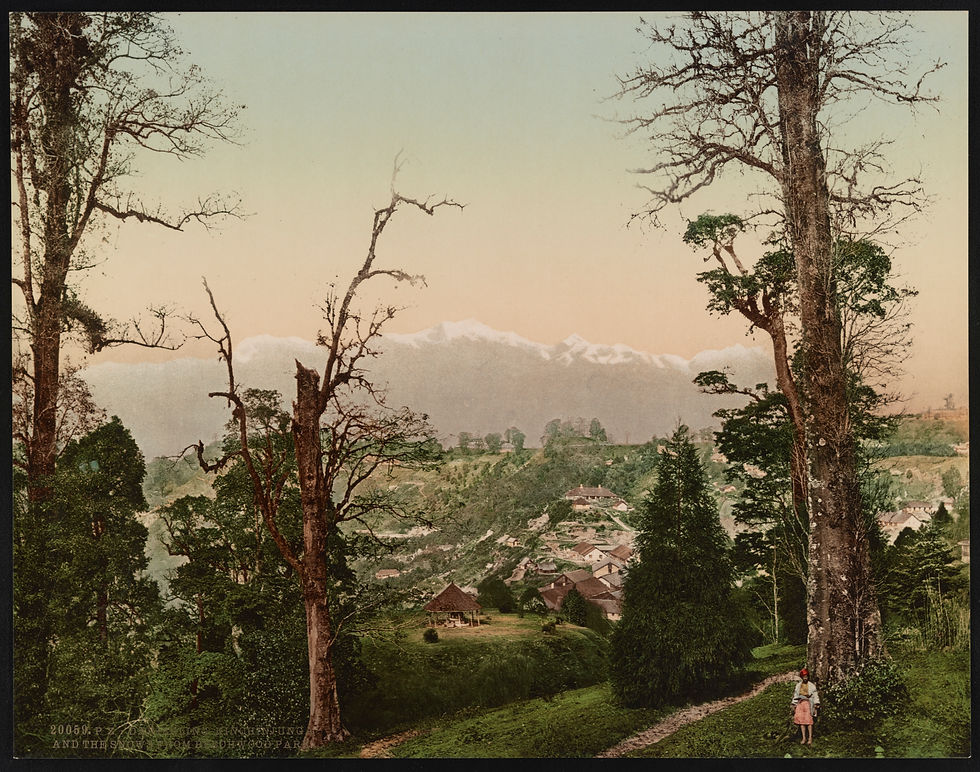
Image: Darjeeling in 1890
Source: Library of Congress
Summing Up
My trip to Darjeeling was coming to an end. Thankfully my experience did not mirror the apocryphal story Mark Twain alludes to in his vignette on Darjeeling:

Mary Oliver famously asked, “Tell me, what is it you plan to do / with your wild and precious life?” Darjeeling attracted people whose answer might have sounded something like Rilke’s: “I live my life in widening circles / that reach out across the world.”
The long cast of compelling characters in this Darjeeling series included empire builders (George Lloyd, Archibald Campbell), dreamers (Alexandra David-Neel, George Mallory, Heinrich Harrer), seekers (Alexander Csoma de Kőrös, Sarat Chandra Das, Lowell Thomas), rogues (Captain Samler), and perhaps even a CIA spy (Hope Cooke). They all travelled, physically and mentally, in pursuit of an idea, a dream, a mystery, or a life they could not have lived elsewhere.
While playing with my one-year-old niece, it struck me that she would never know who my mother was. In a century, no one on this earth would have met her. Not long after that, no one would know who I was either. I would become as unreal as the past inhabitants of Darjeeling mentioned above are to me.
As I grow older, the world seems increasingly unreal, like a television transmission: contingent on an antenna we call the mind, with the one difference that we are inside the screen. Perhaps that is why I write about the places I travel to: a way of holding on to a frame from a television that does not allow playback. Kathryn Schultz says it best:
our brief crossing is best spent attending to all that we see: honoring what we find noble, denouncing what we cannot abide, recognizing that we are inseparably connected to all of it, including what is not yet upon us, including what is already gone. We are here to keep watch, not to keep"
The taxi carried me down the mountain, but Darjeeling has not quite let me go; some part of me is still there, reading Kipling in Darjeeling.


Comments