Shimla Part 3: the path to power
This post captures my observations of Shimla on my second trip, in autumn (October). My first visit had been in spring (April).
My reflections on the first trip appeared in Posts 1 and 2, set mostly on the Mall. They covered the bare minimums of a Shimla visit: the shops, the Ridge, Lower Bazaar, Lakkar Bazaar and Kali Bari.
For those staying longer, I recommend the walk described in this post, from the western end of Mall Road (by the Vidhan Sabha entrance) to Viceregal Lodge. Now called Chaura Maidan Road, this stretch was originally part of Mall Road itself. The new nomenclature is a recent phenomenon. A pedestrian at the turn of the twentieth century would therefore have considered the entire walk from Viceregal Lodge to Scandal Point and the Ridge as being on the Mall.
Like my earlier posts, this one too draws on two books that enriched my Shimla trip: Edward John Buck’s Simla, Past and Present (1925) and Raaja Bhasin’s Simla: The Summer Capital of India (2011). Facts cited in this essay are attributed to these works and other sources from which they are drawn. I use “Simla” when referring to the period when that was the accepted spelling, hoping that Shimla’s spelling police, if any, are more indulgent than their Shiv Sena counterparts in Bombay... oops... Mumbai.

Pictured below is the starting point of my walk, at the Mall’s western terminus. The stretch from Scandal Point to here was covered in Post 2. The round trip from Scandal Point to Viceregal Lodge takes about three hours and involves some steep climbs.

On the corner to your right stands Knockdrin, a fortified facility:

According to Edward Buck, the house was originally called Will Hall and was well known in Simla as early as 1862, when it belonged to Captain Gerald Butler of the Indian Army. In 1868, it was sold to Captain Levinge, who renamed it Knockdrin. The name was most likely a homage to Knockdrin Castle in Ireland (pictured below), which belonged to the Levinge family, of which the captain was presumably a member.

Source: Wikimedia Commons
In 1906, Knockdrin became the residence of the Foreign Secretary to the Government of India. One of its occupants was Mortimer Durand, a man with a couple of distinctions to his name. In 1893, on behalf of Viceroy Lansdowne, he negotiated the Durand Line, demarcating the border between Afghanistan and British India. Given the trouble this border continues to cause between the Taliban and Pakistan, Mr. Durand’s descendants might be wise to conceal their surname if Kabul features in their travel plans.
The second distinction is far less controversial. In 1888, laid up with an illness and with time on his hands, Durand conceived a football tournament. The Durand Cup, which survives to this day, was played exclusively in Shimla until 1940.
Knockdrin is largely hidden from the road by its tall walls:

Opposite Knockdrin, across the same intersection, stands Kennedy Cottage, now occupied by the Central Public Works Department (CPWD):

Some mistakenly assume this to be Kennedy House, the first pucca house in Shimla, built in 1822 by Captain Charles Pratt Kennedy. The actual house—pictured in the 1824 lithograph below—was demolished, and its original site now lies within the Vidhan Sabha premises.

Image: drawn by Major J. Luard in 1825, Printed by Graf & Soret in 1833
Source: Wikimedia Commons
In fact, the entire area—including the Vidhan Sabha and the CPWD building—once formed part of Captain Kennedy’s estate, which, according to Edward Buck, included Kennedy House, Kennedy Lodge, and Kennedy Cottage. The present CPWD building dates only to 1920, meaning that even this is not the original Kennedy Cottage.
The Kennedy Estate passed through several owners before being acquired by the government. One of them was the hot-headed Major Samuel Thomas Boileau Goad, whom we encountered in the previous post in connection with his son’s association with the Railway Board Building.
Leaving Mall Road, I was now on Chaura Maidan Road. On the left stands Cleremont, a late-1920s building that houses government departments:

A few steps further along, on the left, stands the Simla Sanitarium, run by the Seventh-day Adventist Church:

A chapel adjoins the hospital, where the cases that baffled doctors could be referred to a higher authority:

The Adventist Church arrived in Simla in 1913, initially focusing solely on missionary work. In 1915, it established a treatment room in a building then known as Carton House. After moving between several premises in the city, the Sanitarium returned to Carton House in 1933, where it remains today.
Ahead of the Sanitarium stands The Retreat, built in 1905 as a residence for members of the Viceroy’s Executive Council:

After Independence, The Retreat became the residential quarters of senior Indian Army officers. The Army’s Western Command was headquartered in Shimla for three decades. Local historian Raaja Bhasin writes that, for a brief period, General Thimayya renamed it Command House when he took charge of the Western Command, finding its original name inappropriate for a serving officer. The modern Indian politician might favor Seva Sadan for the nameplate and Swiss Cottage for the destination of the proceeds.
A decade after his Shimla stint, General Thimayya became embroiled in a public dispute with Defence Minister V. K. Krishna Menon in the run-up to the war with China. He famously resigned, only to be persuaded by Nehru to withdraw his resignation.
Little of The Retreat is visible from the street:

Ahead of The Retreat stands the historic Cecil Hotel, now run by the Oberoi Group:

In Simla, Past and Present, Edward Buck notes that the site housed a single-storey residence called Tendril Cottage in the 1840s. Around 1877, the cottage was demolished and replaced by three small rental flats. The resulting residential estate, known as Tendrils, was purchased in 1902 by the Hotz family, whom we encountered in the previous post as owners of the Dalziel Hotel near the SBI Building.
The Hotz family later added a much larger structure to the estate, which became the Cecil Hotel. In the photograph below, reproduced from Buck’s book, the Cecil stands on the left (it is also the building shown in the picture above). The three Tendril flats, since demolished, are visible in the extreme right foreground:

One of the three Tendril flats once had a famous tenant: Rudyard Kipling.
As mentioned in Post 1, Kipling had a significant connection with Shimla. Born in Bombay and educated in England, he returned to India in 1882 as a young journalist in Lahore. Between 1883 and 1888, he spent his summers in the hill station.
Today, the Cecil’s adjoining Annex (pictured below) recreates the architectural features of the original Tendril cottages:

The Cecil was a prominent centre of social life in Simla. Collins and Lapierre write in Freedom at Midnight:
Each evening at 8:15, a turbaned butler marched down its carpeted corridors tolling a dinner gong as though it were a P & O steamer. The guests, in black tie and evening dresses, came down to dine at tables covered with Irish linen, Mappin and Webb silverware, Doulton porcelain and German Bohemian crystal glasses for champagne, whisky, wine, port and water at each place.
In 1922, a twenty-two-year-old man stood outside the Cecil looking for work. He had arrived in Simla to apply for a government clerical post but had flunked the interview. With a young daughter to support, he desperately needed a job.
Summoning his courage, he walked through the hotel’s front door, only to be thrown out by the hall porter. Undeterred, he discovered that the manager, D. W. Grove, went home for lunch and a siesta. Keeping vigil, and with the help of a nearby shopkeeper who identified Grove for him, the young man approached the manager and boldly asked for a job. That very day, he began work as a clerk at the Cecil, earning fifty rupees a month.
This story appears in Bachi J. Karkaria’s Dare to Dream, the biography of that young man, Mohan Singh Oberoi.
Lesson learnt: always find out when the hiring manager takes his siesta
By the time Mohan Singh Oberoi joined the Cecil, ownership had passed from Mrs. Hotz to John Faletti, an Italian hotelier. Mrs. Hotz had also owned Wildflower Hall; both properties are now managed by the Oberoi Group.
The Cecil’s main competitor was the Grand Hotel, run by another Italian, Federico Peliti, whom we encountered in Post 2. The year 1922, when Oberoi began his career at the Cecil, was also the year the Grand burnt down. Those who suspect Oberoi of having torched the competition might want to retake Statistics 101.
Karkaria recounts that Mohan Singh Oberoi’s initial duty was to keep track of the hotel’s coal supplies. D. W. Grove soon recognised his talent and promoted him. One night, while Oberoi was manning the Cecil’s reception desk, a politician asked him to find someone to type a document. The young man volunteered to do it himself and was paid a hundred rupees—enough to buy his wife and himself their first watches. The politician was Motilal Nehru. The great man's presence was no fluke. The Cecil’s proximity to Viceregal Lodge made it a convenient base for senior Congress and Muslim League leaders.
When Grove left the Cecil for greener pastures, he was succeeded by an English couple, Ernest and Gertrude Clarke, who would play a pivotal role in transforming Mohan Singh Oberoi’s fortunes.
In 1929, after leaving the Cecil, Ernest Clarke acquired the Carlton Hotel at the eastern end of Mall Road, renamed it Clarke’s and made Oberoi his co-owner. When the Clarkes returned to England in 1934, Oberoi became the sole owner. We visited Clarke’s Oberoi, the first hotel in the Oberoi empire, in Part 1, though it was closed for renovation at the time.
The story of Mohan Singh Oberoi’s return to the Cecil as its owner is recounted with dramatic flourish in Karkaria’s book.
The Cecil was part of Associated Hotels of India (AHI), a public company floated by owner John Faletti in 1916. AHI owned what was then India’s largest hotel chain, including a namesake Cecil in Murree, the hill station near present-day Islamabad. Following the 1965 Indo-Pak war, the Pakistani government confiscated AHI’s hotels in Pakistan.
At AHI’s 1944 annual general meeting, held at the Cecil, Oberoi arrived carrying a canvas hold-all stuffed with bundles of share certificates. N. V. Smith, the company secretary, initially refused him entry, pointing out that his name was absent from the list of shareholders. Oberoi produced an envelope packed with certificates, and his cousin confirmed that the bag held more.
Sir Edward Buck, AHI’s chairman and the author of Simla, Past and Present, from which these chronicles borrow liberally, confirmed that Oberoi held the controlling interest. He congratulated him and offered him the chairmanship. Oberoi, in turn, asked Buck to remain chairman of the board.
Twenty-two years after being turned away from the Cecil, Oberoi had returned—not to seek a job, but to take control of the hotel.
The events leading to Oberoi’s dramatic appearance at the Cecil were no less theatrical. He had been quietly buying AHI shares through banks, keeping his identity concealed. The largest shareholder was Spencer’s & Company, which operated railway dining cars. AHI was in poor financial health, and Oberoi began buying shares in small lots from Spencer’s directors. He was not alone in this pursuit: Shiv Nath Singh, his childhood friend and business partner, was also intent on acquiring AHI, setting the two men on a collision course.
Shiv Nath seemed poised to secure the final block of shares Oberoi needed to gain control of Clarkes. He had nearly persuaded G. V. Pike, a director of Spencer’s, to sell and had been given a week to close the deal. When Oberoi arrived at Pike’s home in Simla, he discovered that his partner had got there first. Fortune intervened, however: Shiv Nath was called away to Mussoorie because his daughter had fallen ill.
Unaware of his rival’s absence, Pike was left waiting. Oberoi seized the opening. When Pike disclosed that Shiv Nath had offered Rs 6 a share, Oberoi raised the bid to Rs 8. Though reluctant to let down the first bidder, Pike was persuaded to release the shares immediately after Oberoi explained that he needed them to secure a bank loan. The transfer went through, and Oberoi paid Pike Rs 80,000 a few days later. The two celebrated the deal with a sherry.
The Cecil also owns Cooper Block, a charming but dilapidated building right next to the Annex:

A similarly dilapidated building stands opposite Cooper Block:

Google Maps identifies the building above as belonging to the Himachal Pradesh Public Works Department (HPPWD). One can only hope that the HPPWD maintains its other buildings better than its own.
As I stood outside the Cecil, I marvelled at a throwaway line in Collins and Lapierre’s Freedom at Midnight, in their account of the violence that followed Partition:
Fay Campbell-Johnson, wife of Lord Mountbatten’s press attaché, gaped in horror at the spectacle she beheld from the veranda of Cecil's Hotel, where the Raj’s summering rulers had sipped their tea. Sikhs on bicycles, waving their kirpans, were swooping down the Mall chasing fleeing Moslems like hunters a fox. They would ride up behind a gasping victim and behead him with one terrible swish of their sword.
It was hard to imagine the scene they describe unfolding on the very road pictured below:

For those who can afford it, the Cecil is well located, roughly a thirty-minute walk from both Viceregal Lodge and Christ Church, in opposite directions. I prefer to stay in buzzy surroundings, however, and the area around the Cecil feels a little too quiet, especially after sunset. So, as on my previous trip, I stayed at the relatively affordable Willow Banks on the Mall.
Walking on from the Cecil brings you to Ambedkar Chowk:

A quaint post office stands at Ambedkar Chowk:

From the post office, the road forks in three directions. One can continue along Chaura Maidan Road to Viceregal Lodge, my destination, or take either of two detours: one towards the Himachal State Museum and the other towards Yarrows.
I took the fork leading to the museum, which sits atop Inverarm, also known as Mount Pleasant. It is one of Shimla’s seven hills, the others being Jakho (home to the Hanuman temple), Observatory Hill (site of Viceregal Lodge), Bantony (where Kali Bari stands, as we saw in Post 2), Summer Hill (home to Himachal Pradesh University) and the Elysium Spur (where Auckland House School is located). British Simla grew around these hills, though the city has since expanded into new areas.
On the climb to the museum stands a house called Alderton:

According to Buck, Alderton dates to 1896 and was owned by J. Elston, who held the largest property portfolio in the hill station. Elston was a director of the Alliance Bank of Simla and lived well into his nineties. The Government acquired Alderton in 1920. Today, the house serves as an official residence for an Army officer posted in Shimla.

The climb up Inverarm Hill is quite steep:

If you fancy giving your feet some extra punishment, take the detour towards the Doordarshan building. I did so after being misdirected by a couple of locals who assured me that the museum lay further up this way:

The Doordarshan building itself belongs to a more modern era, dating to the 1990s:

Realising my mistake, I retraced my steps and took the path to the museum, passing a small, nondescript cottage:

From the cottage, I could see the museum gates:

A short walk into the grounds and a little further uphill brings the museum into view, with the Doordarshan tower jutting up behind it:

The site originally housed a residence called Inverarm, after which the hill is named. Buck writes that in the 1860s, Inverarm was a small, mud-roofed house that was taken over and enlarged by the Imperial Government. Several senior officials stayed there, including, briefly in 1877, Viceroy Lytton himself, while Peterhoff, the official Viceregal residence, was undergoing repairs.
Inverarm Hill offers breathtaking views of Shimla:

The museum itself is very well maintained, with a modest entry fee:

The museum is aptly named the State Museum, as its exhibits focus on Himachal Pradesh as a whole. There was relatively little on Shimla itself.

My favourites were the prehistoric burial relics unearthed in Kinnaur and Spiti (see map above), dating as far back as 1400 BCE. The skeleton pictured below is believed to be that of an eleven-year-old child. The pots found alongside it point to an established burial culture.

I trekked back down Inverarm Hill and took the second fork from Ambedkar Chowk, towards Yarrows. Along many of Shimla’s roads, the municipality has provided pedestrian walkways protected by railings (pictured below)—a thoughtful safeguard for the inebriated, at risk of tumbling into the valley.

Yarrows serves as residential accommodation for officer trainees of the Comptroller and Auditor General of India (CAG). The house was designed around 1913 by British architect Sir Herbert Baker for G. R. Lowndes, a member of the Viceroy’s Executive Council.

Yarrows is off-limits to tourists, and nothing of the house is visible from the gate. The picture below is therefore sourced from the web:

Source: Wikimedia Commons
The two detours from Chaura Maidan Road had left me exhausted, so I stepped into the Cecil’s old-world charm for some refreshments. The hotel’s grandeur, evident in the pictures below, owes much to extensive renovations.

Shimla’s fortunes declined after the 1966 reorganisation of Punjab, when Haryana was carved out of the state and it became part of Himachal Pradesh. Indira Gandhi’s government acceded to the long-standing Sikh demand for a Punjabi-speaking state, a move seen as a gesture of recognition for the Sikhs’ contribution to the 1965 Indo-Pak war. The reorganisation had an unintended consequence for Shimla: Punjab’s administrative machinery, including the High Court, moved to Chandigarh, depriving the city of a major institutional tenant.
The administration of the newly created Himachal Pradesh issued hotel licences liberally, encouraging a boom in low-quality tourism. As the Cecil’s upscale clientele dropped Shimla from their travel plans, the hotel acquired a stodgy reputation and operated only during the summer season. Eventually, in 1984, Mohan Singh Oberoi shut it down for renovations. It remained closed until 1997, when he felt its facilities had been restored to Oberoi standards.
Shimla itself has since been spruced up considerably and is now one of my favourite places in India. As I dined at the Cecil, I could only hope that its resident guests did not count me as a specimen of low quality tourism.
Karkaria recounts an anecdote that illustrates the role Ishran Devi played in her husband’s business. Years after the Cecil had closed, she asked for an inventory of its brass planters. Dissatisfied with the tally, she sent an employee to scour the storerooms until all eighty-seven pots had been accounted for. She knew exactly how many belonged on each landing and staircase.
When a luxury hotel offers you a complimentary “appetiser”, you know a sobering bill awaits:

As I sat eating, I imagined Stella of Kapurthala lingering in the same dining room. Her story appears in Bachi Karkaria’s biography of Oberoi. The Raja of Kapurthala had been smitten when he saw her singing at a London music hall. The ill-fated marriage was annulled when it emerged that the rules of succession allowed only a son born to a woman of royal lineage to inherit the throne. The king, its seems, had skipped due diligence before proposing.
Stella received a settlement but was swindled out of the money by a confidence trickster. She eventually made her way to Simla and took up residence in the Cecil’s Annexe, where she allowed herself the luxury of a roast chicken, cooked in the attached kitchenette.
Virginia Woolf wanted a room of one’s own and £500 a year; Stella of Kapurthala settled for a kitchenette and roast chicken
While Stella’s story unfolded after the dissolution of her marriage, the seeds of another ill-fated union were sown at the Cecil in 1955. Mohan Singh Oberoi’s son, Tilak Raj (Tikki), spotted Leela Naidu, the previous year’s Femina Miss India, reading a book on the hotel lawns. The two married the following year, but the marriage proved disastrous and ended in divorce. Naidu is best remembered by many of us as Dona Maria Souza-Soares in Trikal.
Wary of adding another chapter to the Cecil’s history of ill-fated romances (a real insurable risk), and considerably lighter in the wallet, I set off with renewed determination for Viceregal Lodge. This time, I stayed on Chaura Maidan Road, passing the Wingait Hotel:

Tripadvisor reviews suggest that the Wingait hotel staff enjoy telling guests that the building was once home to the Viceroy’s daughter. One reviewer even reported mysterious nocturnal happenings that could only, in their view, be attributed to ghosts. I could independently verify neither claim.
Signs pointing to the Peterhoff hotel prompted another short detour up the hill:

The present-day Peterhoff Hotel (pictured below) is a modern building, but the site has considerable historical significance:
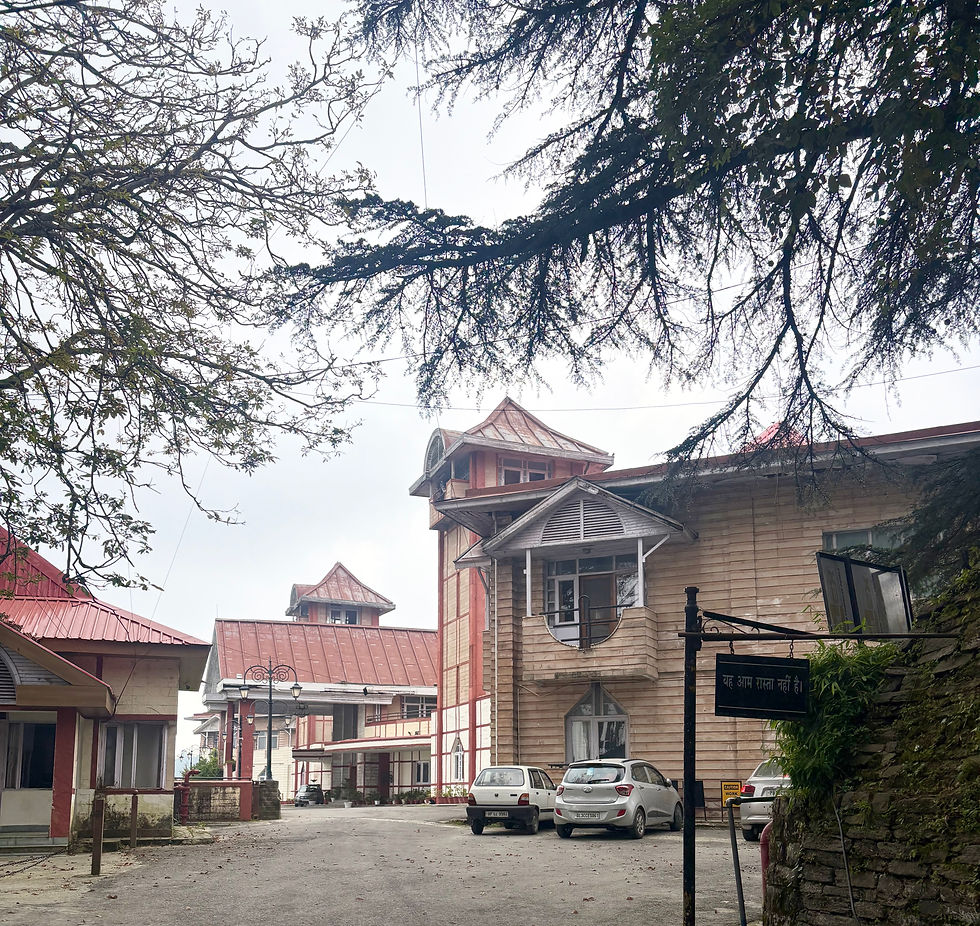
The original Peterhoff on this site served as the Viceroy’s residence before the construction of Viceregal Lodge, the destination of this walk. In Simla, Past and Present, Edward John Buck painstakingly catalogues the residences occupied by every Viceroy—and, before 1858, Governor-General—during their stays in Simla.
The first Governor-General to visit Simla was the Earl of Amherst, who stayed in Kennedy House (pictured earlier) in 1827. The house belonged to Charles Pratt Kennedy, the East India Company’s liaison with the region’s princely states. Amherst left with an unfavourable impression of the town.
The fragility of life in Amherst’s time emerges from Buck’s breezy account: “The earl quitted it in June under the belief that the vegetation which springs up rapidly in the monsoon made Simla unhealthy, and his medical officer and two civilians attached to his staff died from cholera at Pinjore, near Kalka, on the return journey to the plains.”
While the Earl of Amherst was the first Governor-General to set foot in Simla, it was not until 1830 that the hill station formally became a British town. His successor, Lord William Bentinck, was therefore the first to reside there in an official capacity. In fact it was Bentinck who negotiated the acquisition of 4,000 acres from the rulers of Patiala and Keonthal for the hill station. A dak bungalow was demolished to make way for his residence. The site of “Bentinck’s Castle” later became the Grand Hotel, where we stopped in the previous post.
In 1833, the incumbent Commander-in-Chief (C-in-C) of India, Sir Edward Barnes, resigned after repeated clashes with Bentinck over military budget cuts. The British authorities appointed Bentinck to the post as well, making him the last person to hold the dual offices of Governor-General and C-in-C, until his departure from India in 1835.
After Bentinck’s departure, Buck lists a succession of residences occupied by the Governor-Generals, including Auckland House, now home to a school. Peterhoff became the official residence in 1863 and retained that status until Viceregal Lodge superseded it in 1888. Initially rented from the Raja of Sirmoor, Peterhoff was eventually purchased by the Imperial Government.
The first Viceroy to reside at Peterhoff was the Earl of Elgin, who arrived in Simla in the summer of 1863. Elgin’s stay at Peterhoff was brief: he died of a heart attack while on official tour in the Himalayan region.
Buck writes that the residence stood either on or adjacent to a native graveyard. The management of the Peterhoff Hotel is probably not keen to publicise this detail. Those planning a stay may be reassured to learn that Tripadvisor reviews make no mention of spectral encounters. However, during the Raj era, typhoid outbreaks among successive Viceroys’ households were attributed to the graveyard’s proximity.
Below is an illustration of the original Peterhoff, reproduced from Edward Buck’s book. The building burnt down in 1981, by which time it served as the residence of the Governor of Himachal Pradesh:

In 1864, Elgin’s successor at Peterhoff, Viceroy John Lawrence, made Simla the summer capital of British India. His doctors had made a hill residence a condition of his accepting the post. In a letter, he famously wrote, “I believe that we will do more work in one day here (Simla) than five down in Calcutta.” Lawrence explained that he spent five months of the year there because he could serve the Company “more laboriously and more effectively” than in the plains. Few empires have made a more convincing case for the virtues of remote work.
Collins and Lapierre describe the move up the hills of the imperial entourage thus:

Before the Kalka–Simla toy train began operating in 1903, the Viceroy and his entourage would disembark at Kalka railway station and make the 40-mile uphill journey by horse-drawn tonga, a trip that took eight hours. The sahibs’ baggage followed by bullock cart or on the backs of coolies. Collins and Lapierre write:
Long lines of coolies bore upon their work-bent spines an interminable flow of cases full of potted shrimp, foie gras, sausages, Bordeaux, champagne to supply the banquets which gave Simla’s season an elegance unparalleled in India.
The expense of moving the government to Simla each summer was roundly derided by the Anglo-Indian and native press. Buck’s copious quotations from Viceroys’ correspondence, portraying them as laboring tirelessly in Simla seems to be a case of “the lady doth protest too much”. It is hard to summon much sympathy for the sacrifice Buck attributes to Lord Northbrook:
Lord Northbrook was the only Viceroy since the days of Canning to spend a summer in Bengal. He stayed there during the Bengal and Bihar famine of 1874, and he left on record that a heavy price was paid for this act of self-sacrifice in the ill-health of many of the officers of Government and of the principal members of his staff.
I, for one, reserve my sympathies for those who perished in the famine.
Peterhoff does not seem to have been a particularly pleasant home, at least for a Viceroy. Lord Lytton, Viceroy from 1876 to 1880, described it as a “pigsty”. Although Lytton chose Observatory Hill as the site for Viceregal Lodge, he did not remain in office long enough to occupy the new residence, which was completed after his departure.
Buck recounts an eyewitness account of the changing of the guard at Peterhoff, when Viceroy Lytton handed over to his successor, Lord Ripon, in 1880. The transition followed an odd tradition: the outgoing Viceroy hosted a final state dinner for his successor at his official residence, then departed, leaving both the guests and the house behind. This meant that Lady Lytton dressed for dinner in her own room, never to see it again. The old Viceregal household gradually melted away, leaving Ripon and his staff in quiet possession of Peterhoff.
Following partition, the Punjab High Court relocated from Lahore to Peterhoff. In 1949, a verdict of death penalty was given to two convicts at the Peterhoff court. They were Nathuram Godse and Narayan Apte.
The original trial had taken place before a Special Court at Delhi’s Red Fort. Nine principal defendants, including Godse, co-conspirator Narayan Apte and Hindu Mahasabha leader Veer Savarkar, faced charges. On 10 February 1949, the court acquitted Savarkar for lack of corroborating evidence, sentenced Godse and Apte to death, and condemned five other conspirators to life imprisonment.
The seven convicted men appealed to the East Punjab High Court in Simla. The proceedings at Peterhoff moved swiftly, and judgment was delivered in June. Two appellants were acquitted, while Godse and Apte’s death sentences were upheld. Godse, who had declined to mount a defence and accepted responsibility for the assassination, had not appealed his death sentence itself. Instead, he challenged his conviction on the conspiracy charge, seeking to shield his co-defendants.
Perhaps you are in the Gandhi camp or on Godse’s side. Maybe you are a centrist whose position depends on which political party you happen to represent in the legislature at any point of time. Whatever your persuasion, Peterhoff is worth visiting while in Shimla.
After the High Court moved to Chandigarh in 1955, Peterhoff became a state guest house. In 1971, when Himachal Pradesh achieved full statehood, it became the Governor’s residence, a role it held until 1981, when a fire destroyed the building.
From Peterhoff, you can see the All India Radio (AIR) building below:

The site once housed a residence called Valentines, which became home to the Foreign Office for more than a decade from 1875. After the office moved out, the house was leased by Colonel Henderson.
The house acquired historical significance during the Second World War, when it accommodated the Burmese government-in-exile. Some historical context is useful here.
Britain fought three wars against Burma between 1824 and 1885, seeking to secure its Indian borders and gain access to valuable resources such as timber and rice. Through these wars, it gradually annexed Burmese territory, finally overthrowing the last king of the Konbaung dynasty in the Third Anglo-Burmese War. Assam and Manipur, independent kingdoms threatened by Burmese expansion, came under British control following the First Anglo-Burmese War.
In 1886, Burma was absorbed into British India as a province. Rangoon had fallen to the British in 1852, and it was there that the last Mughal emperor, Bahadur Shah Zafar, was exiled in 1858. The royal capital, Mandalay, fell in 1885; decades later, Bal Gangadhar Tilak would be imprisoned in Mandalay Jail from 1908 to 1914. Burma was something of a British warehouse for troublesome Indians.

Image: the Prince and Princess of Wales driving through the streets of Mandalay in 1906
Source: Library of Congress
By the 20th century, Burma had developed its own nationalist movement, with Aung San Suu Kyi’s father emerging as one of its leading figures. Recognizing that Burma’s economic and cultural concerns differed sharply from India’s, the British separated it from British India in 1937, making it a Crown Colony with its own legislature.
In doing so, they may have spared Nehru a separatist headache. Or perhaps not. Aung San might simply have joined the illustrious list of Sheikh Abdullah, Periyar, Angami Zapu Phizo and Laldenga. The more, the merrier.
When the Japanese Imperial Army overran Burma in early 1942, the British colonial administration, led by Governor Sir Reginald Dorman-Smith, fled to Simla and re-established itself in exile at Valentines. There, officials drafted extensive policy documents, known as the Simla Blueprints, for Burma’s postwar reconstruction.
When Dorman-Smith and his administration returned to Rangoon in October 1945, they brought the Blueprints with them. They then attempted to arrest nationalist leaders such as Aung San, badly misjudging the strength of Burma’s independence movement.
Shimla historian Siddharth Pandey, writing in The Tribune, recounts discovering a rare exchange at the British Library between the government-in-exile and the Burma Office in London. The former sought better infrastructure in Simla, including “well-furnished houses”. But Governor Dorman-Smith’s request for a motor car ran into the hill station’s strict motoring hierarchy. “The Viceroy, Commander-in-Chief and the Governor of Punjab are the only people permitted to use a motor car in Simla,” came the reply, “and I would have thought the Governor of Burma could well travel by rickshaw like everyone else.” A subsequent response was even more curt: “I see no reason why the Governor should have a motor car at Simla.”
After independence, Valentines was repurposed as a government office and renamed Himachal Dham. When the building burned down in 1957, the site was redeveloped for the All India Radio building, which Raaja Bhasin describes as “four rockets lashed together and grounded against their will.”
In 1974, a young man auditioned for a job as an announcer at the Simla AIR. He was flatly rejected. If only AIR Shimla had the foresight to hand Anupam Kher a microphone, we might have been spared decades of his cinematic histrionics including the career defining role as the screeching, pink-wigged gay caricature in Mast Kalandar
I walked back down to Chaura Maidan Road, passing Armsdell, the present-day residence of the Chief Justice of the Himachal Pradesh High Court:

Armsdell was once the residence of Demetrius Panioty, Assistant Private Secretary to Viceroy Lord Ripon in the 1880s. The Panioty Fountain, erected in his memory in 1898, still stands in Kolkata’s Esplanade, though in a dilapidated state:

Source: Wikimedia Commons
During Lord Reading’s viceroyalty (1921–1926), the Vicereine established a rest house for nurses at Armsdell.
Returning to my earlier observation about the fragility of life in the 19th century, Edward J. Buck offers another breezy account of a fatal accident: “Another fatal accident I may mention occurred on the occasion of the first Queen’s Birthday ball, given by Lord Mayo at Peterhoff. After the dance was over two young officers mounted the same pony, and one was thrown over the khud near Armsdell and killed on the spot.”
Walking ahead, the Shimla Circuit House comes into view on the left:

Like dak bungalows, circuit houses were built during the British Raj as rest stops for a select category of government employees. Over time, they evolved into something akin to hotels, opening their doors to private citizens as well.
Walking towards Viceregal Lodge, I admired Shimla’s cleanliness and order:

A comparison of the Shimla and Darjeeling Town Halls, pictured below, offers a telling illustration of the Himachal government’s administrative superiority:

Even between my two visits, just a few months apart, I noticed improvements. In the picture below, for instance, the tangle of wires in the left panel has disappeared in the right. The Shimla municipality has been moving overhead wires underground, improving not just the aesthetics but also public safety.

At last, the gates of Viceregal Lodge came into view—the pièce de résistance of this walk:

Viceregal Lodge stands on Observatory Hill, one of Shimla’s seven hills. As noted earlier, the site was chosen during Lord Lytton’s viceroyalty (1876–1880). Peterhoff, the Viceroy’s residence since 1863, had proved uncomfortable for most of its occupants. Yet no Viceroy was willing to shoulder the expense and effort of a new building that he would scarcely have time to enjoy.
The project was finally completed in 1888, during the viceroyalty of the Earl of Dufferin. Lady Dufferin must have welcomed the move to the new digs, having written the following about Peterhoff:
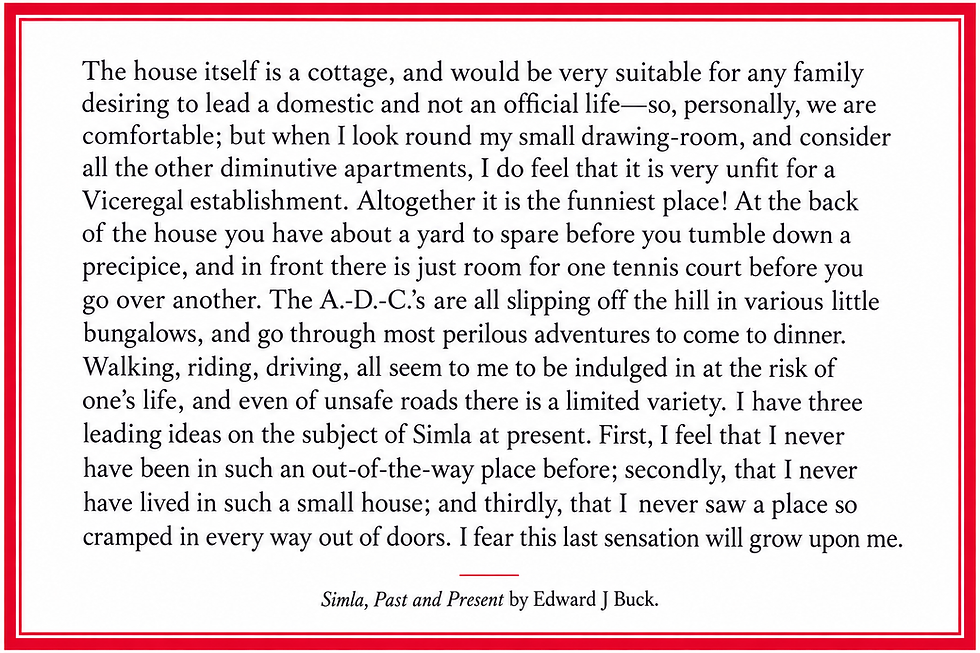
Edward Buck writes, rather ominously, “When Lord Dufferin made up his mind that a thing should be done, whether it was the annexation of a new province, or the building of a new house, it generally was done.”
Seeking a distraction from his day job, Dufferin visited the construction site almost daily. Perhaps, having annexed Upper Burma and deposed King Thibaw, he needed a less consequential occupation. History records his determination, but not the colorful words his subordinates said after these daily inspections.
The Dufferins seem to have been in rather unseemly haste to enjoy their new home. The rushed construction left the Viceregal Lodge structurally deficient, casting doubt on its stability and necessitating substantial annual expenditure on repairs.
The estate is so vast that there is still considerable walking to do after passing through the gates:

Those unable to walk can be driven right up to the entrance for drop-off, though cars must otherwise be parked outside the gates.
A short walk brings you to a small annex building on the left:

Leaving the annex behind, I walked along the beautiful campus road. To be fair, however, even Shimla’s public roads are almost as clean and well-maintained:

Soon, I was rewarded with my first glimpse of the side façade:

And finally, there it stood: the majestic Viceregal Lodge:

It is curious to reflect that even the grandest residence is, to its occupants, merely a home. When the Viceroy’s family moved from the much-despised Peterhoff to Viceregal Lodge, the Vicereine recorded in her diary:
We really inhabit the new Viceregal Lodge today (23rd July, 1888) so I left the old directly after breakfast, just returning there for an hour at lunch-time, and busied myself whole day arranging my room and my things, and the furniture in the drawing-room.
In another diary entry, Lady Dufferin voices a concern about her new home:
there is, moreover, a laundry in the house. How the dhobies will like it at first I don’t know. What they are accustomed to is to squat on the brink of a cold stream, and there to flog and batter your wretched garments against the hard stones until they think them clean. Now they will be condemned to warm water and soap, to mangles and ironing, and drying rooms, and they will probably think it all very unnecessary, and will perhaps faint with the heat.
The civilising mission had reached the laundry, where the principal obstacle to progress appeared to be the dhobis themselves.
Viceregal Lodge was no ordinary residence. It soon became the social epicentre of Simla’s elite. Writing in 1925, Edward Buck observed:
Society in Simla has so much grown that whereas in Lord Lytton’s day at Peterhof ’ the official parties did not exceed 400 persons, over 800 are now invited to the state ball in Viceregal Lodge and the annual levee held by the Viceroy in June is attended by an average of nearly 350 officers and officials.
Ever wondered where India’s VIP culture comes from? In Freedom at Midnight, Collins and Lapierre recount how the elite’s rickshaws carried red rosettes, entitling them to use the Viceroy’s private entrance to Viceregal Lodge. Those bearing white rosettes had to use the public gate.
Viceregal Lodge hosted two events of immense significance to the making of modern India.
The first was the Simla Conference of 1945, convened by Viceroy Archibald Wavell. Historian Ramachandra Guha argues that Wavell deserves more credit than his flamboyant successor, Mountbatten, for facilitating the end of British rule in India. According to Guha, Wavell was sympathetic to Indian nationalist aspirations and worked tirelessly to devise a practical, time-bound plan, lending momentum to the goal.
This is particularly remarkable given that Wavell was appointed by Churchill. As Commander-in-Chief of India during the Quit India Movement, he might well have regarded civil disobedience at home as a nuisance while Britain was fighting the Japanese. Yet, as Viceroy, he worked towards a negotiated transfer of power.
In the summer of 1945, Wavell invited Indian leaders to Viceregal Lodge to discuss his plan for power-sharing. It proposed reconstituting the Viceroy’s Executive Council, with every portfolio, including foreign affairs and finance, held by Indians except those of the Viceroy and the Commander-in-Chief. The new council would have equal representation for “Caste Hindus” and Muslims.
To facilitate the talks, Wavell ordered the release of the entire Congress Working Committee, including Nehru, Patel and Maulana Abul Kalam Azad, who had been imprisoned for nearly three years:

Image: From Left to Right: Rajendra Prasad, Mohammad Ali Jinnah, C. Rajagopalachari, Unknown, Maulana Abul Kalam Azad at Viceregal Lodge
Source: Wikimedia Commons
The conference ended in deadlock. Jinnah insisted that the Muslim League was the sole legitimate representative of Indian Muslims and demanded the right to nominate every Muslim member of the council. He also wanted a guarantee that any decision opposed by the Muslim members could pass only with a two-thirds majority.
Congress, represented at the conference by its president, Maulana Abul Kalam Azad—a Muslim—vehemently rejected these demands. Conceding them, Congress argued, would reduce it to a purely “Hindu” party.
After the Simla Conference collapsed, the British called provincial and central elections for the winter of 1945–46. The results were stark: Congress swept the general (non-Muslim) seats, while the Muslim League won the overwhelming majority of Muslim-reserved seats. Jinnah’s gamble at Simla had been vindicated at the ballot box.
It is important to appreciate the nuance here. These elections were not conducted under universal adult franchise. Governed by the provisions of the Government of India Act, 1935, the franchise was restricted by criteria such as property ownership, payment of land revenue, literacy and educational qualifications. The results, therefore, tell us what only a fraction—roughly 10%—of Muslims in the subcontinent thought of Jinnah.
At the same time, it is fair to acknowledge that in the prior 1937 elections, the Muslim League had performed poorly in the provinces that would later form Pakistan. Its few victories came mainly in Muslim-minority provinces, such as the United Provinces and Bombay, where middle- and upper-class Muslims feared economic and political marginalization under Hindu-majority rule. Clearly, something had changed by 1945–46, and Jinnah’s intransigence at Simla was not without political justification.
According to an account by Captain Praveen Davar, whose father, M. C. Davar, was a senior Congress leader who participated in the Simla Conference, Nehru stayed at Armsdell, the house we passed earlier. The photograph below of Nehru in a rickshaw (hopefully sporting a red rosette) must therefore show him commuting between Viceregal Lodge and Armsdell, barely a ten-minute walk apart.

Source: Wikimedia Commons
I found the elder Davar’s throwaway claim that Nehru routinely walked back from Mashobra, more than 10 kilometres away, after dinner somewhat harder to swallow.
The second historically significant event at Viceregal Lodge was a meeting convened by Lord Mountbatten in 1947. Lapierre and Collins recount the proceedings in their characteristically racy style. What follows is my summary.
Mountbatten arrived in India in March 1947 to dismantle the very empire that was the jewel in the crown of his great-grandmother, Queen Victoria. Most historians agree that he made a hash of the job. In his defence, though, the bloke never wanted it. Clement Attlee, elected Labour Prime Minister in 1945 on a promise to relinquish the empire, chose Mountbatten for the unenviable task because of his experience in Southeast Asia, where he had dealt with nationalist leaders including Sukarno, Aung San and Ho Chi Minh.
By the time Attlee made the offer, communal violence was raging across India in anticipation of Partition. The bloodshed was widely seen as merely an appetiser for the carnage to come. Mountbatten wanted no part of the assignment and tried to dissuade Attlee with a series of idiosyncratic demands, including stipulating how many secretaries he could bring and which aircraft he would have at his disposal. To his dismay, the Prime Minister agreed to his preconditions.
Mountbatten set about devising Britain’s exit plan, while his wife, Edwina, regaled Nehru in the very gardens of Viceregal Lodge where I now stood:

Source: Wikimedia Commons
Besides his frivolous demands, Mountbatten had secured plenipotentiary powers from Attlee, allowing him to determine the terms and timetable of Britain’s withdrawal directly from Viceregal Lodge, without having to keep cabling London for the Cabinet’s approval.
Armed with these powers and never short of confidence, Mountbatten devised a plan to divide India into three parts rather than two. The third was to be a united Bengal, provided both Bengali Hindus and Muslims agreed. The idea came from a Bengali Muslim politician, and Mountbatten ran with it. He even shared the proposal, dubbed the Dickie Bird Plan (viewers of The Crown will recognize Dickie as Mountbatten’s nickname), with London without first consulting Nehru and Patel.
In May 1947, Mountbatten invited Nehru to stay at the Lodge in Simla as his personal guest, against the advice of his staff, who considered such gestures of familiarity inappropriate for a supposedly neutral mediator between Congress and the Muslim League. By then, Mountbatten was getting nervous about having kept his plan to trifurcate India from Nehru. He therefore invited him to his study for a glass of port and casually handed him the draft for bedtime reading.
If Mountbatten intended the document as a cure for insomnia, it worked. A horrified Nehru stormed into the bedroom of his associate Krishna Menon—the very man who would help architect the China debacle more than a decade later—and flung the document at him in frustration. Mountbatten, who had considered trifurcation as a solution to the infeasibility of a two-headed Pakistan, presumably anticipated 1971 but not the immediate reaction of the Congress. It takes a far-sighted man to anticipate the breakup of a country; it takes an exceptionally optimistic one to expect everyone to applaud the idea in advance.
Mountbatten then summoned a more illustrious Menon: V. P. Menon, the highest-ranking Indian official on the Viceregal staff, to redraft the independence plan, leaving the provinces and princely states with just two options: India or Pakistan. Announced on 3 June 1947, the Mountbatten Plan became the framework for Partition. After independence, Menon would become Patel’s enforcer, making the princely states “offers they couldn’t refuse.”
Gazing up at the tower before me, I tried to imagine all this drama unfolding behind its walls:

At the top of the picture below, you can see a set of inscriptions:

The left panel reads “HENRY IRWIN C.I.E. / ARCHITECT”. Henry Irwin was the chief architect who designed the Lodge. C.I.E. stands for Companion of the Order of the Indian Empire, a British order of chivalry awarded to him.
The central panel reads “RASHTRAPATI NIWAS / BUILT DURING THE VICEROYALTY / OF HIS EXCELLENCY THE EARL OF DUFFERIN / 1884 TO 1888”. These are the Lodge’s construction years, spanning Lord Dufferin’s viceroyalty. “RASHTRAPATI NIWAS” was carved over the original inscription after independence, when the building briefly served as a presidential retreat.
The right panel reads “F B HEBBERT / AND HON’BLE L M ST CLAIR / EXECUTIVE ENGINEERS”. They were responsible for executing Irwin’s architectural plans.
Above the central panel is a carved stone crest featuring a crown, a central shield, crossed banners and a radiating sunburst. Its imagery draws on British imperial heraldry, including associations with the Order of the Star of India, symbolizing the Crown’s authority over the viceregal seat.
President Dr S. Radhakrishnan felt that the vast estate was underutilized and transferred it to the Ministry of Education to serve as a centre for higher academic learning. In 1965, the building was formally inaugurated as the Indian Institute of Advanced Study (IIAS), which it remains today.
We saw Shimla’s connection with Burma in the All India Radio (AIR) building. The IIAS offers another: Aung San Suu Kyi was a Fellow here for two years in the late 1980s.
The Viceregal Lodge grounds are free to enter. Exploring the building itself, however, requires a modestly priced ticket for a guided tour, available from the souvenir shop pictured below, next to the main building:

The guided tour lasted half an hour and covered three halls, each doubling as a photographic museum. Their displays included rare photographs from the British Raj, among them images from the Simla Conference mentioned earlier.
Photography is prohibited inside the building, so the picture below is sourced from the web:

Source: Wikimedia Commons
The picture above shows the liberal use of Burma teak. As travellers in India often discover, even the most trivial details conceal a complex history. Teak, for instance, played a significant role in the Third Anglo-Burmese War mentioned earlier.
By the 1880s, the once-mighty Konbaung Empire had already lost its coastal territories and Lower Burma in two wars with the British. What remained was the independent kingdom of Upper Burma, ruled by King Thibaw from Mandalay. The British grew increasingly suspicious of Thibaw’s efforts to cultivate ties with France, which was actively expanding its own empire in Indochina.
In 1885, the Burmese royal court accused the Bombay Burmah Trading Corporation, a British logging firm, of extracting teak without declaring it, and threatened to confiscate its timber. Seizing the dispute as an opportunity to intervene and forestall French influence, Viceroy Dufferin demanded that King Thibaw submit the matter to British arbitration, admit a British envoy to Mandalay, and surrender control of Burma’s foreign relations. Thibaw refused.
On 14 November 1885, the British launched an invasion up the Irrawaddy River. The war lasted barely two weeks, as the poorly equipped Burmese royal army was swiftly overwhelmed. British forces captured Mandalay, and King Thibaw and his queen were exiled to Ratnagiri, India, where they would spend the rest of their lives. The British Empire ran a two-way service for deposed royalty: Bahadur Shah Zafar went to Burma; Thibaw came to India.
Having spent so much on the war, one can hardly begrudge Lord Dufferin a little Burmese teak for his new abode.
Walking back from the Lodge, I imagined the parked cars pictured below replaced by rickshaws sporting red rosettes:

It was time to make my way back to my hotel on the Mall.
Summing Up
The first week of October is a lovely time to visit Shimla. I have heard that the town gets uncomfortably crowded during the summer holiday peak, while the monsoons increasingly bring the risk of landslides. From October to April, Shimla is an appealing destination for Delhi residents. The road from Chandigarh to Shimla is a four-lane highway for roughly 90 percent of the journey, sparing travellers the queasiness often associated with hill-station drives, with their hairpin bends, blind spots and steep climbs.
During my week-long stay in October, it rained heavily on just one day. The temperature drops noticeably when it rains, though, making it quite chilly.
Unlike Darjeeling, where the mountains are forever playing hide-and-seek in the mist, views in Shimla are mostly clear outside the monsoon. I did, however, catch one precious moment from my hotel balcony as the mists began to lift:

The contrast between the views by day and by night is equally alluring:

Lapierre and Collins describe Shimla as “the most bizarre product of the British Raj, a strangely anomalous, consummately English creation planted in the Himalayan foothills, poised disdainfully above the scorched and over-populated plains of India, cool, green and unmistakably English”. I, for one, am glad Shimla exists—and has not been destroyed, despite its easy accessibility from Delhi.


Comments