The Shimla Mall: Part 2
This is the second installment of a two-part essay drawn from my four-day stay on the Mall in Shimla. In Part 1, I described my walk along the pedestrianized tourist stretch of the Mall and the Ridge—the bare minimum expected of a “Mall” excursion. This post explores a few additional sites for those with more time to wander through the area.

As mentioned in the previous post, the “Mall” actually unfolds across four levels. The highest tier comprises Kali Bari Road and Lakkar Bazaar, followed by the Ridge, then the Upper Mall—which, strictly speaking, is the actual Mall Road. Finally comes the Lower Bazaar.
In this essay, I complete my walk along the Upper Mall before turning to the adjoining stretches of Kali Bari Road, Lakkar Bazaar, and the Lower Bazaar.
Mall Road: Beyond the Tourist Hotspot
While most visitors experience only the kilometer-long pedestrianized retail stretch, Mall Road extends for more than three kilometers. Part 1 traced my eastward walk from the western edge of the tourist zone, at the Central Telegraph Office (CTO) building, to the road’s eastern end. In this post, I head west from the checkpoint at the CTO (pictured below) toward the road’s western terminus.

Looking down from Mall Road, one can see a campus of buildings crowned with sloping green roofs:

The campus, built between 1882 and 1885, houses the headquarters of the Army Training Command (ARTRAC), the Indian Army’s think tank. The Indian Army is divided into seven commands, of which ARTRAC is responsible for doctrine and battle strategy, while the other six are operational commands overseeing distinct geographic regions.
The first Commander-in-Chief (C-in-C) to set foot in Shimla was Lord Combermere in 1825. Some historical context is useful here. For most of the 19th century, the three Presidencies—Bengal, Bombay, and Madras—maintained their own armies. Though the C-in-C was notionally responsible for the entire country, his direct control extended only over the Bengal Army.
In 1895, the three Presidency armies were amalgamated into a single force and divided into four territorial commands: Bengal, Bombay, Madras, and Punjab. While the 1895 legislation created an “Indian Army” on paper, it was Field Marshal Kitchener who forged it into a genuinely unified organization. In 1908, Kitchener reorganized the army into two commands—Northern Command, headquartered in Rawalpindi, and Southern Command, headquartered in Pune—though the four-command structure was revived after the First World War.
Kitchener could hardly have guessed that decades later Rawalpindi would become a thorn in the side of both Indian and Pakistani politicians. Or perhaps he should have, because even during the British Raj, friction between the Viceroy and the C-in-C was common. Kitchener himself had a famously testy relationship with Viceroy Lord Curzon. One of their disputes concerned the Viceroy’s control over the military’s administrative functions—an argument the C-in-C ultimately won, prompting Curzon’s resignation. In modern-day Pakistan, Curzon may have discovered that arguing with the C-in-C can lead to outcomes rather more permanent than resignation.
Lord Kitchener, who had hoped to become Viceroy, was not content being “merely” C-in-C. Though the post came with an official residence, he chose instead to rent Wildflower Hall in Mashobra, about a thousand feet above Shimla. From there, he is said—perhaps apocryphally—to have remarked, “I always wanted to live four hundred meters higher than the Viceroy of India.”

Image: Wildflower Hall 1896
The building pictured above was demolished in 1925 to make way for a hotel, but that too was gutted in a fire in 1993. The hotel that now occupies the site is run by the Oberois.
Following the First World War, the Army was reorganized into four permanent commands: Northern, Southern, Eastern, and Western. At Partition, the Northern Command, headquartered at Rawalpindi, was ceded to Pakistan. Though the Western Command also went to Pakistan, it was re-raised after Independence. India operated with three commands until the Sino-Indian War of 1962, after which four additional commands were gradually created in response to emerging strategic challenges.
The Commander-in-Chief’s office moved into the present ARTRAC headquarters in 1885 and remained there until 1939. After Independence, the Western Command shifted here in 1954 and stayed until 1985, when it moved to Chandimandir near Chandigarh. ARTRAC took over the campus in 1993.
A panoramic view of the premises can be seen from Kali Bari Road:

An information placard beside the Army Memorial statue on Mall Road (pictured below) notes that the ARTRAC site originally housed the Masonic Lodge—the Freemasons’ presence in Shimla was briefly mentioned in the previous post—before later serving as the Government Press and eventually becoming the summer headquarters of the British Indian Army.

It is thrilling to think that much of the strategic planning for the two World Wars, as well as the Indo–Pak wars of 1965 and 1971, unfolded within these buildings.
In the fall of 1921, a 27-year-old Brigadier John Tiltman arrived from London to work in these buildings. His job was to snoop on telegraph traffic between Afghanistan and Russia, for which the British had installed two radio interception stations in what is now Pakistan.
Some historical context helps explain Tiltman’s work. Imperial Britain had long treated Afghanistan as a buffer state designed to keep Russia at arm’s length from India. The Third Anglo-Afghan War (May–August 1919) ended with Britain formally recognizing Afghanistan as a fully sovereign nation, thereby ending its status as a British protectorate. The Durand Line was reaffirmed as the political boundary between Afghanistan and British India, now Pakistan.
Afghanistan’s independence, coupled with the arrival of the Bolsheviks in Russia and their declared intention to dismantle Western imperialism, deeply alarmed the British. It was against this backdrop that Tiltman arrived in Shimla. He later provided a riveting account of his eight-year stint at Army Headquarters there.
A couple of comic incidents stand out from Tiltman’s Shimla chronicles.
Tiltman recounts that in 1925, when the Government of India sent the army to quell unrest in Waziristan on the northwest frontier, the Russian ambassador in Afghanistan dispatched a cipher telegram to Moscow asking what joint action Russia and Afghanistan proposed “in view of the occupation of Waziristan.” An interpreter mistranslated this as “with a view to the occupation of Waziristan,” turning a reference to an ongoing British operation into what appeared to be a plan for a future joint invasion. The error briefly alarmed Army Headquarters in Delhi until the translation was reviewed and corrected, after which Tiltman was instructed to verify such translations himself.
As generations of hapless English teachers have reminded their students: prepositions matter.
The second tale concerns a 1926 episode involving two Russian cipher clerks in Kabul—Kolluv and Serafimovich. The latter, prone to mistakes brought on by frequent hangovers, proved unreliable. After repeated errors, Moscow ordered that every cipher message be signed—in cipher—by the responsible clerk, appending long numerical signatures (“Zachifrowan Kolluv” or “Zachifrowan Serafimovich”). The added verbosity increased the volume of interceptable material available to Tiltman. One man's vodka is another man's work.
The episode ended abruptly when Serafimovich himself deciphered a message recalling him to Moscow. He sought refuge at the British Embassy, was turned away, and was never heard from again. Serafimovich finally decoded something correctly, and it ruined his life.
Tiltman’s cryptanalysis work in Shimla began first as a military employee and later as a War Office civil servant bearing the wonderfully archaic title “Signal Computor.” Walking along Mall Road, I imagined John Tiltman tracing the same path after a hard day’s work at codebreaking:

In 1929, John Tiltman returned to London to join the Government Code and Cypher School, later headquartered at Bletchley Park. Though he was not directly involved in breaking the German Enigma codes during the Second World War, his work contributed to that seminal effort. It was thrilling to uncover this unexpected connection between Bletchley Park and Shimla.
The Enigma machine was analogous to a typewriter in which the output letter differed from the one keyed in; the relationship between input and output depended on the machine’s settings at the moment of typing. Tiltman, however, specialized in linguistic ciphers rather than machine-based systems of this kind.
Many such ciphers relied on obscure works of literature. After returning to London from Shimla, Tiltman often found himself hunting down little-known novels and poetry anthologies while tracking Moscow-backed networks in Europe. A recurring complication was the existence of separate American and British editions of the same book, which could differ in pagination—and sometimes even in the poems included.
Fans of Sherlock Holmes will recognize a similar device in The Valley of Fear: a message encoded as a series of numbers (e.g., 534 C2 13), which Holmes identifies as a book cipher. Such codes require sender and receiver to share the exact same edition of a text, with numbers referring to page, column, and word. Holmes and Dr. John Watson reason that the book must be widely available; after dismissing the Bible and Shakespeare, they settle on Whitaker’s Almanack. Using the 1894 edition on his shelf, Holmes initially produces gibberish, before realizing that—given the date—the sender must have used the newly published 1895 edition.
Walking west along Mall Road, you can see the rear façade of the SBI Building on your left:

In the 1925 edition of Simla: Past and Present, Edward John Buck includes an 1846 lithograph by George Powell Thomas depicting the house that originally stood on this site:

The SBI building stands on the site occupied by the shed on the left in the picture above. The Bank of Bengal purchased the property in 1907 and constructed the building that survives today. In 1921, the Bank of Bengal merged with the other two Presidency banks to form the Imperial Bank of India, which eventually became the State Bank of India.
The house at the center of the sketch above was sold in 1890 to the hotelier Florence Elizabeth Hotz. The Hotz family ran the hotel until 1972, when it was sold to Indian owners. The establishment survives—now spelled “Dalziel”—though its reviews suggest that longevity has not necessarily been matched by affection.
Just a few steps beyond the SBI Building stands the Railway Board Building:

Beginning in 1853, when the first railway line opened between Bombay and Thane, Indian railways were initially built largely by British private companies. The government provided free land and guaranteed a 5 percent annual return on investment. A state-backed guarantee against losses, with no ceiling on profits, was too attractive a proposition to ignore. Indian railways consequently absorbed vast amounts of British capital and became a major investment market in the late nineteenth century.
The government retained some technical oversight through the Public Works Department (PWD) and reserved the right to purchase the lines later. Readers familiar with the PWD may wonder whether the railways of that era ran on steam or divine intervention.
By the 1870s, however, the system of guaranteed private returns was considered too expensive, and the government began assuming a larger role in railway construction and operations. What emerged was a hybrid arrangement involving privately owned lines, state-owned lines, and state-owned but privately managed lines. The coexistence of multiple business models, combined with the rapid expansion of the network, made decentralized regulation through local PWD units increasingly dysfunctional. The Railway Board was therefore established in 1905 to oversee Indian Railways, and it began operating from this building.
After Independence, the Railway Board moved to Delhi, but the red-and-white structure, now occupied by other government departments, still retains the legacy name.
Edward John Buck records that the Railway Board site once housed two residences—Lowville and Herbert House—which were first rented and later demolished by the government. A new building erected for the PWD, then the railways’ regulator, burned down on the night of February 12, 1896. The structure standing today was completed in August 1897.
A curious story attaches itself to the building that burned down. The man who oversaw its construction, Horatio Boileau Goad—better known as Horace Goad—was an Indian Police Service officer who later joined the Shimla Municipality. He committed suicide on the very night—February 12, 1896—that the building caught fire.
Buck writes that Indians in the station solemnly believed the blaze was “Goad Sahib’s” funeral pyre, especially since rumors claimed he had once jokingly predicted a disaster in Simla upon his death. Some even said they saw his spirit in the flames. Rational readers, however, will be relieved to learn that Goad was in Ambala at the time of his suicide, making any theory of arson difficult to sustain. But readers discerning enough to persist with this essay, armed as you are with a lively awareness of the distinction between correlation and causation, would surely never have entertained such suspicions in the first place.
In taking his own life, Goad was following in his father’s footsteps. His father, Major Samuel Thomas Boileau Goad, was incidentally one of Shimla’s largest landlords, owning thirty-three properties in the town. The elder Goad reportedly once chased the District Superintendent of Police around the station with a hog spear, forcing the officer to seek refuge in a friend’s bungalow. With classic British understatement, Buck notes that Major Goad was evidently “a gentleman of strong character.”
The younger Goad was reputedly the cleverest policeman in the North-Western Frontier Provinces. Buck writes: “Even the ayahs regarded him as a man to hold in awe; indeed many of the little ones they tended were quieted by the threat of being handed over to Goad Sahib unless they behaved as good children on the Mall.” But Horace Goad possessed one peculiar talent that made him one of the inspirations for Kipling’s character Strickland: the art of disguise.
In Kipling Sahib: India and the Making of Rudyard Kipling, Charles Allen writes that it became something of a parlour game in Shimla to guess the real-life inspirations behind Rudyard Kipling’s leading characters, and it was widely agreed that Strickland could only have been based on Horatio Boileau Goad. Like Goad, Strickland possessed a “native’s” knowledge of local customs, enabling him not only to adopt Indian disguises convincingly but also to serve as a bridge between British rationality and Indian superstition.
The sight of the Hanuman idol at Jakho Temple—perched atop Jakho Hill, the highest of Shimla’s seven hills, and visible from many points around the Mall area (pictured below, the idol rising above the treeline on the horizon)—brings to mind a famous Strickland story: The Mark of the Beast.

In the story, an Englishman named Fleete gets very drunk with his friends, Strickland and the narrator. On their way home, they stop at a Hanuman temple and in his drunken state, Fleete grinds his cigar butt into the forehead of the god's statue, an act that leaves his friends horrified. The temple priests are initially furious, but their anger turns to a strange calm when a leper crawls out and nuzzles his head against Fleete’s chest before disappearing back into the shadows. The next morning, Fleete develops a leopard-like mark on his chest and begins behaving like a wild beast—craving raw meat, sniffing the air like a predator, and terrifying even the horses that once knew him.
Strickland and the narrator capture the leper and use heated metal to torture him until he agrees to heal their friend. The leper touches Fleete’s chest, and the animal-like spirit immediately leaves him. The next morning, Fleete wakes up feeling like he has a bad hangover. The leopard mark on his chest has completely vanished. Although the local doctor is baffled and the temple priests later deny the incident ever happened, the narrator and Strickland remain deeply shaken, realizing they witnessed a mystery of the East that Western logic cannot explain.
In another story, Miss Youghal's Sais, Strickland adopts the identity of an Indian horse groom named Dulloo, living among the stables for three months without detection, even by fellow grooms. It is delightful to imagine Strickland’s real-life counterpart, Horace Goad, disguised as one of the cartmen pictured below, prowling the streets of Shimla in pursuit of a criminal:

Image: image of carts lined up outside Christ Church in 1860
Source: Library of Congress
Opposite the Railway Board building stands a quaint post office, its red-and-white colour scheme coordinating neatly with that of the Railway Board building:

A short walk further along brings you to the entrance of Gorton Castle:

The building currently houses government offices. Visitors therefore need to inform the guard that they are tourists, will not enter the offices, and intend only to view the exterior. Gorton Castle, with its illustrious history, is among the most beautiful buildings on the Mall:

Edward Buck recounts the history of the present building, which inherited its name from the house that once occupied the site. Gorton Castle was among the grandest residences in Shimla and passed through numerous owners over the nineteenth century, including British officials and wealthy residents. The name derives from an ICS officer, Mr. Gorton, who is recorded as the owner in 1840.
For a brief period, the property belonged to the Catholic Church. However, at the request of Lord Ripon (1880–1884), himself a Catholic, who wanted Gorton Castle as accommodation for his staff, the Church agreed to sell the estate in exchange for an alternative site on which to build a chapel. During this period, the house became famous for its dancing floor made of Andaman padauk wood, installed to demonstrate the quality of the timber.
In the late nineteenth century, the banker Sir James Walker purchased the property. According to one account, in 1899 the Surgeon-General discovered that Indian patients at Ripon Hospital had been displaced from several wards to make room for European patients, even though the hospital had primarily been intended for Indians. A committee was therefore formed to identify a separate site for a European hospital, and it selected Gorton Castle.
Walker generously offered the property free of cost for a hospital serving European patients. Residents, however, objected to the prospect of a hospital on the Mall, and the land was instead sold to the Government of India in 1900 for civil offices. A different site was chosen for what later became Walker Hospital, itself gutted in a fire in 1998. The old house was demolished, and the structure now known as Gorton Castle was completed in 1904.
The original design for Gorton Castle, later modified, came from Samuel Swinton Jacob, who spent most of his career in the princely state of Jaipur. He published the Jeypore Portfolio of Architectural Details, a massive six-volume compendium of technical drawings documenting Rajasthani architectural forms and decorative motifs so that architects could study and adapt them for new buildings. Jacob stands in striking contrast to Edwin Lutyens, who famously declared, “Personally, I do not believe there is any real Indian architecture or any great tradition.”
Walking past Gorton Castle, I paused to admire its majestic side façade:

There is an observation point that appeared to be a popular break spot for employees from the many nearby government buildings—the Railway Board, Gorton Castle, and the Post Office:

Looking out at the views from there, I found myself wondering how employees in the surrounding buildings managed to get any work done. Then again, being government workers, perhaps they do not. Ha!

A short walk beyond the observation point brought into view a majestic grey building—the Himachal Pradesh Vidhan Sabha:

The building was completed in August 1925 to house the Imperial Legislative Assembly. At the central level, British India had two principal authorities: the Secretary of State for India in London, who sat in the British Cabinet, and the Viceroy, based in India. The Viceroy, who reported to the Secretary of State, was assisted by the Imperial Legislative Council, historically a nominated body that included both the Viceroy and the Commander-in-Chief of India.
Following the Morley–Minto Reforms of 1909, the Imperial Legislative Council was expanded from sixteen to sixty members, of whom twenty-seven were elected. The move was intended to address growing demands for representation from the Indian National Congress. A century later, one suspects many veterans of the old boys’ club would have warmly approved of the modern solution to reservations: expand the table just enough that the incumbents need not surrender their own chairs.
By the time Lord Reading inaugurated the Legislative Assembly on August 20, 1925 (see the picture below from Edward Buck’s Simla: Past and Present), the Montagu–Chelmsford Reforms of 1919 had already introduced a bicameral legislature. The Imperial Legislative Council had been replaced by a Council of State (Upper House) with sixty members and a Legislative Assembly (Lower House) with 145 members.

The new building was intended to accommodate the larger Lower House; the Upper House met at the Viceregal Lodge, the Viceroy’s summer residence. Edward Buck recounts an amusing anecdote. Before the new chamber was built, the government consulted legislators across India on whether summer sessions should continue to be held in Shimla. Only one member objected. Asked why he preferred to work through Delhi’s heat, the gentleman replied that he had no intention of joining these new legislative bodies at all.
The practice of Shimla serving as the official summer capital of British India came to an end in 1939. The very idea of a summer capital had long been criticized as a boondoggle. Lord Curzon’s insistence that Shimla “is no longer a holiday resort of an Epicurean Viceroy and pampered Government” was perhaps a case of "the lady doth protest too much".
The outbreak of the Second World War forced a sudden shift in priorities. The annual migration of thousands of officials—and tons of paperwork—from Delhi to the hills was expensive and logistically cumbersome. Under the pressures of a “wartime emergency,” the government decided to remain in Delhi year-round in order to conserve resources and maintain closer coordination with the war effort. Though initially conceived as a temporary suspension, the practice was never revived.
The Legislative Assembly building subsequently found use as administrative offices for the state, before eventually returning to its original legislative function in the 1960s as the Vidhan Sabha of the Union Territory—and later the state—of Himachal Pradesh.

On the other side of the Vidhan Sabha, along Mall Road, stands the B. R. Ambedkar Library—reassuringly close at hand for legislators wishing to swiftly remedy any lingering knowledge gaps as they tirelessly serve the people:

Though the library building blends seamlessly with Shimla’s colonial aesthetic, it was opened only in 2019.
The Vidhan Sabha and the library mark the western terminus of Mall Road. Though not technically on the Mall itself, Kennedy Cottage—occupied by the Central Public Works Department (CPWD)—lies barely a minute away and is well worth a stop:

Some mistakenly assume this to be Kennedy House, the first pucca house in Shimla, built in 1822 by Captain Charles Pratt Kennedy. The actual house—pictured in the 1824 lithograph below—was demolished, and its original site now lies within the Vidhan Sabha premises.

Image: drawn by Major J. Luard in 1825, Printed by Graf & Soret in 1833
Source: Wikimedia Commons
In fact, the entire area—including the Vidhan Sabha and the CPWD building—once formed part of Captain Kennedy’s estate, which, according to Edward Buck, included Kennedy House, Kennedy Lodge, and Kennedy Cottage. The present CPWD building dates only to 1920, meaning that even this is not the original Kennedy Cottage.
The Kennedy Estate passed through several owners before being acquired by the government. One of them was the hot-headed Major Samuel Thomas Boileau Goad, whom we encountered earlier in connection with his son’s association with the Railway Board Building.
For those who have ventured this far west, it makes sense to walk another five minutes along Chaura Maidan Road from Kennedy Cottage to see the Cecil Hotel:

Source: Wikimedia Commons
The residential estate then known as Tendrils was purchased in 1902 by the Hotz family, who appeared earlier in this narrative as owners of the Dalziel Hotel near the SBI Building. Mrs. Hotz went on to build a small hotel empire across the Greater Shimla region, including the Cecil and Wildflower Hall, both now managed by the Oberoi Group. Mohan Singh Oberoi, as mentioned in Part 1, began his career as an employee at the Cecil.
In Simla: Past and Present, Edward Buck notes that during the 1840s the site contained a single-storied residence called “Tendril Cottage.” Around 1877, the cottage was demolished and replaced with three small rental flats. The Hotz family later added a much larger structure to the estate, which became the Cecil. In the photograph below from Buck’s book, the three Tendril flats—since demolished—can be seen in the extreme right foreground:

One of the three Tendril flats once had a famous tenant: Rudyard Kipling
Kali Bari Road
Kali Bari Road—the road on the right in the picture below—can be accessed from Scandal Point. The hill climbed by the road is Bantony Hill, one of Shimla’s seven hills.

The route takes you past the magnificent rear façade of the Central Telegraph Office (CTO) building, whose history was described in Part 1:

On your right stands the Saint Andrew’s Church building, now owned by the Municipal Corporation and home to a division of the Himachal State Library:

Edward Buck summarizes the history of St. Andrew’s Church, also known as the Scots Kirk—kirk being the Scots word for church—which stands behind and above the General Post Office (GPO) on the Mall chronicled in the previous post.
The church was built on the site of an earlier Union Church constructed in 1869. In 1897, internal difficulties within the congregation led the trustees to request that the Church of Scotland send a minister. After a series of temporary appointments, the Church of Scotland formally assumed control in 1905, transforming it into a regular Scottish church serving Shimla’s sizeable Scottish community. Reverend James Black became its first long-term minister in 1910. Under his leadership, plans were drawn up to rebuild the church. The foundation stone for the new structure was laid in 1914 by Viceroy Lord Hardinge, and the church was dedicated the following year.
The church also bears an intriguing connection to the Second Boer War, fought between the British Empire and the two Boer republics—the South African Republic (Transvaal) and the Orange Free State, both founded by descendants of Dutch settlers. Driven largely by tensions over British influence and control of gold-rich territories, the war ended in 1902 with a British victory, leading to the incorporation of the Boer republics into the Empire and, eventually, the formation of South Africa.
Between 1901 and 1904, thousands of Boer prisoners of war were transported from South Africa to British India. Ambala was one of several cantonments selected to house these captives, partly to prevent them from rejoining the guerrilla struggle in South Africa. Reverend Geo. McKelvie, who had been sent from Scotland to serve the earlier church that St. Andrew’s replaced, ministered not only to the congregation in Shimla but also to the Boer POWs in Ambala.
The arrangement reflected the peculiar efficiency of empire: when Britain captured Dutch-descended farmers in Africa, the obvious solution was to send them to a cantonment in Punjab under the care of a Scottish minister. The Empire’s civilizing mission apparently included importing prisoners by the shipload and assigning clergymen to keep both souls and rebellions suitably managed.
Shimla’s larger connection to the Boer War, of course, lies in the figure of Commander-in-Chief Kitchener. The man who loomed over the Viceroy from Wildflower Hall had led British forces to victory in South Africa before arriving in India. For those of us who slept through history class, familiarity with the Boer War may instead come from Arthur Conan Doyle's The Adventure of the Blanched Soldier, in which the protagonist, James M. Dodd, searches for his friend Godfrey Emsworth, with whom he had served in the Imperial Yeomanry during the conflict.

Image: illustration from The Strand Magazine
Source: Wikimedia Commons
For those wondering, no—Emsworth was not hidden away in Ambala. The solution could hardly have been so obvious, given that the story contains Holmes’s famous quip: “When you have eliminated all which is impossible, then whatever remains, however improbable, must be the truth.” It is, of course, entirely probable that the patient reader of this meandering blog will now seek out the original story to discover what became of Emsworth.
Further along from St. Andrew’s Church—now a municipal building—stands the Young Women’s Christian Association (YWCA):
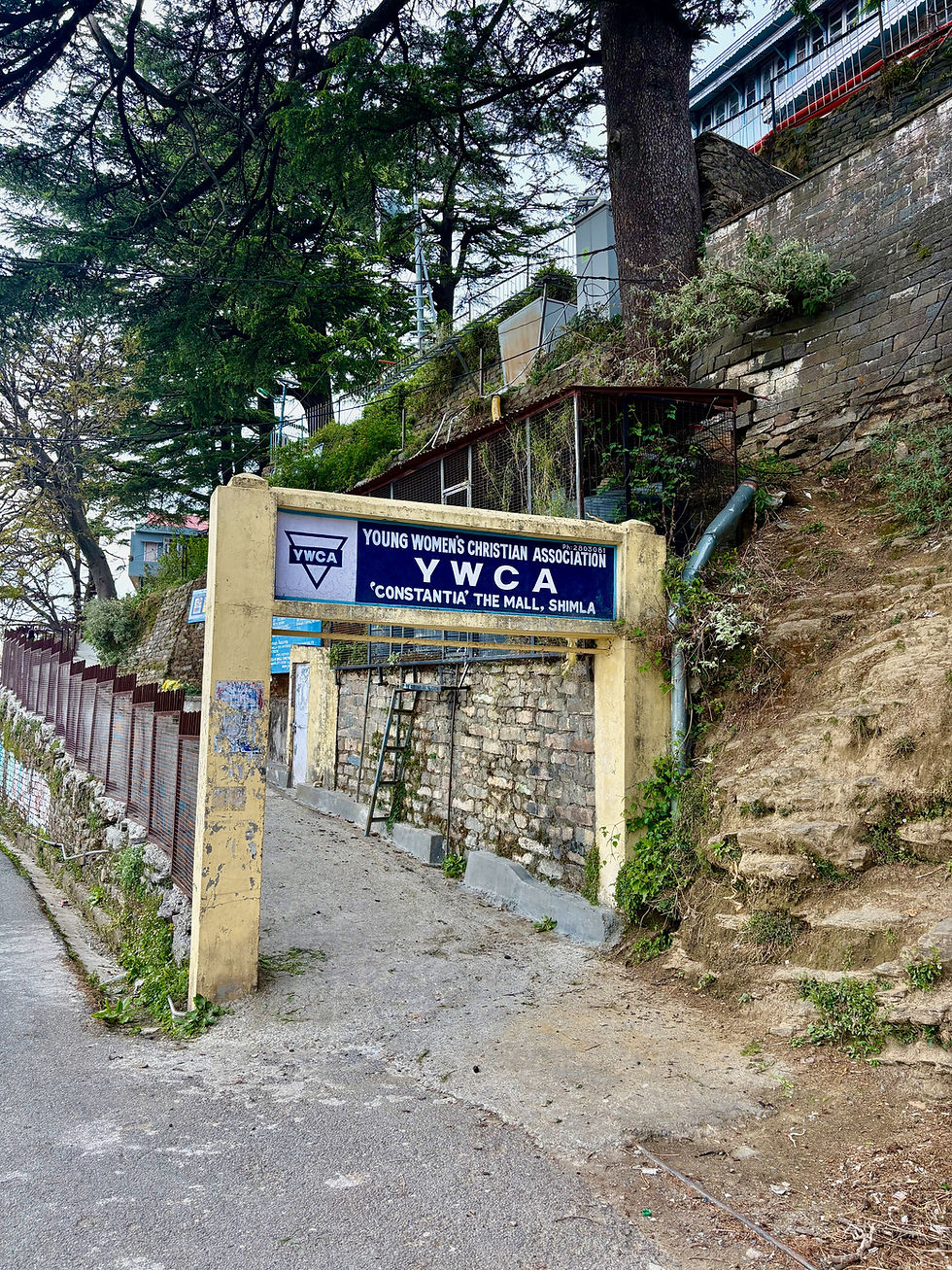
The building, which is off-limits to tourists, stands on the Constantia Estate, which Edward Buck notes was regarded by some as the oldest residence in Shimla, rather than Kennedy House.
Continuing along Kali Bari Road, one encounters the majestic Bantony Castle:

The Bantony began life as a humble cottage in 1830. In 1880, the estate was purchased by the Maharaja of Sirmaur, and the present castle-like structure replaced the original house. Buck writes that during the First World War the Maharaja “sportingly” handed the estate over to the Government, allowing temporary Army Headquarters offices to be built on the grounds. Buck’s use of the word “sportingly” leaves open the possibility that the Government’s request came with the sort of persuasive charm only an empire could muster. A few decades later, many princes would similarly “sportingly” hand over their kingdoms to Sardar Patel.
The building had long fallen into disrepair but was painstakingly restored and reopened in 2023. The Government deserves considerable credit for the restoration work carried out across the Mall area, including the Town Hall, the Gaiety Theatre, and the broader beautification of the pedestrianized stretch. India remains a poor country with many competing demands on the public purse, which makes these conservation efforts all the more commendable.
A sound-and-light show is staged at Bantony Castle in the evenings. When I visited during the day, however, the premises were closed.
From outside the gates, I could see a red-brick, tumbledown cottage within the Bantony Estate, standing to the right of the larger building:

Right next to Bantony Castle stands the Grand Hotel, which is off-limits to tourists as it now functions as a state-run guest house:

Edward Buck records the history of this hotel in considerable detail. The site originally housed a dak bungalow, which was demolished in 1829 to build a residence for Lord William Bentinck, then Governor-General, during whose tenure the modern hill station of Shimla began to take shape. The residence came to be known as Bentinck Castle. It never became the preferred home of subsequent Viceroys—though some Commanders-in-Chief resided there—and between 1850 and 1887 it served as the offices of the Simla Bank.
When the bank went into liquidation, the property was acquired by businessmen who demolished Bentinck Castle and established a new club intended to rival the United Services Club, which we visited in the previous post. The new building, however, burned down shortly after its construction. No contemporary account links the fire to the competing club, whose proprietors were presumably far too gentlemanly to express rivalry through arson. In any case, such measures were unnecessary, as the new club proved unable to compete with the established incumbent.
The enterprise eventually went into liquidation as well, after which the property first passed to M. Bonsard, who had arrived in India as Lord Lytton’s viceregal cook. Bonsard owned the estate only briefly before it was purchased in 1892 by Chevalier Peliti.
Federico Peliti came to India after winning a competition in Turin—a city famed for its chocolates—to serve as confectioner on the Viceroy’s staff. Following the assassination of Lord Mayo in 1872, he turned entrepreneur and opened his first storefront in Calcutta.
Peliti later expanded the property with additional blocks, transforming it into the celebrated Grand Hotel. This postcard from 1902 captures the hotel in all its grandeur:

Image: Postmarked Simla, Oct. 29, 1908 and sent to Mrs. Taylor, Bath, England.
Source: Wikimedia Commons
In the winter of 1922, a devastating fire destroyed the hotel’s main buildings. Because the property was only partially insured, and North India was entering an economic depression in the aftermath of the war, the once-prime site remained vacant for years.
Besides the Grand Hotel, Peliti also owned the eponymous restaurant Peliti’s near the Tourism Lift on the Mall. The establishment makes a memorable appearance in Kipling's The Phantom Rickshaw. In the story, the young ICS officer Theobald Jack Pansay cruelly rejects his former mistress, Agnes Keith-Wessington, the wife of a military officer. In 1884, Pansay becomes engaged to Kitty Mannering, and shortly after brutally rebuffing Agnes one final time, she dies. Following her death, however, Pansay finds himself haunted by her spectral rickshaw, visible only to him.
Peliti’s is the setting for the phantom rickshaw’s first appearance. While the rest of Simla crowds around Peliti’s veranda in broad daylight, Pansay alone sees the ghostly “magpie” servants and the yellow-paneled carriage standing directly opposite the shop.
Leaving the Grand Hotel behind and continuing uphill, I arrived at Kali Bari:

Edward Buck reproduces the story he was told about this temple by the priest in charge. Before Rothney Castle was built near Jakho Hills in 1838, there was a small temple on the site containing an old idol of Ma Jee (mother). According to lore that is frighteningly similar to the earlier mentioned Kipling story The Mark of the Beast, a British sahib found the temple unattended, threw the idol down the hillside, and used the temple as his camp kitchen. That night he reportedly had a frightening vision of two horsemen attacking him.
His servants believed this was punishment for insulting the idol and warned that disaster would follow unless Ma Jee was restored. The sahib then had the idol brought back and is said to have built a new temple for her near Christ Church. When that land was later needed for the Rothney Estate, the idol was moved again around 1845 to its present location.
One virtue of the Kali Bari temple is that the steep pedestrian climb leading up to it discourages casual footfall, making the premises a relatively quiet place to rest. Within the complex stands a more recent shrine to Lord Shiva, built in the twentieth century.

One of the challenges of walking around the Mall is the large monkey population. They are common across Indian hill stations and make me queasy. I discovered, however, that they are far less numerous when the sun is out, and the presence of plenty of people even during the off-season made me feel reasonably safe.
In Kipling's Collar-Wallah and the Poison Stick, the narrator encounters a Mohammedan farmer, who shares a harrowing tale of his own struggle against Shimla's "monkey-folk". He recounts how a troop of monkeys, led by a leather-collared chief, waged an escalating campaign of mischief against him, from stealing peppers to making off with his wife’s silver anklets. The farmer, a former Hindu, believes the monkeys targeted him because they sensed he had abandoned the old gods.
In a desperate attempt to poison the monkeys, the farmer laced rice with arsenic, only to watch the collar-wearing leader perform a strange ritual before the troop ate it unharmed. The next night, the monkeys took their revenge by uprooting every blade of his rice crop, ruining him completely.
Hopefully, the monkeys of Shimla are not clairvoyant and mistook my visit to Kali Bari for genuine piety—though skipping the trek to Jakho would admittedly give them valid grounds for taking umbrage.
Lakkar Bazaar
Lakkar Bazaar derives its name from lakkar (wood), having historically developed as Shimla’s market for timber and wooden handicrafts. The extreme left end of the Ridge (pictured below) leads into it:

The narrow, crowded character of Lakkar Bazaar forms a striking contrast to the open expansiveness of the Ridge:

Given the wide variety of wood found in the region—pine, oak, cedar, rhododendron—it is unsurprising that a market for woodcraft emerged in Shimla. Yet Lakkar Bazaar seemed geared more toward tchotchke shoppers than timber enthusiasts. Its atmosphere struck me as a hybrid of the crowded Lower Bazaar and the genteel Mall:

The postcard below, depicting Lakkar Bazaar, dates to 1910:

Source: Wikimedia Commons
The now-dilapidated Regal Building, formerly known as the Prince of Wales Theatre, opened in 1925:

A photograph of the newly opened cinema, reproduced below, appears in the 1925 edition of Edward Buck’s Simla: Past and Present:

Buck writes that the arrival of the Prince of Wales and Elphinstone cinemas in Shimla led to a decline in audiences for plays at the Gaiety Theatre.
One can still spot the inscription “Prince of Wales Loft” on one of the balconies—a balcony that now appears to be conducting a long-running experiment in gravity:

Source: Wikimedia Commons
The building houses a roller-skating rink, though I would be wary of venturing inside, as the entire structure appears one strong gust away from turning into a live adaptation of Wuthering Heights:

The store promoting "Tomorrow's Antique" appears to cater to customers unwilling to wait generations for their heirlooms.
Lower Bazaar
From the Upper Mall, the Lower Bazaar does not present a particularly inviting sight:

First impressions should not deter you from venturing down into the Bazaar, because despite its narrow, crowded lanes, it is remarkably colorful and clean:

Kim contains the following description of the Lower Bazaar:
“He led the horses below the main road into the lower Simla bazar—the crowded rabbit-warren that climbs up from the valley to the town-hall at an angle of forty-five. A man who knows his way there can defy all the police of India’s summer capital; so cunningly does veranda communicate with veranda, alley-way with alley-way, and bolt-hole with bolt-hole. Here live those who minister to the wants of the glad city—jhampanis who pull the pretty ladies’ rickshaws by night and gamble till the dawn; grocers, oil-sellers, curio-vendors, firewood dealers, priests, pickpockets, and native employees of the Government: here are discussed by courtesans the things which are supposed to be profoundest secrets of the India Council; and here gather all the sub-sub-agents of half the native States.”
Readers expecting salacious intrigue from Kipling’s description will be disappointed to learn that the most illicit activity I encountered in the Lower Bazaar was probably a shopkeeper evading GST.
The western end of the Bazaar is home to a row of booksellers:

The bookshops here appeared to deal mostly in textbooks. For something more entertaining, one could stop by Lachhman Dass & Sons. Since the store was closed when I visited, I was left wondering about its unmistakable “sensible gifts to the left, stories you’ll have to explain to the right” vibe.

The western end of the Lower Bazaar is flanked by the Collectorate building, now known as the DC (District Collectorate) Office:

Located directly below the Central Telegraph Office (CTO), the structure was built in the last decade of the nineteenth century. During the British Raj, it served as a courthouse. Buck records that in the mid-nineteenth century, a house called Gaston Hall occupied the site.
Though undeniably beautiful, the building possesses the air of a forbidding castle—the sort of place where ordinary citizens instinctively lower their voices and begin searching for the correct form in triplicate. Perhaps that is precisely the point of housing the DC Office there!
My Mall Road holiday would not have felt complete without a daily stop at the Heritage Trail Café, located diagonally opposite the Tourism Lift just outside the pedestrianized zone:

It is worth spending some time browsing the historic photographs of Simla displayed here:

The clientele is sober, making it a quiet place to reflect on my experiences around the Mall:

The café sells delicious handmade chocolates and subtly sweet churros, of which I packed copious quantities to take home.
One thing you cannot help noticing is the tangled mess of overhead wires everywhere in Shimla. In the West, hanging shoes from utility lines is apparently a cultural phenomenon. Thankfully, that particular urban flourish has yet to take hold in India.

Image: Three pairs of shoe tossing, including a pair of Nike Air Force 1s in New York
Source: Wikimedia Commons
During my visit, construction work was underway across parts of the Mall. I later learned that the government was undertaking a project to underground these wires. It is yet another example of the impressive efforts being made by Himachal’s tourism and civic authorities.
Summing Up
Patient readers of this two-part essay will have noticed the cast of colorful characters who populated Shimla during the heyday of the British Raj: the scandal-prone seductress Lola Montez; the occultist jeweler of mysterious origins, Alexander Malcolm Jacob; the conjurer of long-lost brooches and teacups, Helena Blavatsky; the code-breaking spy John Tiltman; the master-of-disguise policeman Horatio Boileau Goad; and Goad Senior, who preferred chasing policemen with his hog spear. Somewhere amid the fog, séances, spies, jewelers, seductresses, and spear-wielding policemen, the actual administration of India appears to have carried on as a side activity.
In Magic Mountains: Hill Stations and the British Raj, Dane Kennedy writes "hill stations sought to isolate their seasonal residents from India's harsher features, to offer them a comforting haven for rest and recreation". So Shimla was the 19th century equivalent of India's "gated communities"!


Comments