The Loop Chicago Part 2
Updated: Dec 22, 2025
In this series of posts, I am exploring the sights and scenes of Chicago’s “Loop” neighborhood. In the previous post, I outlined the Loop’s borders and recorded my observations along Michigan Avenue. In this post, I continue the exploration on State Street, walking north to south, and then on Wabash in the opposite direction—making, quite appropriately, a loop.

N-S Street 2: State Street
Gene Siskel Film Center
Getting off the Red Line on Lake Station, I walked south on State passing by Gene Siskel Film Center on the way:
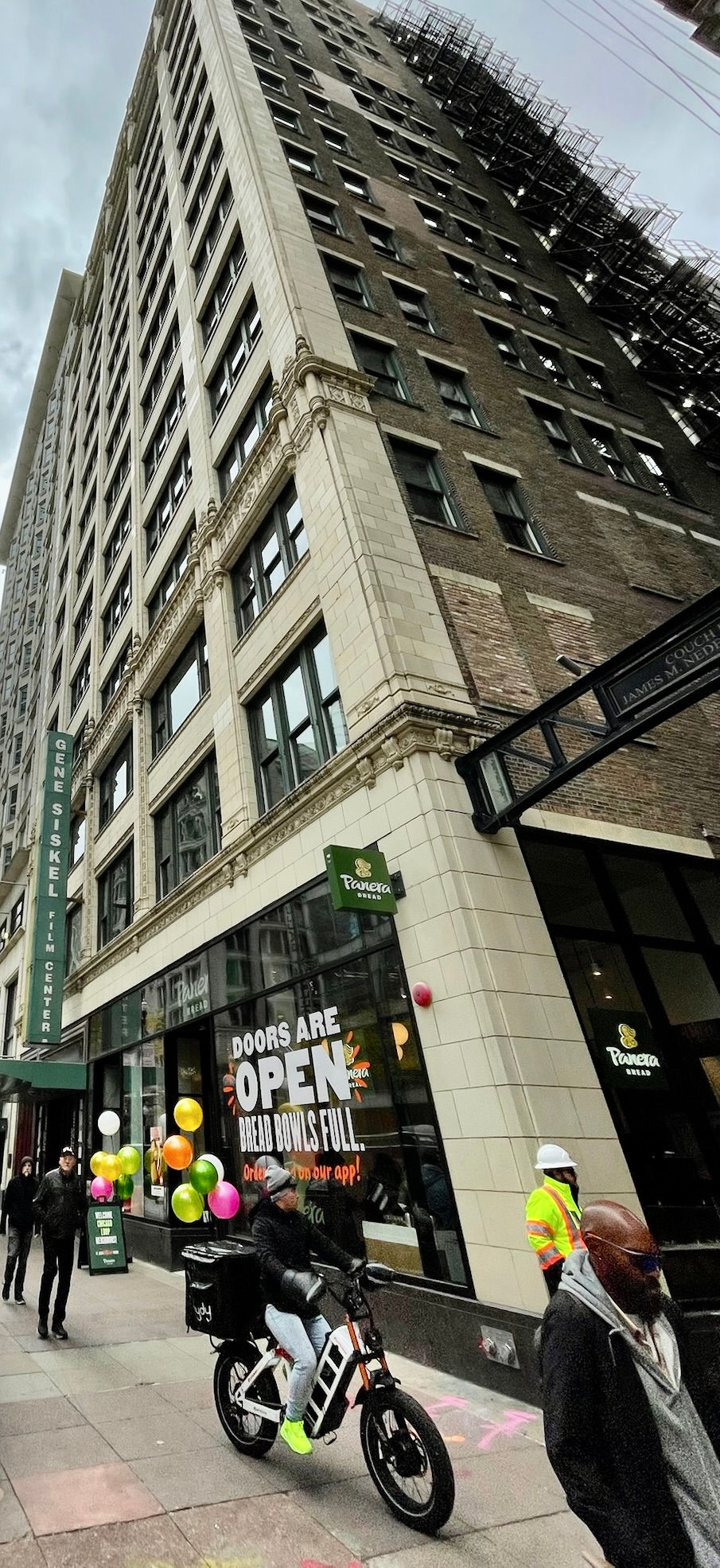
The venue showcases independent, international, and classic films. It is named after one of Chicago’s two legendary film critics, Gene Siskel, the other being Roger Ebert. The pair wrote for the city’s two major newspapers: Siskel for the Chicago Tribune and Ebert for the Sun-Times.
The idea of culture critics as tastemakers for the masses feels anachronistic. Even those trying to escape their algorithmic labyrinths by seeking human recommendations are more likely to rely on user ratings than on critics. Vox expertorum has yielded to vox populi. Or, given the Gene Siskel Center context, the Tomatometer has yielded to the Popcornmeter.
The title of James Surowiecki’s "The Wisdom of Crowds" may feel like gallows humor to those of us aghast at the spirited electoral choices of our fellow citizens. Yet, believe it or not, there is some evidence supporting collective intelligence over individual expertise, the premise of the book.
In the March 1907 issue of "Nature", the British statistician Francis Galton published his findings from an agricultural fair in rural England. One attraction at the fair was a contest in which attendees guessed the weight of an ox on display. Some 800 participants submitted guesses on tickets, along with a small entry fee. Galton collected the used tickets and discovered that the average guess was 1,207 pounds—astonishingly close to the ox’s actual weight of 1,198 pounds. The crowd was wiser than almost all the individual contestants.
While the ox-betting crowd was wise, Galton—a first cousin of Darwin—was less so. His theory of eugenics, popular among racists, has long since been debunked. Yet the underlying intuition behind his Nature article "Vox Populi" lived on: it helped win Eugene Fama a Nobel Prize for the Efficient Markets Hypothesis, and those of us who invest in index funds are acting on that very intuition. Before modern communications, aggregating individual opinion was not easy. Hence, the theater producer Mr. Blumenfield in PG Wodehouse stories devises a novel solution. Declaring that the “collective intelligence of the Broadway public” matches that of a ten-year-old, he uses his own son as a ruthless critic: if the boy laughs, a play survives; if he is bored, actors are fired on the spot.
I am sure Gene Siskel was a very nice man, but culture critics—of art, fashion, film, music, food—typically reflect the tastes of a society’s elites. Instead of being tastemakers, critics lag society, joining the party once an aesthetic sensibility has become a part of the zeitgeist. Blues, jazz and hip-hop were originally dismissed as working class slop but were later embraced as vibrant and inventive. Comics were widely seen as disposable children's entertainment but now the preferred term is "graphic novel".
Nicolas Slonimsky, the composer and musicologist, captured this phenomenon in "The Lexicon of Musical Invective", an anthology of critical reviews of now-famous musicians by their contemporary critics. One reviewer in the April 1825 issue of the London journal "The Harmonicon" described Beethoven’s Ninth as “precisely one hour and five minutes too long”—the length of the piece, in case you were wondering.
While cultural curation has its drawbacks, crowdsourcing comes with its own, one of which is the phenomenon of Review Bombing— a coordinated online campaign in which users flood sites like Rotten Tomatoes and IMDb with negative reviews to tank a film or show. Often, the poor ratings are unrelated to artistic merit. Disney’s live-action "Little Mermaid", for example, was review-bombed simply because the lead actress was Black.
Chicago Theater
Across the Gene Siskel Film center is the Chicago Theater with its iconic vertical signboard:

The building opened in 1921 as a movie theater—six years before the first full-length talkie, "The Jazz Singer", premiered. During the silent-film era, theaters used live musicians to accompany screenings because the films had no synchronized sound. Small theaters, called nickelodeons because admission cost a nickel, might rely on a single pianist, while large houses could feature full orchestras.
With the American penchant for efficiency, musical-instrument manufacturers developed theater organs specifically for silent films. These instruments could play music but also produce sound effects—bells, sirens, and more. One such organ, built by the Rudolph Wurlitzer Company and dubbed the Mighty Wurlitzer, still resides in the Chicago Theatre.
Those early silent film exhibitors would have been baffled by what happened on August 29, 1952, at the Maverick Concert Hall in New York. The pianist David Tudor walked onstage, opened and closed the piano lid three times, and sat in complete silence for intervals of 30 seconds, 2 minutes 23 seconds, and 1 minute 40 seconds before leaving. He was performing 4'33", also known as “The Silent Piece,” by the composer John Cage. During those 4 minutes and 33 seconds of supposed “silence,” the hall was full of sound—wind and rain from outside, the murmurs of the audience, the sound of them shifting in their seats, the footsteps of people walking out etc.
John Cage, the “composer” of 4'33", wanted to impress upon the unsuspecting audience that there is no such thing as silence and that all ambient noise is a form of music. He later said the insight came to him during a visit to an anechoic chamber at Harvard—a room engineered to absorb all sound reflections and create near-total silence. To his surprise, he still heard two sounds. When he described them, the acoustic engineer explained that one was the sound of his nervous system and the other the sound of his blood circulating!
The Chicago Theatre, which now exclusively hosts live performances, belonged to an era that favored luxurious exhibition spaces because films were getting longer. The need to upgrade cinema venues persists—only now the competition is at-home viewing. Theaters still satisfy the desire for an affordable communal experience for those who cannot splurge on concerts.
The modern Western idea of communal film-watching is largely limited to sartorial synchronization—wearing pink to "Barbie". But anyone who has watched a film in a single-screen theater in India will remember cheering, whistling, or even throwing coins at the screen. Sociologists call this a “participatory and interactive style of viewing,” though I prefer the term “boorish behavior.” Even sociologists, I suspect, would draw the line at the scene of teenage boys pleasuring themselves in "Cinema Paradiso".
It is easy to lament the extinction of communal experiences, but it is an inevitable consequence of prosperity. In my condominium building in India, I watch with some bewilderment the enthusiasm with which older residents participate in cultural celebrations on religious holidays. The neighborhood Durga Puja means something to my parents that remains opaque to me. People who did not grow up with electronic entertainment turned to each other for engagement.
Today, people often say they seek “community.” But their definition differs from the traditional meaning in two important ways. First, they want communities of choice—shared hobbies, shared politics—rather than communities of circumstance such as family, church, or neighborhood. Second, having selected the who, they also want control over the how: the terms of engagement—how much, when, where, and for how long. The disconnect between our professed desire for community and our cherished personal boundaries is captured in a doctor’s confession to Father Zosima in The Brothers Karamazov: the more he loved people in general, the less he liked them individually.
Marshall Field's
Walking just a few steps North, I could see the grand State Street facade of Marshall Field's (now Macy's):

The Loop segment of State Street is more retail centric than the Michigan Avenue part chronicled in the prior post. Department stores and smaller retailers started moving to this part of State Street, when Potter Palmer, a dry goods merchant and real estate developer, built a store here in 1867. Prior to this, the heart of Chicago retail was on Lake Street. But Lake's physical limitation of being only eight blocks long encouraged activity to move to State Street and Wabash Avenue. The opening of a Marshall Field's store at this spot in 1868 (later rebuilt after the Great Fire of 1871) played a big role in establishing State Street as the city's premier shopping destination.
Marshall Field's became Chicago’s most iconic department store, renowned for its luxury goods and elegant architecture. While the tech companies of today are pilloried for promoting addictive behaviors, the retail industry was the pioneer of mass psychological operations. For instance, many stores and shopping malls have a maze like layout that is intended to create spatial disorientation, triggering visitors to wander around and being exposed to product categories they were not searching for. This phenomena called the "Gruen Effect" is ironically named after an architect who hated it!
Another trick is the so called "left digit bias" that refers to the tendency for shoppers to overweight the first digit of a price. Retailers use this by pricing items at $9.99 instead of $10, knowing the left digit “9” makes the item seem like a better deal. In 2023, a team of researchers published their findings on the existence of left digit bias by crunching data on 600 million price quotations on the Lyft rideshare platform. For a subset of price quotations between $10.96 and $11.03, with each cent value appearing roughly equally, they found that rides priced at $10.96–$10.99 had conversion rates around 50.2%, while those priced at $11.00–$11.03 dropped to about 48.7%. This was part of a consistent pattern seen at every whole-dollar threshold. While this may sound like a small difference in conversion rates, the researchers estimated that following a left digit pricing strategy, Lyft could earn an additional $160 million annually in profits!
In 2006 the Marshall Fields store was rebranded as Macy’s, a move that sparked public outcry from Chicagoans who saw it as the loss of a cherished local institution. The backlash Macy faced pales in comparison to the furor that greeted the Cracker Barrel restaurant chain, when it unveiled a redesigned logo that eliminated the longstanding illustration of an "Old Timer" wearing country overalls leaning against a barrel. Within days the company had to revert to the old logo. The Cracker Barrel outlets are a nostalgic symbol of rural Americana, evoking the atmosphere of old country stores with rocking chairs, vintage décor, and Southern-style comfort food.
It is difficult for privileged urbanites to understand how people become attached to a restaurant chain. The impulse, perhaps, lies in the rapid pace of change that modern life imposes. Globalization and technology create winners and losers. For those on the winning side, expanded immigration means an exotic Ethiopian restaurant down the street, and futuristic technology is the thrill of summoning a robotaxi for a night out. For those on the losing side, it means lower wages and the agony of being unable to save a loved one because they cannot afford the health insurance their neighbor has. The loss of a symbol from a time when life felt more pleasant—or is remembered that way—can feel cruel to someone in that position.
The Marshall Fields store is known for its two prominent clocks on State Street. The first was installed in 1897 at the corner of State and Washington Streets, followed by a more ornate one at State and Randolph in 1902. For several years the two differed in design till 1909, when the original clock was replaced with a matching version of the new one:

A cool view of the Randolph Street side clock is to look at it against the Chicago Theatre sign:

Like the Chicago Cultural Center, Marshall Fields also houses a large Tiffany Dome:

The dome can be viewed from the ground floor but you can take the escalators up to the fifth for a closer look.
Macy’s—now the operator of Marshall Field’s—holds a central place in American Christmas tradition through its Thanksgiving Day Parade in New York, its holiday window displays, and its role as a symbol of festive retail magic. Santaland Diaries, a humorous essay, recounts the experience of David Sedaris working as a Christmas elf called "Crumpet" at the Macy’s in New York. It is best experienced in Sedaris’s own dry, self-deprecating narration rather than on the page.
The humor in this comic monologue lies in the corporate-contrived nature of “joy,” dispensed through mandatory elf training and a forty-page Elfin guide. Its poignancy, however, comes from watching adults bring their children to Macy’s Santas while clinging to an ideal of joy they no longer feel themselves. In the final vignette, Sedaris sees a woman slap and shake her crying daughter, Rachel, threatening her to sit on Santa’s lap and smile. He dutifully snaps the photo—a manufactured image that, at least on paper, suggests everything is cheerful and exactly as it should be. Sedaris ends the essay with this devastating line:
It's not about the child or Santa or Christmas or anything, but the parents' idea of a world they cannot make work for them.
Marshall Field’s was known for its motto “Give the lady what she wants.” The elves in Macy’s Santaland were trained to give Rachel’s mother what she wanted.
The null point
A stone’s throw from the State Street façade of Marshall Field’s lies the intersection of State and Madison streets:

The intersection of State and Madison Streets serves as Chicago’s geographic origin point, where State Street divides east and west addresses and Madison Street divides north and south addresses—making it the city’s official “0,0” coordinate. This null point serves as the edifice for Chicago's famous grid layout. Urban planner Geoff Boeing’s analysis of street “entropy” found Chicago to have the world’s most grid-like layout, scoring 0.89 on a scale where 1 represents a perfect grid. In contrast, London’s irregular, historically layered streets scored only 0.015.
A clear and concise explanation of the Chicago grid is provided here by a Chicago resident. The TLDR is that the grid system Chicago inherited at its incorporation in 1837 became obsolete as the city annexed neighboring towns like Hyde Park and Lakeview, creating duplicate street names and addresses. A private citizen, Edward Brennan, was so passionate about the issue that, after years of nagging the city government, he convinced officials to undertake a massive renaming of streets and renumbering of addresses in 1908. As part of this overhaul, State and Madison was chosen as the new null point.
Edward Brennan, who earned no money from his efforts, was doing what was described in the previous post as life’s work. He passion can be gauged by his level of detailing. Every Chicagoan knows, without thinking, that if Marshall Field’s is at 111 N State, then the Gene Siskel Film Center at 164 N State must lie on the opposite side. In the city’s grid system, odd numbers always appear on the south and west sides of streets, while even numbers are on the north and east sides. This was one of many details in Brennan’s plan that the city adopted.
Just like Chicago has a “0,0” coordinate, so does the Earth. In 1984, the mapping agency of the US Department of Defense (DoD) created a single global standard for measuring latitude and longitude. Prior to this there were multiple regional systems that assumed slightly different Earth shapes. Hence, the coordinates for the same physical location could differ by hundreds of meters between different systems. When we type an address on Google Maps, it is converted to a longitude and latitude using the DoD created system. You can see these coordinates by tapping and holding on any location in the Google Maps app.
There is a point in the Gulf of Guinea on the west coast of Africa where the equator (the horizontal line dividing the Earth into North and South—equivalent to State Street) and prime meridian (the vertical line dividing the Earth into East and West—equivalent to Madison Street) intersect. According to Google Maps, this is the Earth’s null point!
In reality, of course, there is no null point in the Earth or the universe. And we have none either, since we are born with a measure of genetic predetermination. Our need to define a null point is not merely practical—like GPS—but rooted in a primal fear of being lost. A null point, whether our birthday or the first of January, feels like a chance to start anew when we have lost our way. It is a metaphorical 0–0 point where the errant trails of our past can be forgotten.
Sullivan Center
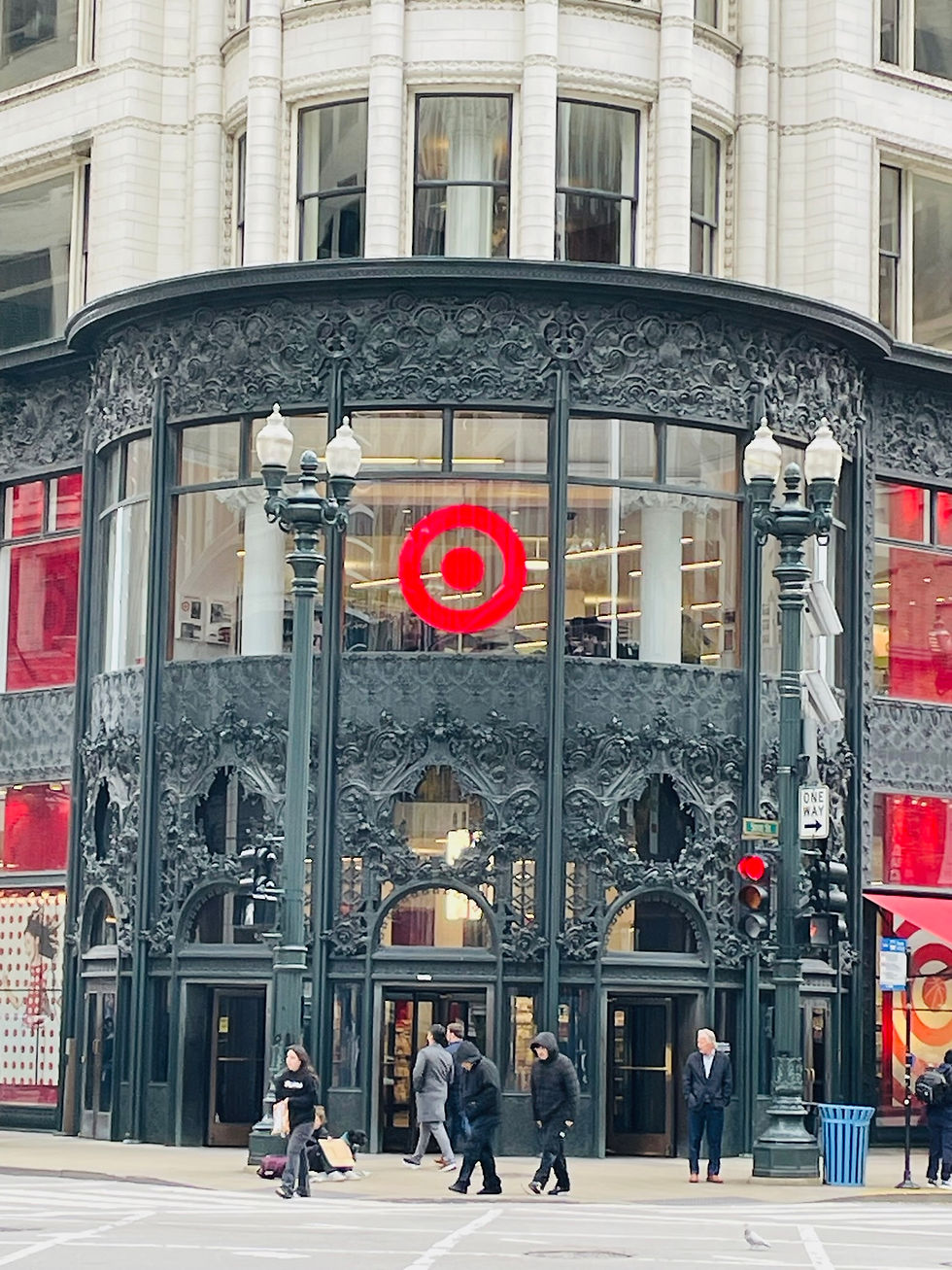
Right on the southeast corner of the null point stands the famous Carson Pirie Scott Building:

The building, now called the Sullivan Center, was designed by the great architect Louis Sullivan and opened in 1899 as a Schlesinger & Mayer department store. In 1904, another retailer, Carson Pirie Scott moved in and occupied the space for more than a century.
Most of us do not think about architecture unless we visit a building specifically to admire it—say the Sistine Chapel or the Colosseum. Yet good architects devote enormous thought to shaping spaces that elicit certain behaviors. The Sullivan Center was designed as a retail outlet, and it includes two features intended to invite passersby to step inside and shop.
One, is the ornamental entry at the corner of Madison and State —a striking feature of the building:
Two, the ground-floor windows—designed to showcase the store’s products—are significantly larger than the windows on the upper floors:
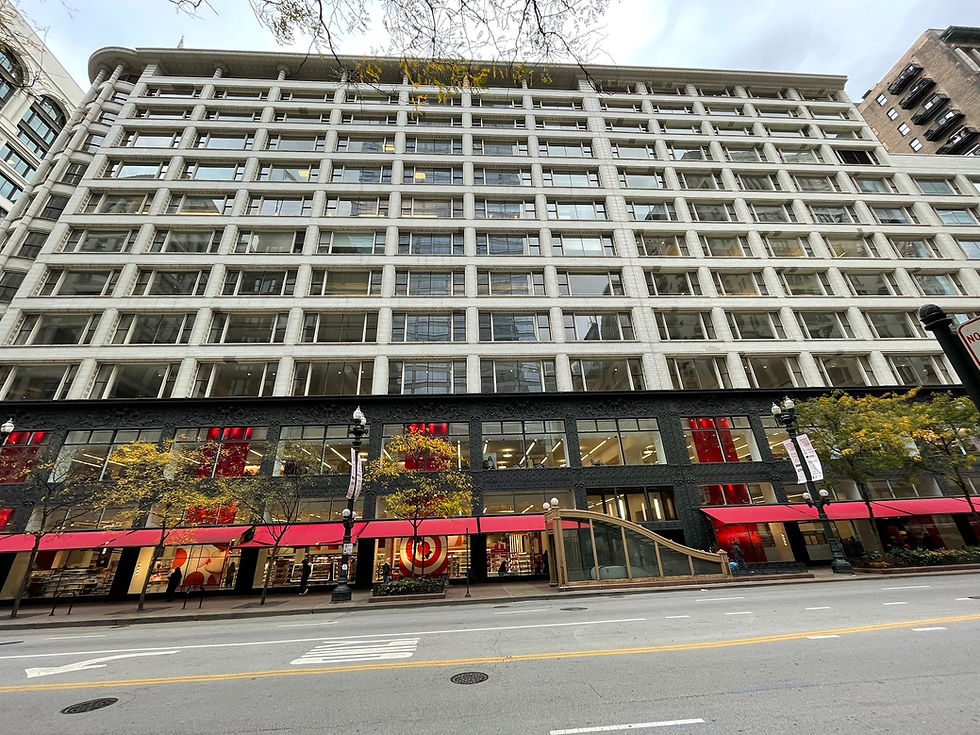
The windows you see on the upper floors were a design innovation of the era—known as the Chicago window, with a large middle pane flanked by two narrower ones. To an alien species, we might look like bees toiling away in those identical hives.
The architect of the building—Louis Sullivan—is famous for theorizing that “form follows function.” In the Carson Pirie Scott building, the ornamental corner entry and the oversized ground-floor windows are forms designed to serve a retail function: drawing people inside to buy merchandise.
A fascinating example of form following function is the use of desire paths in urban planning. A desire path is a route people carve out by repeatedly taking the most convenient shortcut, defying the intentions of city planners. Believe it or not, there is a thriving Reddit community of desire-path nerds. The following is a picture of a sample desire path:

Source: Reddit
Urban planners have turned the desire path on its head by first observing the routes people take naturally before paving new pathways. Anyone who has negotiated Indian roads knows that drivers have a bewildering menu of desire paths: driving against the flow of traffic, zigzagging between lanes, riding two-wheelers on footpaths, and taking illegal U-turns. Indian cities would benefit more from draconian law enforcement than from fancy urban-planning principles.
Sullivan’s “form follows function” maxim has a maladapted cousin called path dependence. The most commonly cited example is the QWERTY keyboard. It was originally designed to reduce the likelihood of striking adjacent keys in quick succession—a problem that caused the metal typebars on early typewriters to jam. Once QWERTY took hold, its form persisted even on virtual keyboards, despite the existence of more ergonomic layouts.
A related dysfunction arises with skeuomorphism—the design practice of making digital interfaces resemble real-world objects. Some examples are harmless, like using a floppy disk as the save icon even though most people have never saved anything to a floppy in their lives. But skeuomorphism can also create commercial friction. The shopping-cart icon, for instance, is not intuitive to users in developing countries who hopscotched from unorganized retail to e-commerce; for them, the cart symbol was a distraction rather than a cue.
Human designers can intentionally execute the principle of form following function. In nature, it is not always clear that the causality runs the same way. Some biologists believe feathers first evolved for insulation or attracting mates, only later becoming useful for flight. In this process—called exaptation—function follows form.
Engineering is more efficient than evolution at producing form that follows intended function. Yet Elon Musk, ever the contrarian, has chosen to invest in humanoid robots rather than engineer alternative form factors to perform human tasks. He has alluded to the “hands problem”—the challenge of designing robot hands with the dexterity of human ones, a key hurdle in unlocking the trillions of dollars in economic value promised by humanoid robots. Robotics firms have even experimented with whether the optimal number of fingers might be fewer than five.
Waterman Building
Not far from the Carson building is the Waterman Building at 127 South State:

The building, which opened in 1920, was commissioned by the L.E. Waterman Company, maker of fountain pens. The ground floor housed a retail store, while pen assembly took place on the upper floors. Waterman eventually moved out, and from the 1940s onward a series of new tenants cycled through the building. Some claim that a Waterman pen was used to sign the Treaty of Versailles, which ended the First World War.
It may seem odd to call fountain pens “technology” today, but U.S. Patent No. 293,545 was granted in 1884 to Lewis Edson Waterman. Fountain pens had replaced ink-dipped quills by storing ink inside the pen itself. Waterman patented a mechanism that regulated ink flow and prevented spillage, a common problem with models at the time. In 1940, the company introduced a pen clip that allowed a pen to be carried in a pocket—an innovation back then!
Like every successful company—it still survives—the Waterman Company has an origin story. Lewis Waterman, then an insurance agent, was inspired to invent a better writing instrument after a leaking pen ruined an unsigned contract. While he returned to his office to redraw the document, a rival broker swooped in and stole the client. An interesting aside: one of the tenants that moved into the Waterman building in 1923 was the White Star Line, a company associated with a far deadlier leak—it owned the Titanic.
The pen has been largely replaced by the keyboard. For most of us, using a pen for anything beyond quick notes would leave our hands aching. Advocates of handwriting argue that the lack of an edit or delete key makes each word more deliberate; by slowing the writer down, it encourages reflection and commitment rather than a stream of half-formed ideas. Stephen King famously wrote the first draft of "Dreamcatcher" with a Waterman fountain pen. Steve Jobs understood that human appreciation for “good handwriting” is enduring; inspired by a calligraphy class he once took, he introduced the idea of beautiful fonts as a feature of word processors.
Yet we shouldn’t romanticize penmanship too much. Offloading raw ideas into a word processor makes it easier to see their flaws and refine our thinking.
Wherever we land in the handwriting-versus-typing debate, most of us agree that marking moments of gravitas—marriage, divorce, the purchase of a home—feels more meaningful with a handwritten signature. The role of Thomas Matlack in American history is a testament to this sentiment. On July 4, 1776, representatives of the thirteen colonies adopted the Declaration of Independence in Philadelphia. The manuscript, authored principally by Thomas Jefferson, was sent the same day to printer John Dunlap, and printed copies began circulating on July 5. But a couple of weeks later, a handwritten version was commissioned—a task that fell to Thomas Matlack, whom we would today call an administrative assistant.
Matlack wrote the Declaration with a feather quill (the Waterman pen was still a century away) on vellum, a writing material made from animal skin and commonly used before paper became widespread in the fifteenth century. His document is considered the “official” version and carries the famous 56 signatures, including John Hancock’s. Matlack’s work reveals both the potential and pitfalls of penmanship: he misspelled represtatives (omitting the en) and left out the word only—errors later corrected by hand and still visible two centuries later.
Beyond lending solemnity to the document, the revolutionary leaders may have chosen vellum and elegant penmanship as a way to place their movement within a lineage stretching from Athenian democracy and Roman republicanism to the Magna Carta—evoking a long tradition of struggles for liberty. Eric Hobsbawm called this kind of gesture an “invented tradition”: a new practice made to appear old in order to serve a social or political purpose.
Century Building
Further ahead opposite to the Waterman is the Century Building at 202 South State which now sits vacant:

While the buildings described in this essay earlier—Marshall Field's, Sullivan Center and the Waterman, were built with the primary purpose of hosting large department stores and commissioned by the anchor entity, the Century was built as a commercial building with the anticipation of demand for affordable office space. When the older buildings occupying this space was demolished in 1915 to pave way for a new one, a newspaper run contest to name it led to the building being christened "the 20th Century Building", later shortened to just Century.
The Century was what was called a "tall shop building". Their tenants, instead of being professional services (doctors, dentists, lawyers) and small businesses, were small retailers. The ground floors of the "tall shops" featured large storefronts rented at premium rates to broad-appeal businesses like clothiers, drugstores, and restaurants. Upper floors housed specialty retailers—hat and glove dealers, dressmakers, jewelers—whose customers sought them out rather than walking in casually.
A mural titled Float, created by illustrator Noah McMillan and installed in 2014, wraps around the building and depicts aquatic animals navigating Chicago landmarks like City Hall:

The mural was installed as part of ongoing efforts to preserve the structure. The federal government purchased the Century Building in 2005 with the intention of converting it into office space, but no action was taken for more than a decade. The prolonged vacancy pushed the building into disrepair. A later plan to sell it to a private developer was scuttled because of security concerns stemming from the federal courthouse located directly behind it on a parallel street. Presumably, the fear is of a Lee Harvey Oswald–style attack from its upper floors, though the courthouse has operated at that site since 1964 without incident.
Plans to demolish the building and replace it with a small landscaped garden met resistance from preservation advocates, who argue that the structure should be adaptively reused—ideally for affordable housing. Preservationists would have opposed demolition even if a new residential building were proposed for the site. But if form follows function, then a form can become obsolete when the function it once served disappears. State Street lost much of its vibrancy in the 1970s with the rise of suburban malls, then again with the growth of e-commerce in the 2000s, and once more with the work-from-home dynamics of Covid. Sometimes it is simply easier to start from scratch than to repurpose an existing building.
The desire to preserve a building like the Century—or a symbol like the Cracker Barrel logo—is rooted in our longing for “home.” If the “null point” is a place of becoming, “home” is the place of being. It may be a place that still exists, our memory of a place, or simply the apartment where our parents live.
The Australian philosopher Glenn Albrecht coined the term solastalgia. Unlike nostalgia, which makes you pine for a place you have left, solastalgia is the homesickness you feel while still at home because the environment has changed. Society broadly agrees on preserving sites of historic significance, but most of us live far from such landmarks. For us, solastalgia comes from the shuttered corner store, the vanished single-screen theatre, or the quiet removal of the red pillar box where we once slipped in our letters.
Preservationists want to retain the “essence” of a building while adapting it for modern use. The façade of the Century Building, for instance, might remain intact even as the stores inside are demolished to make way for apartments. This instinct is reminiscent of the "Ship of Theseus"—a thought experiment which asks whether an object remains the same if all its components are gradually replaced. The Athenians preserved Theseus’s ship by continually replacing its decaying timbers. Plutarch articulated the paradox this created: could a vessel rebuilt piece by piece still be considered the same ship?
The story of London Bridge vividly illustrates this paradox. The bridge immortalized in the nursery rhyme “London Bridge Is Falling Down” stood for roughly 600 years before it finally “fell down” in 1831—though in reality it was demolished and replaced with a new structure. In the 1960s, city officials realized that the 130-year-old bridge was indeed “falling down”—sinking a few inches each decade under the weight of modern traffic. An American businessman, Robert McCulloch, bought it, had it dismantled brick by brick, shipped to the U.S., and reassembled it over Lake Havasu in Arizona. A new London Bridge was then built in London and opened in 1973.
Thomas Hobbes extended the original paradox by asking: if a shipbuilder constructed a new vessel from the discarded parts of the original, which would be the “real” Ship of Theseus? Preservationists face a similar riddle with London Bridge. Is the real one in London, or the one standing in Arizona?
Human beings resemble the Ship of Theseus too—changing physically at the cellular level and emotionally through lived experience. We know that a person’s “essence” is not physical, yet it is hard to pinpoint what aspect of a friend’s or parent’s behavior expresses that essence. Your childhood friend may have changed in countless ways—their politics, fears, dreams—yet something in them remains immutable.
A. M. Rothschild & Company Store
Walking farther, one comes across the building at 333 South State, built in 1912 for the Rothschild & Company department store and now home to DePaul University’s downtown campus:
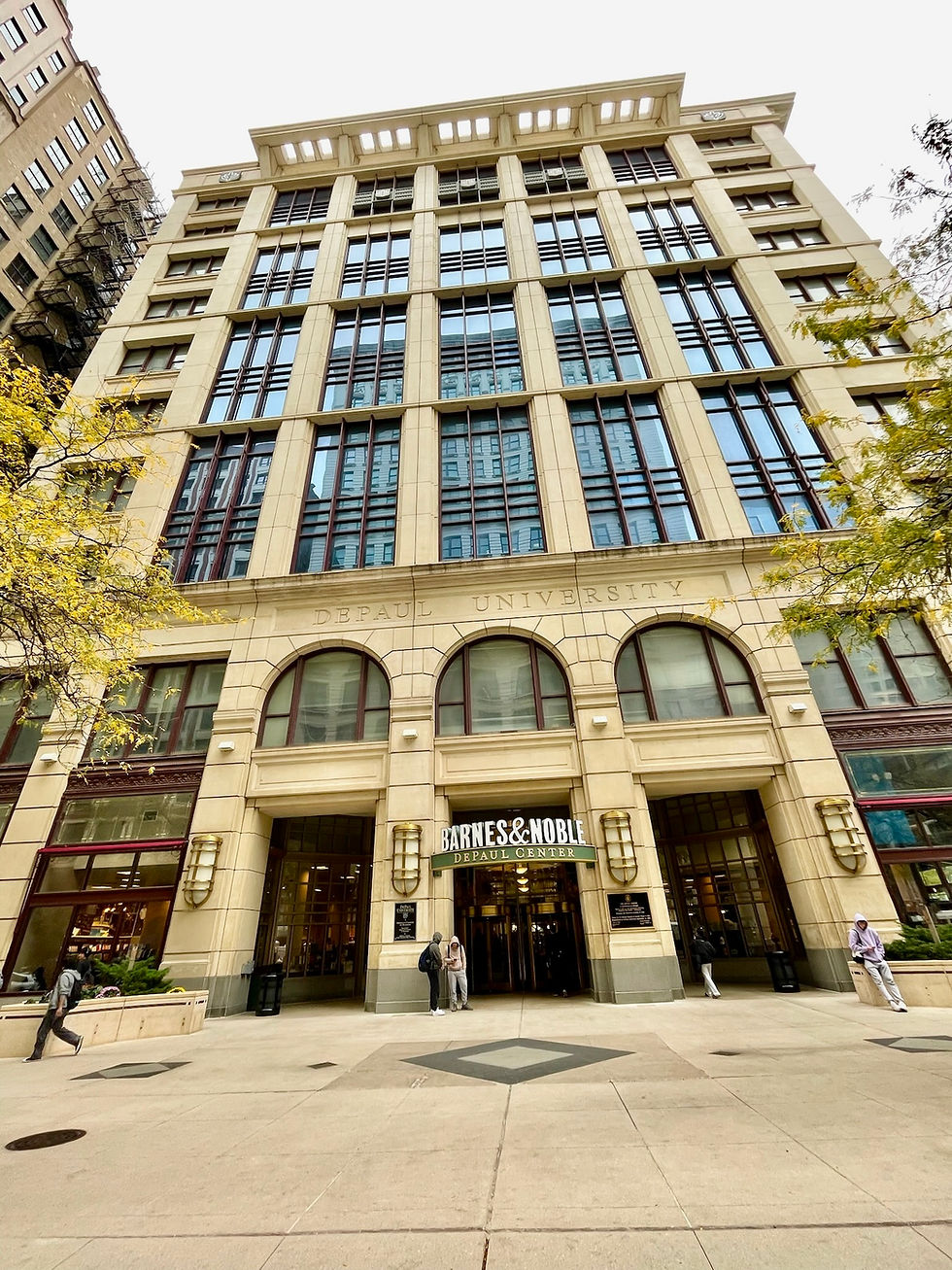
Like many buildings in the Loop, this one also has a fire in its origin story—though not the Great Fire of 1871. Abram Rothschild began his retail business in 1895 with financial backing from his wealthy father-in-law, Nelson Morris. The original A.M. Rothschild & Co. department store, also on State Street, suffered extensive damage in a 1901 fire. Insurance companies refused to honor the aggregate claim of $250,000 (nearly $9 million today), alleging that the blaze began because of unauthorized repair work.
The episode widened a rift that had been growing between Abram and his father-in-law. Although the eponymous store bore the Rothschild name, it was principally owned by Nelson Morris and his sons. After the fire, the Morrises eased Abram into retirement. A year later, Abram shot himself with a revolver. The Morris family commissioned a new store—the building completed in 1912, ten years after Abram's suicide.
Despite the friction, the family honored Abram by engraving the letter R across the State Street façade. You can see the R’s atop each pillar between the arched windows in the picture below:

The Goldblatt brothers bought the building in 1937 and operated a department store there for nearly five decades. For that reason, the structure is also sometimes called the Goldblatt Building.
The building has a tangential connection to a landmark event in Chicago’s—and America’s—history. Its original owner, and Abram Rothschild’s father-in-law, Nelson Morris, ran Morris & Co., one of the “Big Four” meatpackers of late-19th-century America. These firms grew enormous by swallowing small slaughterhouses across the country and, by the early twentieth century, were large enough to dictate prices to both consumers and cattle ranchers. Their operations were concentrated in a few cities, the largest of which was Chicago. The meat-packing assembly line was a nonstop process: animals moved along overhead hooks while workers stripped, cut, and prepared every part for meat or by-products.
The workers in Chicago’s meatpacking plants were poor immigrants—Lithuanians, Poles, Slovaks—laboring in wretched conditions for abysmally low wages. In 1904, the meatpackers’ union went on strike, but because the workers had little bargaining power, the companies could easily replace them. Into this world arrived a 26-year-old New Yorker named Upton Sinclair, sent by the progressive magazine "Appeal to Reason" to document the strike. His investigation became the novel "The Jungle", the story of a Lithuanian immigrant who works as a “shoveler of guts” in the fictional Durham Company, modeled on one of the Big Four meatpackers.
The book became a sensation—though not in the way the socialist-minded Sinclair had hoped. Rather than being outraged by labor exploitation, the public was scandalized by the specter of food contamination exposed by his descriptions of filthy processing conditions. The uproar led to two landmark laws in 1906: the Meat Inspection Act and the Pure Food and Drug Act. The latter created the Food and Drug Administration—today one of the most powerful agencies in the federal government.
The developed world is periodically outraged by labor conditions in poorer countries. It is hard to imagine now, but at the time of "The Jungle", the U.S. had a per-capita income comparable to that of India or Pakistan today. Yet developing countries now adopt regulations modeled on those of rich nations even when enforcement is impossible in their context. It is easy to pass a law banning child labor; it is much harder to enforce it when a family’s economic survival depends on a child’s wages.
Lant Pritchett and his colleagues coined the term “isomorphic mimicry” to describe this pattern: governments copying the outward forms of governance—institutions, laws, policies—of richer countries without the capacity to make them work. In Louis Sullivan’s framework, form, instead of following function, is merely imitated.
The prominence of Chicago’s meatpacking industry during Upton Sinclair's time also illustrates how cities grow organically, with each layer building on the last. Chicago’s earliest advantage was geographic—its position along the waterways linking the Great Lakes to the Mississippi River system fueled its development as a trading hub. When railroads arrived, Chicago naturally became a center for rail freight because the city already had the infrastructure to store, sort, and route shipments.
Livestock was one of the "goods" moving by rail. Instead of tending their animals on distant farms, it became more efficient for farmers to house them in large holding pens near the rail lines—“stockyards”—and pay the yard owners to feed and care for them:

Source: Library of Congress
The next step followed logically after refrigerated railcars were introduced in late 19th century : if the animals were already held near the rail hubs, why not slaughter and process them there, and ship only the finished meat? And just like that, Chicago became the nation’s meatpacking capital.
Harold Washington Library
Finally, flanking the southern border of the Loop on State street I landed at the magnificent Harold Washington Library:

While the facade lends it a classical look, the building is relatively recent. Opened in 1991, it is named after Harold Washington, the first black mayor of Chicago. The sculptures you see on the roof in the picture are those of owls. In the West, the owl is considered wise because of its association with Greek goddess of wisdom, Athena. In India, the owl (Ullu) is synonymous with stupidity or being easily conned. The owl in the West has the ability to see what others cannot—uncovering secrets in the darkness while in India it is blind to the daylight. In all fairness, the owl atop the library entrance is clutching a book and that might explain its wisdom!
Walking in I faced a large somewhat intimidating hall:

The reading halls are huge:

The library holds more than a million books. The problem of finding a book in a library is an old one. Ancient libraries faced the same challenge of cataloging their collections—first clay tablets, and later scrolls made from plant materials like papyrus or from animal skin. The Library of Alexandria, founded in the fourth century BC, soon confronted the task of organizing more than half a million scrolls. Its first head librarian, Zenodotus, arranged them alphabetically and attached tags listing the title, author, and subject.
The invention of the printing press in the fifteenth century vastly expanded the number of books in circulation, making the challenge of cataloging them far more complex. In 1876, Melvil Dewey, the librarian at Amherst College, published a book describing the system he used to organize the library’s collection. The Dewey Decimal Classification (DDC) System is now used around the world.
It is called the decimal system because it uses the base-10 structure of our numbering system. Books are organized into ten broad categories (000 to 900)—for example, 200 is religion, 300 is social sciences, and so on. Each parent category branches into sub-categories: within the 300s, 310 is statistics, 320 is political science, and so forth. The system is multi-level. For instance, “The Bible” is classified as 220, while the King James Bible is 220.5203.
If the fear of the number thirteen is triskaidekaphobia, then perhaps the love of the number ten is decaphilia. Melvil Dewey was a true "decaphile"—devoted not only to the base-10 numbering system but to the number ten itself. I’m grateful that the binary system was reserved for machines; writing 101101 instead of 45 would have dragged my high-school math grades even lower. But Dewey seemed to carry his obsession to extremes. According to one account, he preferred to sleep ten hours each night, was addicted to writing ten-page letters, and insisted that guests at his club—who paid $10 in annual dues—turn off their lights at exactly 10 p.m!
The Harold Washington Library uses the Library of Congress Classification (LCC) system instead of the Dewey Decimal Classification (DDC) System. The LCC was first published by the Library of Congress in 1904. Its creators had evaluated the DDC but found it unsuitable for their needs. Today, LCC is considered better suited to large libraries with vast collections while DDC is widely used in smaller libraries.
Both the DDC and the LCC have been criticized for promoting a Western, white, male, heterosexual worldview. Librarian Michelle Drumm notes, homosexuality first appeared in the 1932 edition of the DDC under the code 132.7546, whose parent category—“132”—was the classification for "Mental Derangement". In 2016, the Library of Congress became embroiled in political controversy when it replaced the index label “Illegal Alien” with two headings, “Noncitizens” and “Unauthorized Immigration,” which together, going forward, would categorize material about people residing in a country unlawfully. The House of Representatives ordered the library to reverse the change.
One is reminded of Adrian Mole, the hapless protagonist of Sue Townsend’s hilarious fictional diaries, who is fired from his library job by his boss Mrs. Froggatt for shelving Jane Austen under “Light Romance.” Adrian writes in his diary:
How was I to know that “Jane Austen, Her Genius, Her Relevance to England in the 1950s” was the subject of Mrs. Froggatt’s dissertation for her degree in English Literature many years before I was born?
While the QWERTY keyboard is an example of path dependence, the Google search engine represents the opposite. For digital content, Google revealed that digital folders are a vestigial carryover from physical-world classification systems like DDC and LCC. Search frees us from the worldviews embedded in taxonomy-based systems. Its PageRank algorithm, rooted in the “wisdom of crowds,” would surface Jane Austen for the search term "Light Romance" if enough people clicked on Austen-related links for that query—regardless of what Adrian Mole or Mrs. Froggatt think.
Internet search has taken things one step further. Like a high-performing librarian, it can decipher what we actually want versus what we say we want. You might search for Harry Potter on Amazon and be nudged towards a dekko at Tolkien. Increasingly, search engines not only fetch what we ask for but also suggest what we should be looking for. Perhaps one day soon, AI will widen its remit beyond fetching content and do what philosophers have attempted for millennia—helping us find a way of living that feels meaningful.
While finding a book at the Harold Washington Library may take some effort, navigating the building itself is remarkably easy. It is beautifully maintained and lacks the musty feel one might expect from a city-run library. I took the elevator up to the famous Winter Garden, a glass-enclosed atrium on the ninth floor:

The election of Mayor Harold Washington was the culmination of a century-long rise in Black cultural and political influence in Chicago. Illinois had been ahead of the nation on slavery—it entered the Union in 1818 as a free state, its 1848 constitution abolished slavery, and it was the first state to ratify the 13th Amendment in 1865. Yet in the 19th century, Southern Blacks migrated to Chicago only in modest numbers because most working-class jobs were filled by European immigrants.
That changed in the early 20th century due to a combination of push and pull forces.
On the push side, Southern states enacted laws that entrenched racial segregation. Public facilities—from schools and churches to water fountains and even cemeteries—were separated by race under the so-called Jim Crow laws, named after a racist caricature portrayed by white actors in blackface. In 1896, the Supreme Court’s decision in Plessy v. Ferguson upheld segregation on trains under the now-infamous “separate but equal” doctrine, giving legal cover to this system.
On the pull side, World War I created a surge in factory jobs in Northern cities. With immigration restricted and many men deployed overseas, industries faced severe labor shortages.
The migration that began during World War I continued through the 1960s, after which Chicago became increasingly white-collar as factories closed, and the South grew less hostile in the wake of the civil rights movement. This movement—dubbed as the Great Migration—ultimately brought more than six million Southern Blacks to the North and West. By the 1970s, nearly one-third of Chicago’s population was Black, and in 1983 the city elected its first Black mayor, after whom the library is named.
N-S Street 3:Wabash Avenue
McClurg Building
Turning north from State Street, I began the return leg of the walk, this time along Wabash Avenue. The McLurg Building at 218 S. Wabash sits tucked behind the elevated train lines:

The building is named after A.C. McClurg & Company, which became the anchor tenant—occupying eight of the nine floors—when the building opened in 1899. The firm, a combination of wholesale book distributor, retail bookstore, and publishing house, had a long and storied history. It had operated in Chicago since 1844 under various names as ownership changed—W.W. Barlow & Company, Wm. Bross & Company, Grigg Bross & Company, among others. A.C. McClurg & Company was the final incarnation, lasting until the business closed in 1968. Alexander Caldwell McClurg had begun as a clerk in the store in 1859, enlisted in the Civil War—where he rose to the rank of General—and returned after the war to resume his job. He eventually purchased the company from his former employers.
The term “trial by fire” is an apt description for the experience of the store's succession of owners. By the time the firm moved into the McClurg Building, its premises across three different Loop locations had burned down thrice—once in 1868, again in the Great Fire of 1871, and finally in the spring of 1899. That last blaze forced the move into the newly built McClurg Building, which itself stood on the site of the former Ayers Building—also destroyed by fire the year before. Beyond the operational turmoil, each fire inflicted heavy financial losses, as insurance never covered the full damage. Fires were a common occurrence in that era. Chicago’s population was expanding rapidly, and the cheapest building material was wood from Midwestern forests.
People were transfixed by the visuals of the 2025 Palisades fire in Los Angeles. Advances in building materials, electrical safety, urban fire codes, and modern firefighting technology have made such scenes rare. For our ancestors, however, the Palisades fire would have been alarming but hardly unusual. London in 1666, Moscow in 1812, San Francisco in 1906—these are merely the famous city-scale infernos; there were countless others.
Fire destroys, yet it is essential to our humanity. Anthropologist Richard Wrangham’s “Cooking Hypothesis” argues that fire—specifically our control over it—made the human species possible. While the human branch split from the ape lineage about 6 million years ago, a form recognizably similar to us emerged roughly 2 million years ago, when the greatest increase in human brain size occurred. Wrangham speculates that our ancestors started cooking during this era. Cooked food, being easier to digest and yielding more usable energy than raw food, supplied the surplus fuel that, Wrangham says, enabled larger brains, more complex thought, and the rise of social life and culture.
We carry an animal’s primal fear of fire, yet we also revere it. In a Hindu wedding, the couple circles a sacred flame so Agni—the fire god—can sanctify their vows. On November 11, 1923, a flame was lit at the Tomb of the Unknown Soldier beneath the Arc de Triomphe and has burned ever since. A few months before every Olympic Games, a flame is lit with a concave mirror in Olympia, Greece and then carried to the host city by runners and other forms of transport (and in 1976, in an unusual twist, the flame’s energy was even transmitted by satellite from Greece to Canada).
In Greek mythology, Zeus punishes humans by taking away fire, forcing mortals to eat raw meat and live in darkness. Prometheus, ever the friend of humankind, steals fire back. In fury, Zeus creates the first woman, Pandora, as retribution. The beautiful Pandora opens a jar given to her by Zeus, unleashing every kind of evil, disease, and misfortune into the world, while hope alone remains trapped inside. Setting aside the misogyny, the lesson is that fire is a decidedly mixed blessing—Pandora is the price we pay for it.
Our frenemy relationship with fire runs through our language. We avoid “adding fuel to the fire,” yet inspirational LinkedIn certified leaders like us feel morally obligated to “light a fire" under our team members. We fear “crashing and burning,” but must get “fired up” to achieve our goals. An employee in our startup who lacks “fire in the belly” can expect us to “hold his feet to the fire.” Not “fanning the flames” can help “keep the flame alive” in a marriage. And in cricket, the English team whose “ashes” were sent to Australia in 1882 famously “rose from the ashes” the very next year.
Jewelers Row
Walking further north from the McClurg Building on Wabash Avenue I landed at Jewelers Row:

Wabash Avenue buildings differ from State Street ones as they do not have large department store friendly spaces on the ground floor. The buildings are more suited for offices, and professional services like dentists and barbers. Within retail, Wabash attracted specialist merchants who relied on patrons actively looking for them, based on referrals, rather than serendipitous foot traffic walk-ins. One such group of merchants were jewelers. From 1890s onwards up to the first world war, Chicago’s jewelry industry consolidated along Wabash Avenue, forming what became known as Jewelers Row.
Jewelry is worn on nearly every part of the body— rings on fingers, bracelets on wrists, anklets on ankles, necklaces on the neck, earrings on the ears, nose rings on the nose, tiaras in the hair—the list goes on. It marks life’s major milestones, from engagement rings and wedding bands to birthstone pendants, heirloom gifts, celebratory bangles, and commemorative pins. But for all the value we ascribe to jewels, many of the materials behind them lack sufficient intrinsic utility to justify their prices.
Families have hoarded gold for millennia, saving it for rainy days long before inflation targeting by central banks became vogue. Gold’s value rests largely on the simple fact that everyone believes it has value. The Bitcoiner’s wish to replicate this mass delusion is not far-fetched, given that something similar happened in the 1970s when, at the stroke of a pen, the dollar went off the gold standard. The idea of embodied cognition holds that our thinking emerges not only from the brain but from our bodies and the world we interact with. Hence, mankind’s original fascination with gold could have been rooted in some primal neurological response to its sparkle and tactility.
Whatever the original spark, gold eventually may have been swept up into what biologist Amotz Zahavi called the “Handicap Principle.” According to this idea, if an animal has a trait that is costly to maintain and useless for survival—like the peacock’s tail, which slows it down and makes it easy to spot by predators—it becomes a reliable signal of underlying fitness. It broadcasts: I am so strong and healthy that I can survive even with this massive disadvantage. Wearing gold or other useless stones is possibly the human equivalent of the peacock’s tail.
Regardless of what explains gold’s value, scarcity is a sine qua non for its price. Hermès (pronounced air mess) limits production of its Birkin bags, requiring buyers to “build their profile” before becoming eligible to buy one. Scarcity’s relevance became salient when the British discovered vast diamond deposits in South Africa in the late nineteenth century. Until then, diamonds had been genuinely rare. The incorporation of De Beers in the 1880s was a response to this new abundance. As the sole miner of South African diamonds, the company could control domestic supply, but things unraveled once mines began appearing around the world. De Beers created a subsidiary to purchase diamonds from other producers, hoard them, and release the rough stones in quantities calibrated to match supply with demand. In effect, De Beers was the original OPEC.
For those sentimentally holding on to their diamond rings because “A Diamond is Forever,” it may be jarring to learn that the slogan, introduced in a 1948 De Beers ad campaign, was designed to discourage resale in the secondary market, lest the increased supply crashed prices. But man is both homo sensus and homo economicus. Steep price increases would naturally tempt people to sell their old jewelry. Thus, like a central bank, De Beers pursued price stability—seeking modest, predictable inflation rather than wild swings.
In the 1970s, when Israeli diamond dealers were hoarding stockpiles instead of cutting and polishing them for sale to jewelry manufacturers, De Beers began restricting sales to them. The company wanted no one hoarding diamonds—except itself. The Israeli hoarding was amplifying the already steep rise in diamond prices in the United States, the largest market for diamond jewelry. De Beers could act thus because it was the single largest buyer of rough diamonds from the mines. But by the dawn of the millennium, the financial strain of purchasing from an ever-growing, geographically dispersed group of miners—and of stockpiling a non-earning asset—pushed the company to formally exit the business of buying the world’s diamond supply.
While cartels are odious and illegal, we can give credit where it is due. Unlike OPEC, which produces a useful product, De Beers persuaded people to spend lavishly on a mineral with no practical utility by pairing clever advertising with an engineered illusion of scarcity through hoarded supply.
The Mallers Building is a historic building within Jewelers Row, housing more than hundred jewelers, watchmakers, and related craftsmen under one roof:

Jewelry districts emerge because suppliers, makers, retailers, and customers all benefit from being close together. A supplier of diamonds, for example, can deliver diamonds to a jewelry workshop upstairs. That workshop, in turn, can buy manufacturing equipment from a nearby supplier and sell its finished necklaces to a retailer just a few doors down. A young man buying an engagement ring can compare across multiple stores before making his decision.
Schopenhauer would consider ornamentation as a self-defeating attempt to find satisfaction through external objects. He declares that pleasure and pain arise from the same basic sources for humans and animals—health, food, shelter, and sex. Having them brings pleasure; lacking them brings pain. But in humans these stimuli provoke far deeper emotions. For instance, animals mate, yet none destroys itself over unrequited love.
Schopenhauer says that our nervous system amplifies the same fundamental impulses we share with animals to a far greater intensity. He argues one contributing reason for this amplification is man's propensity to intensify these needs through luxurious products. Divorce is painful enough without a ring reminding you that “a diamond is forever.” He would advise the giddy suitor rushing to Tiffany’s with the following counsel:
"as a reliable compass for orientating yourself in life nothing is more useful than to accustom yourself to regarding this world as a place of atonement, a sort of penal colony. When you have done this you will order your expectations of life according to the nature of things and no longer regard the calamities, sufferings, torments and miseries of life as something irregular and not to be expected but will find them entirely in order"
While Schopenhauer writes beautifully above, one suspects he would not have been hired at N. W. Ayer, the ad agency that coined De Beers’ famous slogan.
Wrapping Up
Urban addressing frameworks, library cataloging schemas, and countless other wayfinding systems try to keep us from getting lost. Yet whether it is State Street shoppers mourning the disappearance of the Marshall Field’s name or Lewis Waterman losing a sale, loss is the constant in our lives. In the New Yorker essay “When Things Go Missing,” Kathryn Schulz cites insurance-industry data showing that the average person misplaces up to nine objects a day—adding up to nearly two hundred thousand lost items by the time we turn sixty! The essay’s sprightly tone shifts abruptly when she moves from the loss of everyday objects to the loss of her father, who had recently passed away.
Kathryn Schulz identifies three commonalities between loss of objects and those of loved ones.
One, both puncture the central conceit of our self-constructed narratives: that we are in control. In her words:
"regardless of what goes missing, loss puts us in our place; it confronts us with lack of order and loss of control and the fleeting nature of existence."
Two, loss is a defining feature of life. She expresses this idea beautifully:
Entropy, mortality, extinction: the entire plan of the universe consists of losing, and life amounts to a reverse savings account in which we are eventually robbed of everything. Our dreams and plans and jobs and knees and backs and memories, the childhood friend, the husband of fifty years, the father of forever, the keys to the house, the keys to the car, the keys to the kingdom, the kingdom itself: sooner or later, all of it drifts into the Valley of
Lost Things.
Her assertion echoes the Buddhist concept of anicca (impermanence)—one of the three marks of existence, along with anatta (non-self) and dukkha (unsatisfactoriness). Impermanence is the cause; loss is the effect.
Three, Schulz concludes that both types of loss remind us to cherish what we have while it is still within reach. She writes:
Disappearance reminds us to notice, transience to cherish, fragility to defend. Loss is a kind of external conscience, urging us to make better use of our finite days. We are here to keep watch, not to keep.
The above commonalities notwithstanding, she notes one brutal difference. Loss of objects is always accompanied with hope. If we forget our AirPods somewhere, we convince ourselves it’s still at the café and hurry back. When we lose digital files, we hope they are in the recycle bin. But the loss of a person is associated with finality—the certainty that we will never find our loved one, at least in the form we loved them, ever again.
It was time for me to call it a day and go home. I will continue to post my observations from my Chicago Loop perambulations.
Click here for Part 3 of this series.


Comments